. 2021 Dec 13;11(1):23862.
doi: 10.1038/s41598-021-03268-x.

Structural conservation of WEE1 and its role in cell cycle regulation in plants

Affiliations

Structural conservation of WEE1 and its role in cell cycle regulation in plants

A Détain et al. Sci Rep. .

Abstract

The WEE1 kinase is ubiquitous in plant development and negatively regulates the cell cycle through phosphorylations. However, analogies with the control of the human cell cycle by tyrosine- (Tyr-) phosphorylation of cyclin-dependent kinases (CDKs) are sometimes questioned. In this in silico study, we assessed the structural conservation of the WEE1 protein in the plant kingdom with a particular focus on agronomically valuable plants, the legume crops. We analyzed the phylogenetic distribution of amino-acid sequences among a large number of plants by Bayesian analysis that highlighted the general conservation of WEE1 proteins. A detailed sequence analysis confirmed the catalytic potential of WEE1 proteins in plants. However, some substitutions of an arginine and a glutamate at the entrance of the catalytic pocket, illustrated by 3D structure predictions, challenged the specificity of this protein toward the substrate and Tyr-phosphorylation compared to the human WEE1. The structural differences, which could be responsible for the loss of specificity between human and plants, are highlighted and suggest the involvement of plant WEE1 in more cell regulation processes.


Conflict of interest statement

The authors declare no competing interests.

Figures
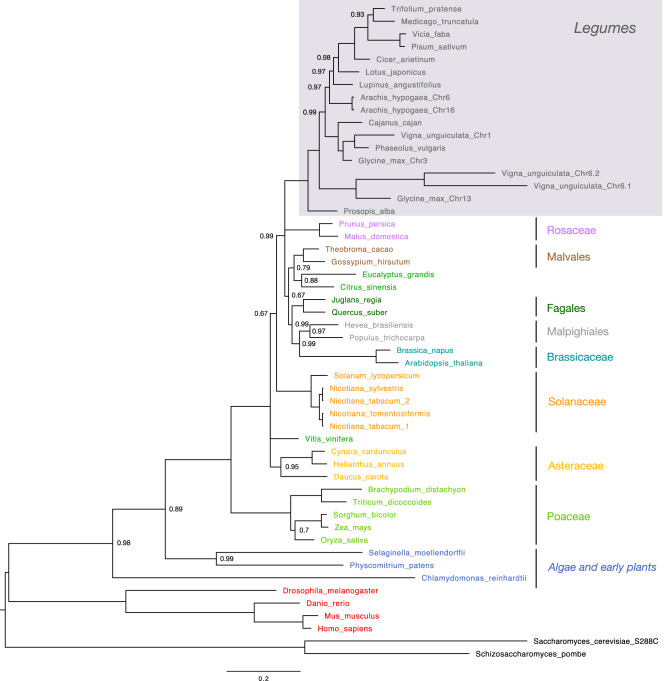
Figure 1
Figure 1
Evolutionary relationships among amino acid sequences of WEE1. The evolutionary history was inferred by Bayesian analysis using the program MrBayes. Node probabilities below 1 are indicated. The tree was rooted by midpoint rooting. Taxonomically-related organisms are indicated by the same color code, except for V. vinifera, C. sinensis and E. grandis. Legumes highlighted by the gray box are detailed in Fig. 2. Scale bar indicates number of expected changes per site.
Figure 2
Figure 2
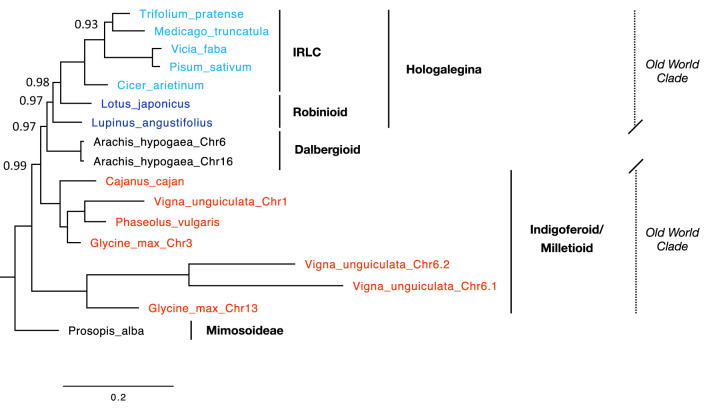
Detail of evolutionary relationships among amino acid sequences of WEE1 in Legumes. The evolutionary history was inferred by Bayesian analysis using the program MrBayes. Taxonomic groups are color-coded: Mimosoideae and Dalbergioid clade in black, Indigoferoid/Milletioid clade in red, Hologalegina in blue. Hologalegina are divided into Robinoid clade (dark blue) and IRLC (Inverted Repeat-Lacking Clade) (light blue). Trifolieae (T. pratense and M. truncatula) as well as Fabeae (V. faba and P. sativum) are also grouped. Node probabilities below 1 are indicated. Scale bar indicates number of expected changes per site.
Figure 3
Figure 3
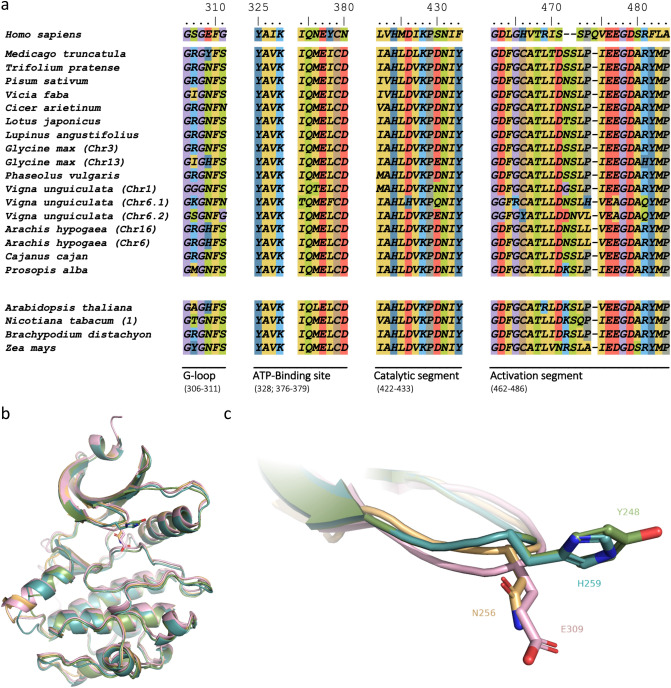
Sequence alignment of four segments of WEE1 for plants of interest and 3D predictions. (a) Sequences were aligned on MEGAX based on CLUSTAL W algorithm. Alignments were then edited using BioEdit 7.2.5 software (Ibis Biosciences, CA). Here, only four segments are shown: G-loop, ATP-Binding site, Catalytic segment and Activation segment. Amino acid numeration is based on the human (H. sapiens) sequence. Amino acids are colored according to their properties: hydrophobic (AILMFVW) in yellow; acidic (DE) in red; basic (RK) in light blue; polar (QSNT) in green; other aromatic (YH) in dark blue; and C in brown, P in grey and G in purple. Legumes (middle) and model (/examples of dicot and monocot) plants (bottom) are shown. (b) Superimposition of the 3D structure of H. sapiens WEE1 (pink) with predicted ones of A. thaliana (blue), M. truncatula (green) and P. sativum (gold). (c) Detail of the 3D G-loops with the human E309 or its analogs (H259 in Arabidopsis, Y248 in M. truncatula, or N256 in P. sativum) with side chains represented in sticks.
Figure 4
Figure 4
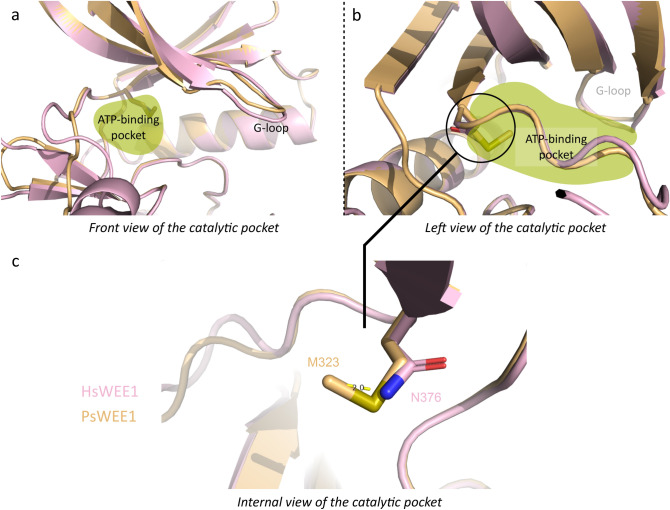
ATP-binding pocket and steric hindrance of human N376. (a) Front and (b) left views of the H. sapiens WEE1 (pink) 3D structure superimposed on P. sativum (gold) predictions in cartoon representation. The ATP-binding pocket is highlighted in green. (c) Internal view of the catalytic pocket with HsN376 and PsM323 represented in sticks. The distance (yellow hatched lines) of 2 Å between the two residue extremities is shown.
Figure 5
Figure 5
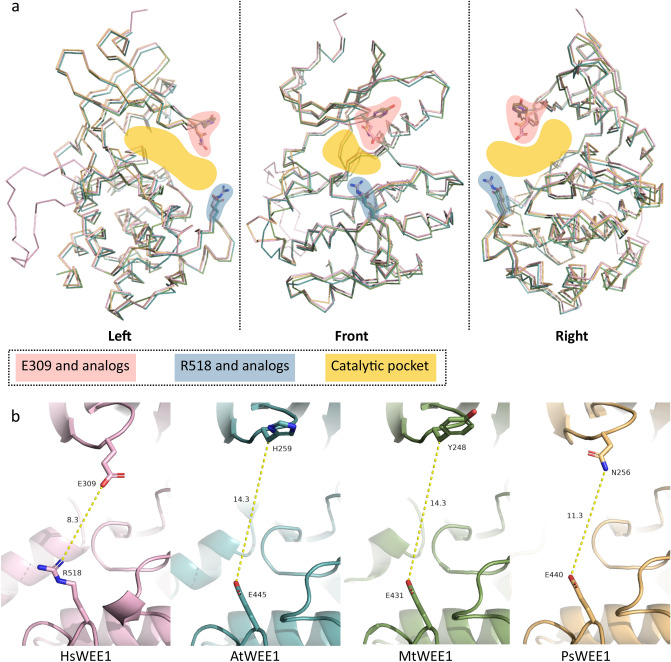
Access to the catalytic pocket of WEE1. (a) Front and side views of H. sapiens WEE1 (pink) 3D structure superimposed to A. thaliana (blue), M. truncatula (green) and P. sativum (gold) predictions in ribbon representation. Residues conditioning the access to the catalytic pocket are highlighted in pink for E309 and its analogs and in blue for R518 and its analogs. The resulting catalytic pocket space approximately occupied by the target is highlighted in yellow. (b) Distance measurement (yellow hatched lines) in Å between residues conditioning the access to the catalytic pocket for the four 3D structures.

References

    1. Russell P, Nurse P. Negative regulation of mitosis by wee1+, a gene encoding a protein kinase homolog. Cell. 1987;49(4):559–567. doi: 10.1016/0092-8674(87)90458-2. - DOI - PubMed
    1. McGowan CH, Russell P. Cell cycle regulation of human WEE1. EMBO J. 1995;14(10):2166–2175. doi: 10.1002/j.1460-2075.1995.tb07210.x. - DOI - PMC - PubMed
    1. Sun, Y., Dilkes, B. P., Zhang, C., Dante, R. A., Carneiro, N. P., Lowe, K. S., Jung, R., Gordon-Kamm, W. J. & Larkins, B. A. Characterization of maize (Zea mays L.) Wee1 and its activity in developing endosperm. Proc. Natl. Acad. Sci.96(7), 4180–4185 (1999). - PMC - PubMed
    1. Sorrell DA, Marchbank A, McMahon K, Dickinson RJ, Rogers HJ, Francis D. A WEE1 homologue from Arabidopsis thaliana. Planta. 2002;215(3):518–522. doi: 10.1007/s00425-002-0815-4. - DOI - PubMed
    1. Gonzalez N, Gévaudant F, Hernould M, Chevalier C, Mouras A. The cell cycle-associated protein kinase WEE1 regulates cell size in relation to endoreduplication in developing tomato fruit. Plant J. 2007;51(4):642–655. doi: 10.1111/j.1365-313X.2007.03167.x. - DOI - PubMed