


SARS-CoV-2 Vaccine Antibody Response and Breakthrough Infection in Patients Receiving Dialysis
- PMID: 34904856
- PMCID: PMC8722718
- DOI: 10.7326/M21-4176
SARS-CoV-2 Vaccine Antibody Response and Breakthrough Infection in Patients Receiving Dialysis
Abstract
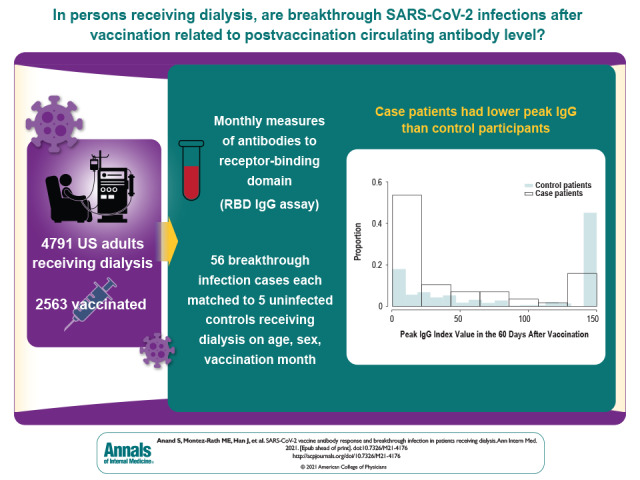
Background: Whether breakthrough SARS-CoV-2 infections after vaccination are related to the level of postvaccine circulating antibody is unclear.
Objective: To determine longitudinal antibody-based response and risk for breakthrough infection after SARS-CoV-2 vaccination.
Design: Prospective study.
Setting: Nationwide sample from dialysis facilities.
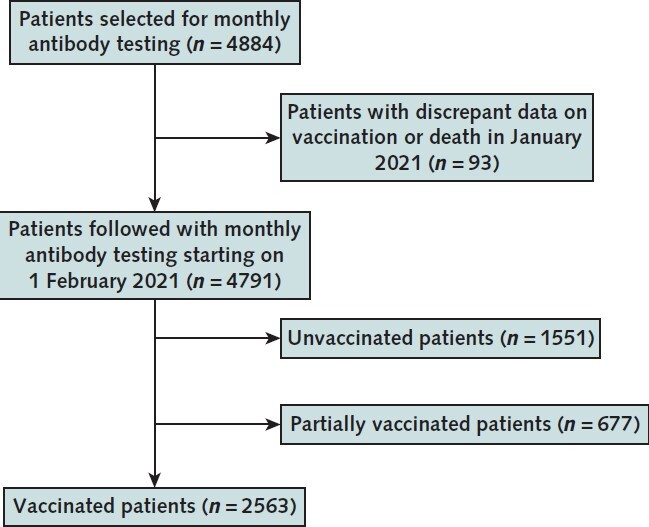
Patients: 4791 patients receiving dialysis.
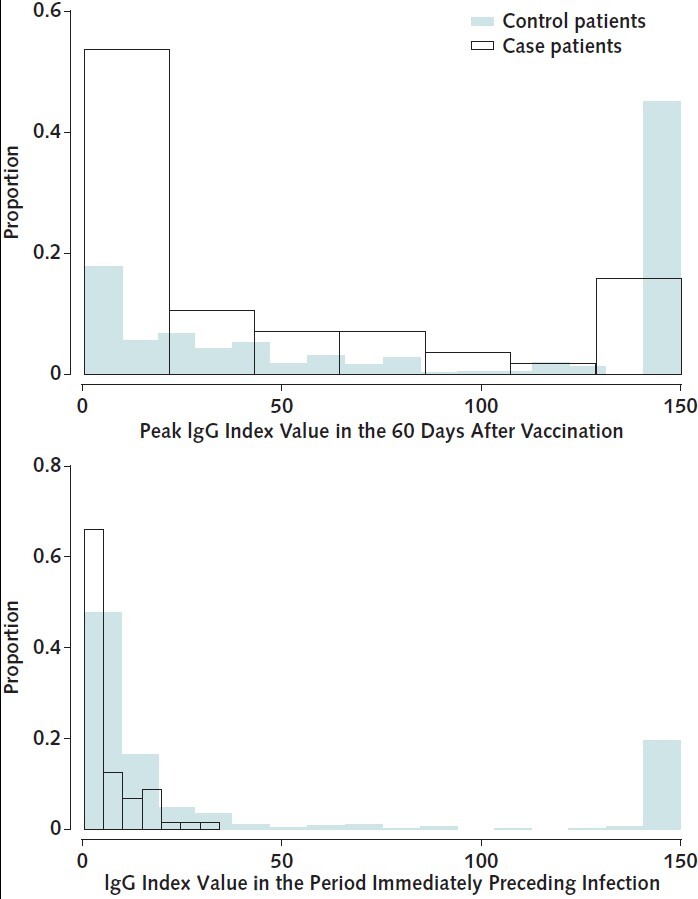
Measurements: Remainder plasma from a laboratory processing routine monthly tests was used to measure qualitative and semiquantitative antibodies to the receptor-binding domain (RBD) of SARS-CoV-2. To evaluate whether peak or prebreakthrough RBD values were associated with breakthrough infection, a nested case-control analysis matched each breakthrough case patient to 5 control patients by age, sex, and vaccination month and adjusted for diabetes status and region of residence.
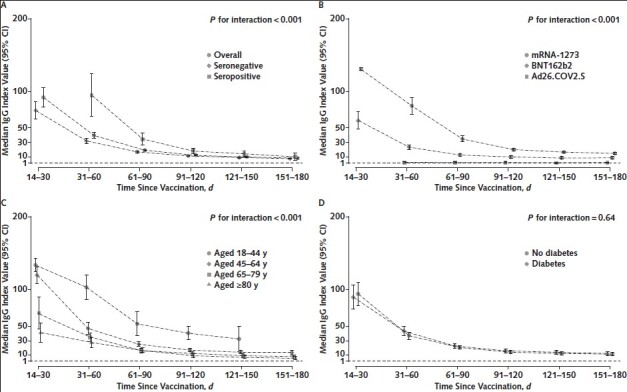
Results: Of the 4791 patients followed with monthly RBD assays, 2563 were vaccinated as of 14 September 2021. Among the vaccinated patients, the estimated proportion with an undetectable RBD response increased from 6.6% (95% CI, 5.5% to 7.8%) 14 to 30 days after vaccination to 20.2% (CI, 17.0% to 23.3%) 5 to 6 months after vaccination. Estimated median index values decreased from 91.9 (CI, 78.6 to 105.2) 14 to 30 days after vaccination to 8.4 (CI, 7.6 to 9.3) 5 to 6 months after vaccination. Breakthrough infections occurred in 56 patients, with samples collected a median of 21 days before breakthrough infection. Compared with prebreakthrough index RBD values of 23 or higher (equivalent to ≥506 binding antibody units per milliliter), prebreakthrough RBD values less than 10 and values from 10 to less than 23 were associated with higher odds for breakthrough infection (rate ratios, 11.6 [CI, 3.4 to 39.5] and 6.0 [CI, 1.5 to 23.6], respectively).
Limitations: Single measure of vaccine response; ascertainment of COVID-19 diagnosis from electronic health records.
Conclusion: The antibody response to SARS-CoV-2 vaccination wanes rapidly in persons receiving dialysis. In this population, the circulating antibody response is associated with risk for breakthrough infection.
Primary funding source: Ascend Clinical Laboratory.
Conflict of interest statement
Figures
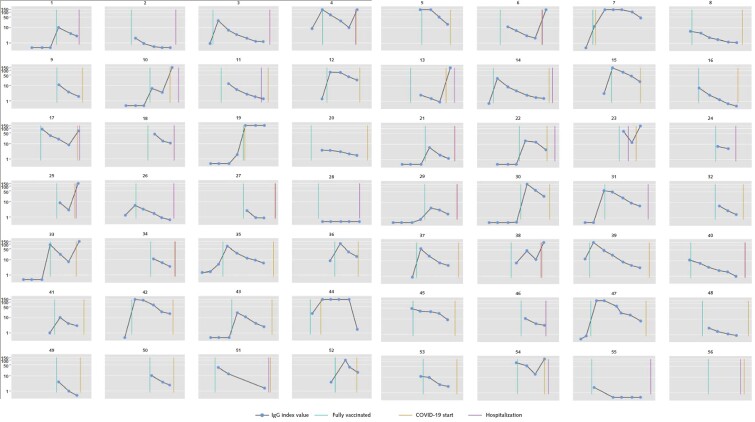
Update of
-
SARS-CoV-2 vaccine antibody response and breakthrough infection in dialysis.medRxiv [Preprint]. 2021 Oct 14:2021.10.12.21264860. doi: 10.1101/2021.10.12.21264860. medRxiv. 2021. Update in: Ann Intern Med. 2022 Mar;175(3):371-378. doi: 10.7326/M21-4176. PMID: 34671782 Free PMC article. Updated. Preprint.
References
-
- Centers for Disease Control and Prevention. Table 1. Recommended Adult Immunization Schedule for ages 19 years or older, United States, 2020. Accessed at http://www.cdc.gov/vaccines/schedules/hcp/imz/adult.html on 14 September 2021.
-
- Kroger A, Bahta L, Hunter P. General Best Practice Guidelines for Immunization. Best Practices Guidance of the Advisory Committee on Immunization Practices (ACIP). Accessed at www.cdc.gov/vaccines/hcp/acip-recs/general-recs/intro.html on 4 October 2021.
-
- Marin M , Marlow M , Moore KL , et al. Recommendation of the Advisory Committee on Immunization Practices for use of a third dose of mumps virus-containing vaccine in persons at increased risk for mumps during an outbreak. MMWR Morb Mortal Wkly Rep. 2018;67:33-8. [PMID: ] doi: 10.15585/mmwr.mm6701a7 - DOI - PMC - PubMed
-
- Mast EE , Weinbaum CM , Fiore AE , et al; Advisory Committee on Immunization Practices (ACIP) Centers for Disease Control and Prevention (CDC). A comprehensive immunization strategy to eliminate transmission of hepatitis B virus infection in the United States: recommendations of the Advisory Committee on Immunization Practices (ACIP) Part II: immunization of adults. MMWR Recomm Rep. 2006;55:1-33. [PMID: ] - PubMed
Grants and funding
LinkOut - more resources
Full Text Sources
Miscellaneous
