


Left atrial structure and function are associated with cardiovascular outcomes independent of left ventricular measures: a UK Biobank CMR study
- PMID: 34907415
- PMCID: PMC9365306
- DOI: 10.1093/ehjci/jeab266
Left atrial structure and function are associated with cardiovascular outcomes independent of left ventricular measures: a UK Biobank CMR study
Erratum in
-
Corrigendum to: Left atrial structure and function are associated with cardiovascular outcomes independent of left ventricular measures: a UK Biobank CMR study.Eur Heart J Cardiovasc Imaging. 2022 Aug 22;23(9):e331. doi: 10.1093/ehjci/jeac119. Eur Heart J Cardiovasc Imaging. 2022. PMID: 35703377 Free PMC article. No abstract available.
Abstract
Aims: We evaluated the associations of left atrial (LA) structure and function with prevalent and incident cardiovascular disease (CVD), independent of left ventricular (LV) metrics, in 25 896 UK Biobank participants.
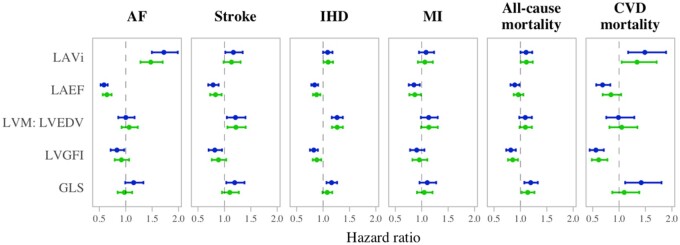
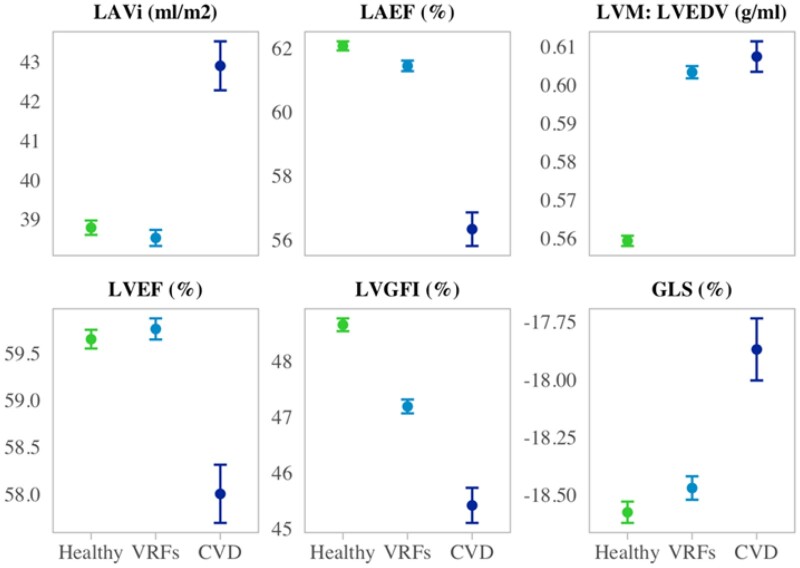
Methods and results: We estimated the association of cardiovascular magnetic resonance (CMR) metrics [LA maximum volume (LAV), LA ejection fraction (LAEF), LV mass : LV end-diastolic volume ratio (LVM : LVEDV), global longitudinal strain, and LV global function index (LVGFI)] with vascular risk factors (hypertension, diabetes, high cholesterol, and smoking), prevalent and incident CVDs [atrial fibrillation (AF), stroke, ischaemic heart disease (IHD), myocardial infarction], all-cause mortality, and CVD mortality. We created uncorrelated CMR variables using orthogonal principal component analysis rotation. All five CMR metrics were simultaneously entered into multivariable regression models adjusted for sex, age, ethnicity, deprivation, education, body size, and physical activity. Lower LAEF was associated with diabetes, smoking, and all the prevalent and incident CVDs. Diabetes, smoking, and high cholesterol were associated with smaller LAV. Hypertension, IHD, AF (incident and prevalent), incident stroke, and CVD mortality were associated with larger LAV. LV and LA metrics were both independently informative in associations with prevalent disease, however LAEF showed the most consistent associations with incident CVDs. Lower LVGFI was associated with greater all-cause and CVD mortality. In secondary analyses, compared with LVGFI, LV ejection fraction showed similar but less consistent disease associations.
Conclusion: LA structure and function measures (LAEF and LAV) demonstrate significant associations with key prevalent and incident cardiovascular outcomes, independent of LV metrics. These measures have potential clinical utility for disease discrimination and outcome prediction.
Keywords: atrial fibrillation; cardiovascular magnetic resonance; cardiovascular outcomes; ischaemic heart disease; lef; left ventricle; mortality; stroke; t atrium; vascular risk factors.
© The Author(s) 2021. Published by Oxford University Press on behalf of the European Society of Cardiology.
Conflict of interest statement
Conflict of interest: S.E.P. provides consultancy to and owns stock of Cardiovascular Imaging Inc., Calgary, AB, Canada.
Figures
References
-
- Stefanadis C, Dernellis J, Toutouzas P.. A clinical appraisal of left atrial function. Eur Heart J 2001;22:22–36. - PubMed
-
- Blume GG, McLeod CJ, Barnes ME, Seward JB, Pellikka PA, Bastiansen PMet al. Left atrial function: physiology, assessment, and clinical implications. Eur J Echocardiogr 2011;12:421–30. - PubMed
-
- Kurt M, Wang J, Torre-Amione G, Nagueh SF.. Left atrial function in diastolic heart failure. Circ Cardiovas Imaging 2009;2:10–5. - PubMed
-
- Gupta DK, Shah AM, Giugliano RP, Ruff CT, Antman EM, Grip LT, et al. ; for the Effective aNticoaGulation with factor xA next GEneration in AF-Thrombolysis In Myocardial Infarction 48 (ENGAGE AF-TIMI 48) Echocardiographic Study Investigators . Left atrial structure and function in atrial fibrillation: ENGAGE AF-TIMI 48. Eur Heart J 2014;35:1457–65. - PMC - PubMed
MeSH terms
Substances
Grants and funding
- MC_PC_21000/MRC_/Medical Research Council/United Kingdom
- MC_U147585819/MRC_/Medical Research Council/United Kingdom
- MC_PC_21001/MRC_/Medical Research Council/United Kingdom
- PG/14/89/31194/BHF_/British Heart Foundation/United Kingdom
- MC_UU_12011/1/MRC_/Medical Research Council/United Kingdom
- MC_PC_17228/MRC_/Medical Research Council/United Kingdom
- MC_PC_21022/MRC_/Medical Research Council/United Kingdom
- G0400491/MRC_/Medical Research Council/United Kingdom
- 203553/Z/16/Z/WT_/Wellcome Trust/United Kingdom
- FS/17/81/33318/BHF_/British Heart Foundation/United Kingdom
- CH/1996001/9454/BHF_/British Heart Foundation/United Kingdom
- MC_UP_A620_1015/MRC_/Medical Research Council/United Kingdom
- MC_QA137853/MRC_/Medical Research Council/United Kingdom
- MC_PC_21003/MRC_/Medical Research Council/United Kingdom
- MR/L016311/1/MRC_/Medical Research Council/United Kingdom
- MC_UP_A620_1014/MRC_/Medical Research Council/United Kingdom
- 203553/WT_/Wellcome Trust/United Kingdom
- MC_U147585824/MRC_/Medical Research Council/United Kingdom
LinkOut - more resources
Full Text Sources
Medical
