


Correlation Between Clinical and Biochemical Markers in Patients With Acromegaly on Different Modalities of Treatment
- PMID: 34909342
- PMCID: PMC8663996
- DOI: 10.7759/cureus.19438
Correlation Between Clinical and Biochemical Markers in Patients With Acromegaly on Different Modalities of Treatment
Abstract
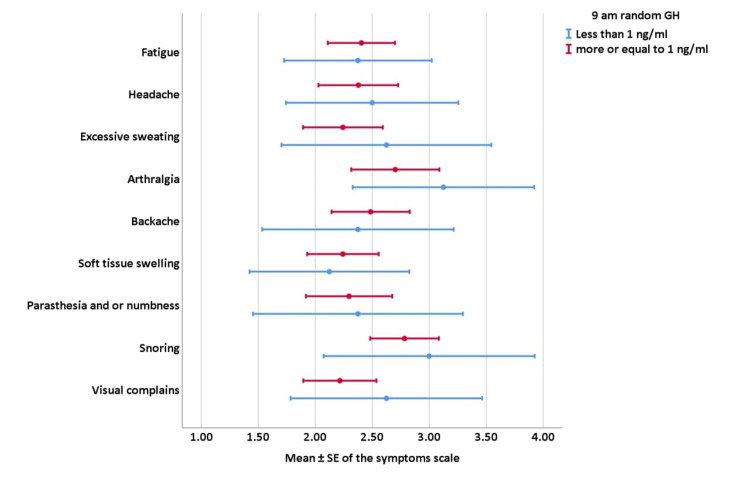
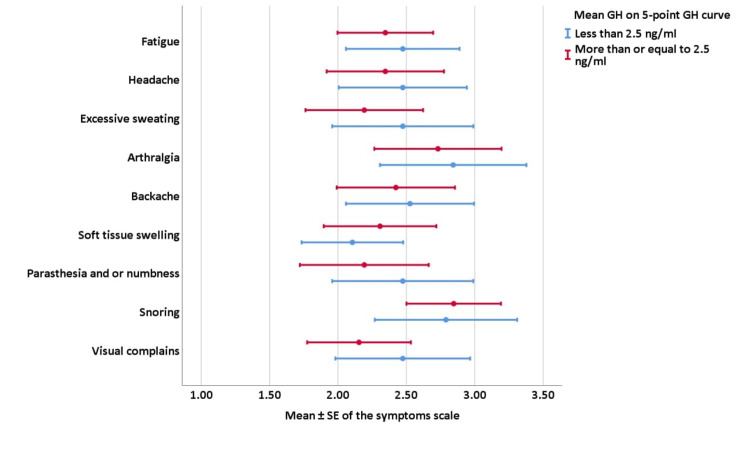
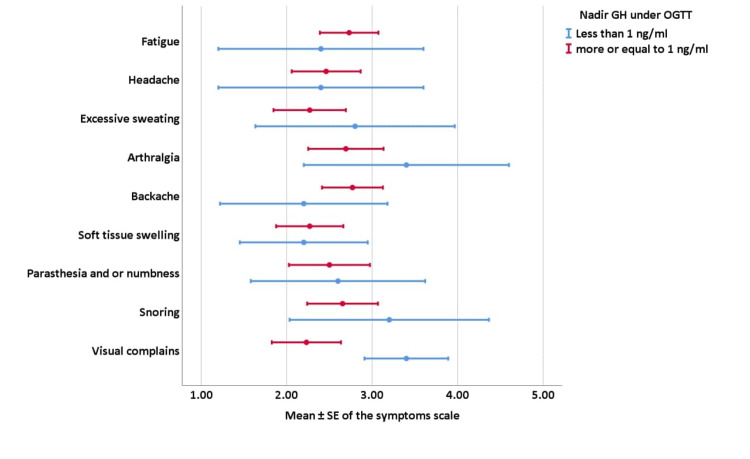
Background Acromegaly is a disabling disease caused by growth hormone (GH) over-secretion, associated with increased morbidity and mortality through different metabolic and somatic consequences involving soft tissue, acral overgrowth, and skin thickening, which will lead to different clinical manifestations. The study aimed to assess the correlation between biochemical markers of acromegaly with different clinical findings and biochemical control with the clinical findings. Methods A cross-sectional study was done on 56 patients with acromegaly attending a tertiary center for diabetes, endocrine, and metabolism in Southern Iraq Basrah. They were 32 (57.1%) males. Fatigue, headache, excessive sweating, joint pain, backache, soft tissue swelling, numbness, snoring, and visual problems were assessed on a four-point Likert scale. In addition, biochemical dynamic GH testing was done using a five-point random GH curve and/or standard GH suppression under the oral glucose tolerance test (OGTT). Results No significant correlation was found between symptoms severity and five-point GH parameters in respect of mean, peak, and nadir. Only backache showed a significant correlation with GH under OGTT suppression parameters in respect to mean, peak, and nadir (P-values < 0.01, < 0.01, and < 0.01), respectively. No particular biochemical control cut-off value in the 9 am random GH, mean five-point GH curve, or nadir GH under OGTT was correlated with the degree of severity for any of the clinical symptoms, as there was no difference between the biochemically controlled and uncontrolled groups in respect to any of the clinical symptom's severity scale. Conclusion Only backache correlated with the biochemical tests of disease activity in the form of GH under OGTT. It appears in this study that the severity of the clinical symptoms does not correlate with biochemical control so that thorough evaluation and treatment of clinical complaints besides biochemical control is an essential part of the management plan in patients with acromegaly.
Keywords: acromegaly; biochemical markers; clinical features; disease activity; quality of life.
Copyright © 2021, Alzajaji et al.
Conflict of interest statement
The authors have declared that no competing interests exist.
Figures
References
-
- Guidelines for acromegaly management: an update. Melmed S, Colao A, Barkan A, et al. J Clin Endocrinol Metab. 2009;94:1509–1517. - PubMed
-
- Systemic complications of acromegaly: epidemiology, pathogenesis, and management. Colao A, Ferone D, Marzullo P, Lombardi G. Endocr Rev. 2004;25:102–152. - PubMed
-
- Acromegaly: an endocrine society clinical practice guideline. Katznelson L, Laws ER Jr, Melmed S, Molitch ME, Murad MH, Utz A, Wass JA. J Clin Endocrinol Metab. 2014;99:3933–3951. - PubMed
LinkOut - more resources
Full Text Sources