


A review on the transmission of COVID-19 based on cough/sneeze/breath flows
- PMID: 34909366
- PMCID: PMC8660964
- DOI: 10.1140/epjp/s13360-021-02162-9
A review on the transmission of COVID-19 based on cough/sneeze/breath flows
Abstract
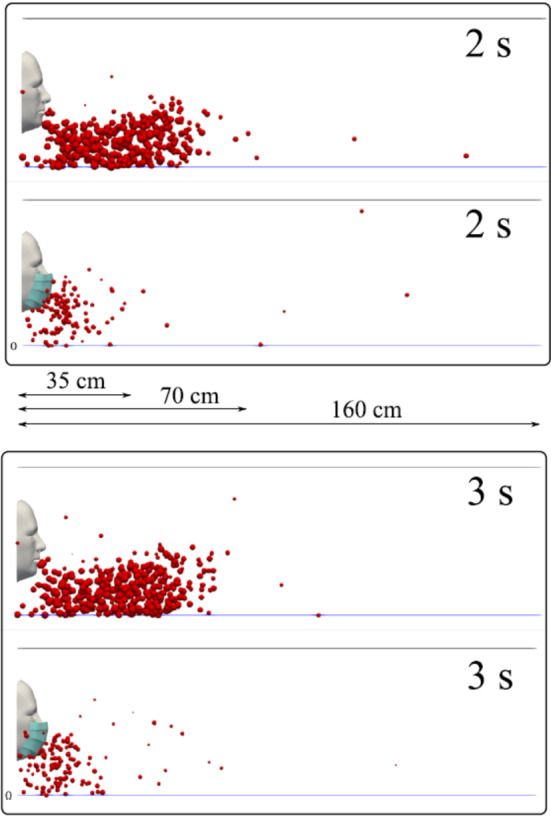
COVID-19 pandemic has recently had a dramatic impact on society. The understanding of the disease transmission is of high importance to limit its spread between humans. The spread of the virus in air strongly depends on the flow dynamics of the human airflows. It is, however, known that predicting the flow dynamics of the human airflows can be challenging due to different particles sizes and the turbulent aspect of the flow regime. It is thus recommended to present a deep analysis of different human airflows based on the existing experimental investigations. A validation of the existing numerical predictions of such flows would be of high interest to further develop the existing numerical model for different flow configurations. This paper presents a literature review of the experimental and numerical studies on human airflows, including sneezing, coughing and breathing. The dynamics of these airflows for different droplet sizes is discussed. The influence of other parameters, such as the viscosity and relative humidity, on the germs transmission is also presented. Finally, the efficacy of using a facemask in limiting the transmission of COVID-19 is investigated.
© The Author(s), under exclusive licence to Società Italiana di Fisica and Springer-Verlag GmbH Germany, part of Springer Nature 2021.
Figures
References
-
- A.A. Aliabadi, S. Rogak, S. Green, K.H. Bartlett, CFD simulation of human coughs and sneezes: a study in droplet dispersion, heat, and mass transfer, in Proceedings of the ASME 2010 International Mechanical Engineering Congress & Exposition (IMECE2010), pp. 1051–1060 (2010)
-
- Alfelali M, Haworth EA, Barasheed O, Badahdah A-M, Bokhary H, Tashani M, Azeem MI, Kok J, Taylor J, Barnes EH, El Bashir H, Khandaker G, et al. Facemask against viral respiratory infections among Hajj pilgrims: A challenging cluster-randomized trial. PLoS ONE. 2020;15:e0240287. doi: 10.1371/journal.pone.0240287. - DOI - PMC - PubMed
-
- Bhat GS, Narasimha R. A volumetrically heated jet: large-eddy structure and entrainment characteristics. J. Fluid Mech. 1996;325:303–330. doi: 10.1017/S0022112096008130. - DOI
-
- Bansil R, Turner BS. Mucin structure, aggregation, physiological functions and biomedical applications. Curr. Opin. Colloid Interface Sci. 2006;11(2–3):164–170. doi: 10.1016/j.cocis.2005.11.001. - DOI
Publication types
LinkOut - more resources
Full Text Sources