Review
. 2021 Dec 16;8(1):67.
doi: 10.1186/s40779-021-00360-1.

Advances in the design and development of SARS-CoV-2 vaccines

Affiliations
Review

Advances in the design and development of SARS-CoV-2 vaccines

Xue-Liang Peng et al. Mil Med Res. .

Abstract

Since the end of 2019, coronavirus disease 2019 (COVID-19) caused by severe acute respiratory syndrome coronavirus 2 (SARS-CoV-2) has spread worldwide. The RNA genome of SARS-CoV-2, which is highly infectious and prone to rapid mutation, encodes both structural and nonstructural proteins. Vaccination is currently the only effective method to prevent COVID-19, and structural proteins are critical targets for vaccine development. Currently, many vaccines are in clinical trials or are already on the market. This review highlights ongoing advances in the design of prophylactic or therapeutic vaccines against COVID-19, including viral vector vaccines, DNA vaccines, RNA vaccines, live-attenuated vaccines, inactivated virus vaccines, recombinant protein vaccines and bionic nanoparticle vaccines. In addition to traditional inactivated virus vaccines, some novel vaccines based on viral vectors, nanoscience and synthetic biology also play important roles in combating COVID-19. However, many challenges persist in ongoing clinical trials.

Keywords: Coronavirus disease 2019 (COVID-19); Nanoscience; Severe acute respiratory syndrome coronavirus 2 (SARS-CoV-2); Synthetic biology; Vaccine.


Conflict of interest statement

The authors have applied for a Chinese patent for a bionic nanoparticle vaccine against COVID-19.

Figures
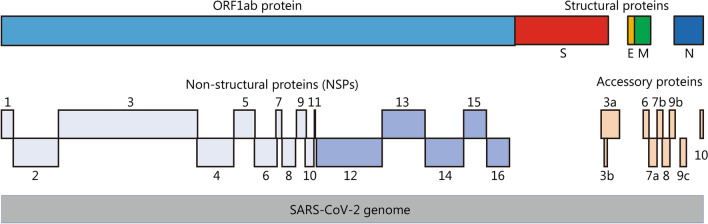
Fig. 1
Fig. 1
Organization of the SARS-CoV-2 genome. S spike protein; E envelope protein; M membrane protein; N nucleocapsid protein
Fig. 2
Fig. 2
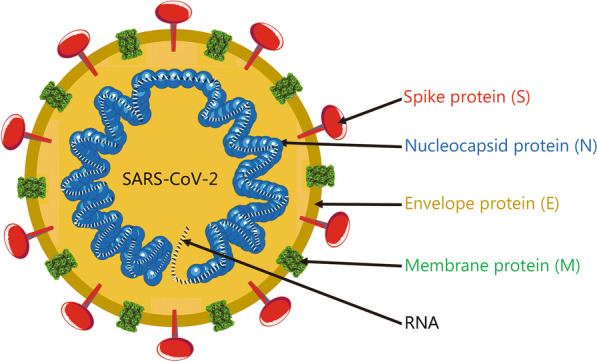
Structure of SARS-CoV-2
Fig. 3
Fig. 3
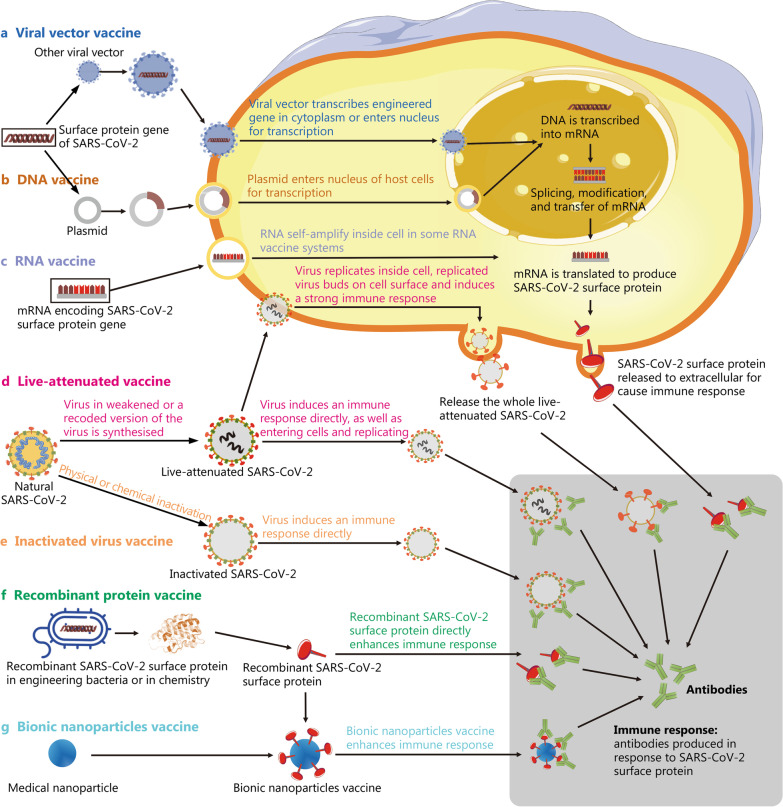
Schematic diagram showing the principles of various vaccines. a Viral vector vaccines are produced by integrating the SARS-CoV-2 antigenic gene fragment into viruses with very low pathogenicity. The gene is then transcribed in the cytoplasm or enters the nucleus for transcription, and finally, SARS-CoV-2 surface proteins are produced and cause an immune response. b DNA vaccines are produced using technology similar to a, but the vector is a plasmid. c mRNA vaccine is based on a synthetic mRNA encoding the SARS-CoV-2 antigen that is produced in vitro and delivered into the body. Then, it is translated into a protein antigen by cells and causes an immune response in the human body. d Live-attenuated vaccines are prepared by continuous passage to weaken the virulence of live viruses. The attenuated virus then directly induces an immune response by entering cells and replicating to induce the production of antibodies against SARS-CoV-2 surface proteins. e Inactivated virus vaccines are generated from the natural virus, which is inactivated using physical or chemical methods. The killed virus then directly induces an immune response. f Recombinant protein vaccines are based on injecting recombinant SARS-CoV-2 surface proteins directly into the living body to induce an immune response. g Based on f, bionic nanoparticle vaccines use nanoparticles composed of a biodegradable material to replace the nucleic acid and proteins of the viral core, while the outer shell contains recombinant viral surface proteins attached using synthetic biology. These two parts then form a virus-like structure through self-assembly and are injected into the body to induce an immune response
Fig. 4
Fig. 4
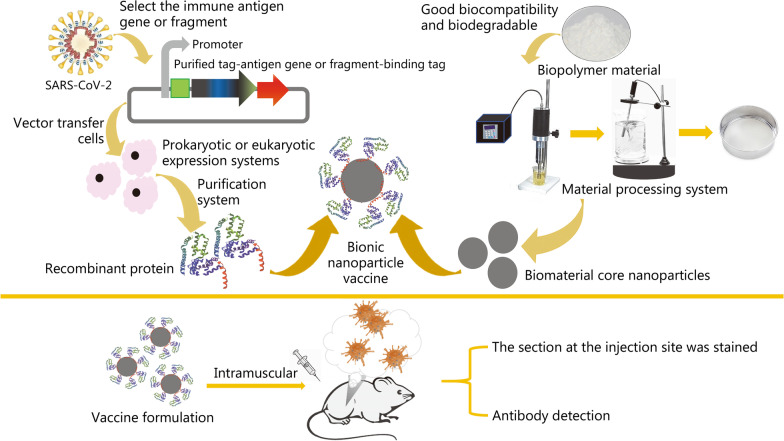
Schematic diagram of the preparation of the bionic nanoparticle vaccine

References

    1. Shang J, Ye G, Shi K, Wan Y, Luo C, Aihara H, et al. Structural basis of receptor recognition by SARS-CoV-2. Nature. 2020;581(7807):221–224. - PMC - PubMed
    1. Wu JT, Leung K, Leung GM. Nowcasting and forecasting the potential domestic and international spread of the 2019-nCoV outbreak originating in Wuhan, China: a modelling study. Lancet. 2020;395(10225):689–697. - PMC - PubMed
    1. Nishiura H, Linton NM, Akhmetzhanov AR. Initial cluster of novel coronavirus (2019-nCoV) infections in Wuhan, China is consistent with substantial human-to-human transmission. J Clin Med. 2020;9(2):488. - PMC - PubMed
    1. Zhou P, Yang XL, Wang XG, Hu B, Zhang L, Zhang W, et al. A pneumonia outbreak associated with a new coronavirus of probable bat origin. Nature. 2020;579(7798):270–273. - PMC - PubMed
    1. Coronaviridae Study Group of the International Committee on Taxonomy of Viruses. The species severe acute respiratory syndrome-related coronavirus: classifying 2019-nCoV and naming it SARS-CoV-2. Nat Microbiol. 2020;5(4):536–44. - PMC - PubMed

Publication types