Review
. 2021 Nov 29:8:703595.
doi: 10.3389/fvets.2021.703595. eCollection 2021.

Advanced Vascular Access in Small Animal Emergency and Critical Care

Affiliations
Review

Advanced Vascular Access in Small Animal Emergency and Critical Care

Jack A Lee et al. Front Vet Sci. .

Abstract

In canine and feline patients presenting in a state of hemodynamic collapse, obtaining vascular access can be challenging. Delays in achieving vascular access interfere with delivery of patient care. In human medicine, definitions of difficult vascular access are variable and include the need for multiple placement attempts or involvement of specialized teams and equipment. Incidence and risk factors for difficult vascular access have not been well studied in veterinary patients, which limits understanding of how best to address this issue. Alternatives to percutaneous peripheral or central intravenous catheterization in dogs and cats include venous cutdowns, umbilical access in newborns, corpus cavernosum access in males, ultrasound-guided catheterization, and intraosseous catheterization. In recent years, advances in ultrasonography and intraosseous access techniques have made these more accessible to veterinary practitioners. These vascular access techniques are reviewed here, along with advantages, limitations, and areas for future study of each technique.

Keywords: cutdown; difficult vascular access; emergency; intraosseous; ultrasound; veterinary.


Conflict of interest statement

The authors declare that the research was conducted in the absence of any commercial or financial relationships that could be construed as a potential conflict of interest.

Figures
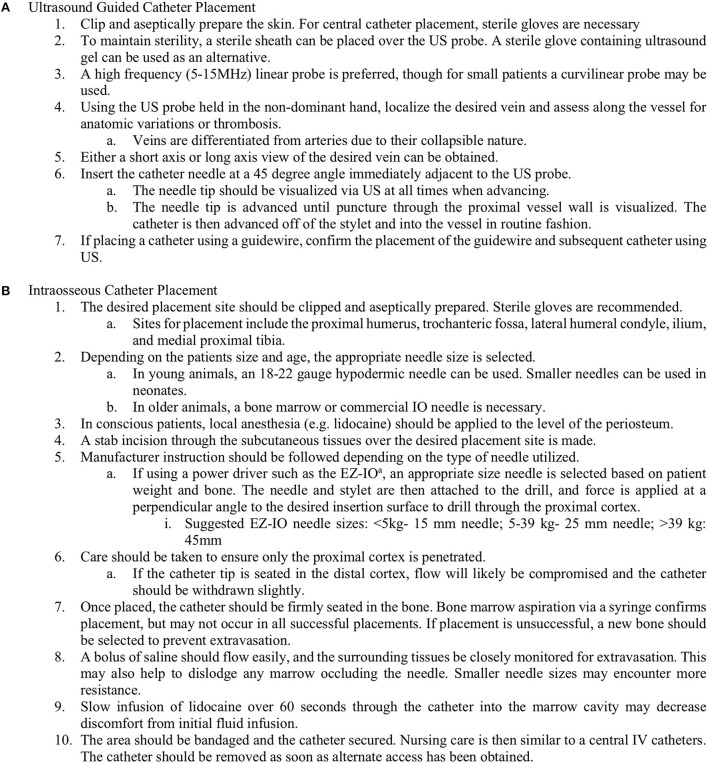
Figure 1
Figure 1
Procedure for ultrasound-guided catheter placement (A) and intraosseous catheter placement (B) in dogs and cats in order to obtain emergency vascular access.
Figure 2
Figure 2
(A) Emergency vascular access via intraosseous catheterization in the canine medial tibia using the EZ-IO G3 Power Driver (Vidacare Corp., Shavano Park, TX, USA). After aseptic preparation of the skin, a scalpel blade is used to make a small skin incision over the desired area. In a right-handed operator, the left index figure is used to palpate the patellar tendon (#) to identify and avoid the stifle joint then placed directly distal to the joint on the cranial aspect of the tibia. The left thumb is then used to identify and secure the caudal aspect of the tibia (*). The remaining fingers of the left hand are used to stabilize the distal tibia. The G3 Power Driver is held in the right hand and positioned perpendicular to the tibia. The catheter is then advanced through the bone until a drop in resistance indicates the catheter has entered the medullary cavity. The catheter should be well-seated in the bone. Bone marrow aspiration via a syringe confirms placement. A bolus of saline should flow easily, and the surrounding tissues should be closely monitored for extravasation. (B) Placement of a catheter in the corpus cavernosum of a male canine. With the patient in lateral recumbency, the penis is isolated within the prepuce at the level of the caudal os penis (**). The pars longa glandis is on the left (##). The needle is then inserted into the corpus cavernosum via the lateral aspect of the penis at an approximately 45° angle, directed caudally. Aspiration of blood and easy flow of saline through the catheter confirm placement.

References

    1. Hakim M, Shafy SZ, Uffman JC, Rice J, Raman VT, Tobias JD, et al. . A survey to define and predict difficult vascular access in the pediatric perioperative population. Pediatric Health Med Ther. (2020) 11:277–82. 10.2147/PHMT.S260639 - DOI - PMC - PubMed
    1. Walsh G. Difficult peripheral venous access: recognizing and managing the patient at risk. J Vasc Access. (2008) 13:198–203. 10.2309/java.13-4-7 - DOI
    1. Petroski A, Frisch A, Joseph N, Carlson JN. Predictors of difficult pediatric intravenous access in a community emergency department. J Vasc Access. (2015) 16:521–6. 10.5301/jva.5000411 - DOI - PubMed
    1. Frey AM. Success rates for peripheral i.v. insertion in a children's hospital. Financial implications. J Intraven Nurs. (1998) 21:160–5. - PubMed
    1. Rauch D, Dowd D, Eldridge D, Mace S, Schears G, Yen K. Peripheral difficult venous access in children. Clin Pediatr. (2009) 48:895–901. 10.1177/0009922809335737 - DOI - PubMed
