. 2021 Dec 16;11(1):24125.
doi: 10.1038/s41598-021-03588-y.

Flexible mechanical metamaterials enabling soft tactile sensors with multiple sensitivities at multiple force sensing ranges

Affiliations

Flexible mechanical metamaterials enabling soft tactile sensors with multiple sensitivities at multiple force sensing ranges

Alireza Mohammadi et al. Sci Rep. .

Abstract

The majority of existing tactile sensors are designed to measure a particular range of force with a fixed sensitivity. However, some applications require tactile sensors with multiple task-relevant sensitivities at multiple ranges of force sensing. Inspired by the human tactile sensing capability, this paper proposes a novel soft tactile sensor based on mechanical metamaterials which exhibits multiple sensitivity regimes due to the step-by-step locking behaviour of its heterogenous multi-layered structure. By tuning the geometrical design parameters of the collapsible layers, each layer experiences locking behaviour under different ranges of force which provides different sensitivity of the sensor at different force magnitude. The integration of a magnetic-based transduction method with the proposed structure results in high design degrees of freedom for realising the desired contact force sensitivities and corresponding force sensing ranges. A systematic design procedure is proposed to select appropriate design parameters to produce the desired characteristics. Two example designs of the sensor structure were fabricated using widely available benchtop 3D printers and tested for their performance. The results showed the capability of the sensor in providing the desired characteristics in terms of sensitivity and force range and being realised in different shapes, sizes and number of layers in a single structure. The proposed multi-sensitivity soft tactile sensor has a great potential to be used in a wide variety of applications where different sensitivities of force measurement is required at different ranges of force magnitudes, from robotic manipulation and human-machine interaction to biomedical engineering and health-monitoring.


Conflict of interest statement

The authors declare no competing interests.

Figures
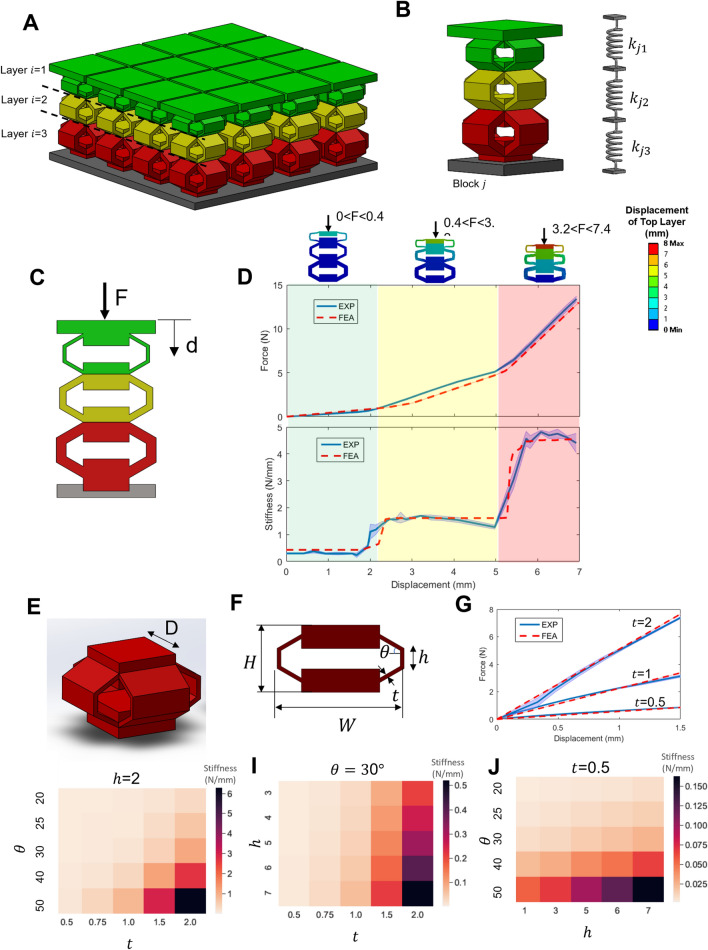
Figure 1
Figure 1
Mechanical metamaterial structure of the MST sensor force transfer medium. (A) Schematic of the MST sensor structure with an array of multi-layered blocks. (B) A single block schematic and its spring model analogous. (C) The cross-section of a single block with three layers. (D) Force–displacement plot of a single nominal block and its corresponding stiffness values. (E) 3D model of a unit cell. (F) Tuning parameters of a single unit cell (θ, t, h) for a given geometrical dimension of the unit cell (Depth, D – Height, H – Width, W). (G) FEA and experimental results of a unit cell stiffness for different t values (H-J) Heatmap representation of the FEA results of the nominal unit cell stiffness for different set of tuning parameters.
Figure 2
Figure 2
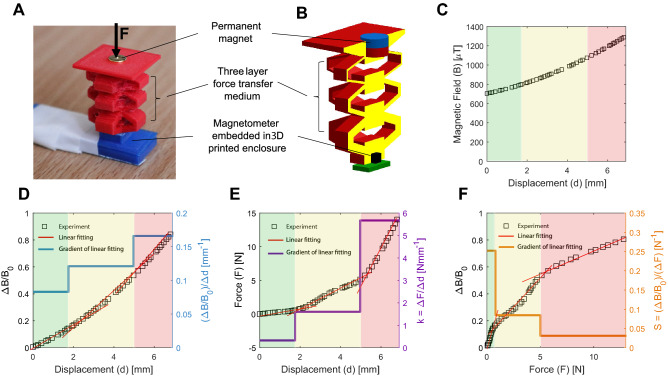
Magnetic-based transduction method of the MST Sensor. (A) A single three-layer block with integrated permanent magnet as stimulus, and magnetometer covered by a 3D printed holder. (B) Schematic cross-section of the single block. (C) The variation of the overall magnetic field with respect to the displacement of the permanent magnet in the top layer. (D) The variation of the ΔB/B0 with respect to the permanent magnet displacement (left y-axis), linear fitting (red lines) at three locking stages (highlighted background in green, yellow, and red), and gradient of linear fitting (right y-axis) corresponding to (ΔB/B0)/Δd. (E) The variation of the applied force with respect to the displacement of top layer (left y-axis) linear fitting (red lines) at three locking stages, and gradient of linear fitting (right y-axis), corresponding to the stiffness of different layers of the block (k=ΔF/Δd). (F) The variation of the ΔB/B0 with respect to the applied force (left y-axis), linear fitting (red lines) at three locking stages, and gradient of linear fitting (right y-axis), corresponding to the multiple sensitivities of the MST sensor at different force sensing ranges (S=(ΔB/B0)/ΔF).
Figure 3
Figure 3
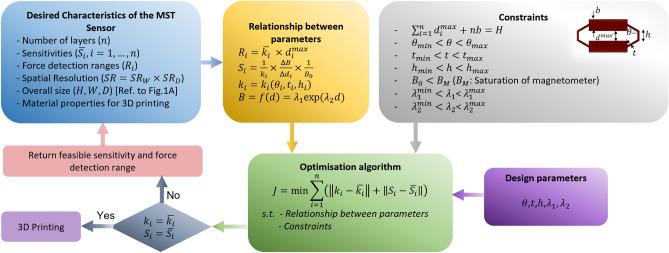
The design framework of the MST sensor. Given the desired characteristics of the sensor, this design procedure will provide the design parameters of the sensor structure.
Figure 4
Figure 4
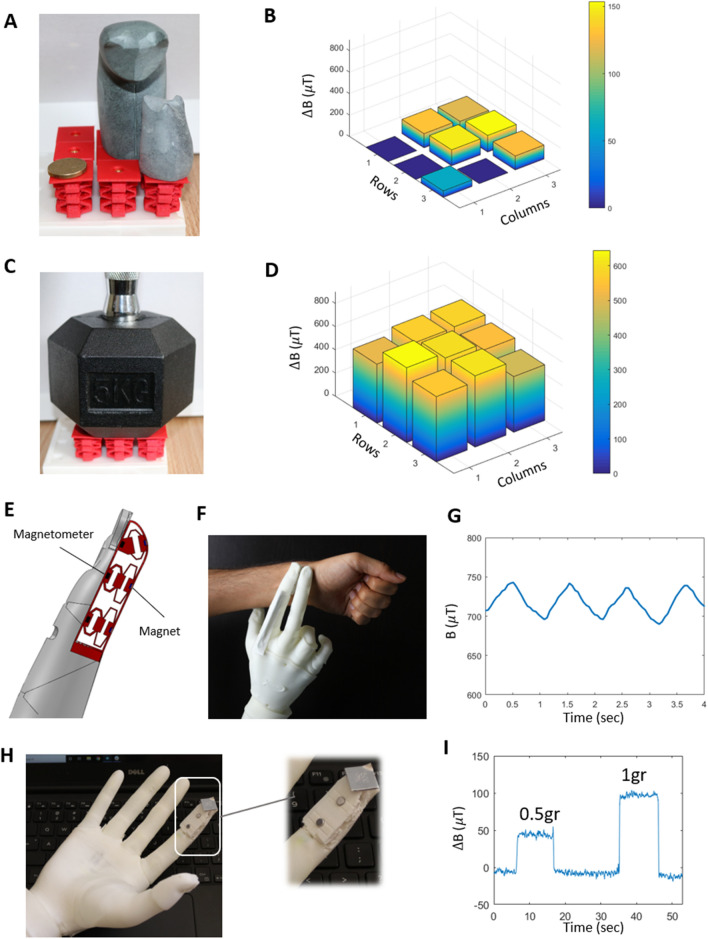
Performance demonstration of two example designs of the MST sensor. (A) A 3×3 array of three-layer blocks with three objects on them: a $2 Australian coin (6.6gr), a handicraft stone kitten (56gr), and cat (265gr). (B) Results of the MST sensor reading of the coin and handicraft stone kitten and cat. (C) A 5 kg dumbbell on the MST sensor array. (D) Results of the sensor reading of the 5 kg dumbbell. (E) The schematic of the robotic prosthetic finger with integrated MST sensor. (F) 3D printed robotic prosthetic hand with embedded MST sensor in its index finger for monitoring the pulse of human radial artery. (G) The magnetic field variation of the middle block of the MST sensor due to the pulse wave. (H) The robotic hand with integrated MST sensor for detecting small contact forces. (I) The response of the highly sensitive unit cell at the tip of the finger to different weights.

References

    1. Senthil Kumar K, Chen PY, Ren H. A review of printable flexible and stretchable tactile sensors. AAAS Res. 2019;2019:1–32. - PMC - PubMed
    1. Amjadi M, Kyung KU, Park I, Sitti M. Stretchable, skin-mountable, and wearable strain sensors and their potential applications: A review. Adv. Funct. Mater. 2016;26:1678–1698. doi: 10.1002/adfm.201504755. - DOI
    1. Dahiya RS, Mittendorfer P, Valle M, Cheng G, Lumelsky VJ. Directions toward effective utilization of tactile skin: A review. IEEE Sens. J. 2013;13:4121–4138. doi: 10.1109/JSEN.2013.2279056. - DOI
    1. Wu Y, Liu Y, Zhou Y, Man Q, Hu C, Asghar W, Li F, Yu Z, Shang J, Liu G, Liao M. A skin-inspired tactile sensor for smart prosthetics. Sci. Robot. 2018;3:eaat0429. doi: 10.1126/scirobotics.aat0429. - DOI - PubMed
    1. Xia Y, Mohammadi A, Tan Y, Chen B, Choong P, Oetomo D. On the efficiency of haptic based object identification: Determining where to grasp to get the most distinguishing information. Nat. Commun. 2013;4:1859. doi: 10.1038/ncomms2832. - DOI - PMC - PubMed

Publication types