Observational Study
. 2022 Feb;37(2):397-408.
doi: 10.1007/s11606-021-07252-z. Epub 2021 Dec 16.

The Impact of the COVID-19 Pandemic on Mental Health, Occupational Functioning, and Professional Retention Among Health Care Workers and First Responders

Affiliations
Observational Study

The Impact of the COVID-19 Pandemic on Mental Health, Occupational Functioning, and Professional Retention Among Health Care Workers and First Responders

Rebecca C Hendrickson et al. J Gen Intern Med. 2022 Feb.

Abstract

Background: The COVID-19 pandemic has greatly affected front-line health care workers (HCW) and first responders (FR). The specific components of COVID-19 related occupational stressors (CROS) associated with psychiatric symptoms and reduced occupational functioning or retention remain poorly understood.

Objectives: Examine the relationships between total and factored CROS, psychiatric symptoms, and occupational outcomes.

Design: Observational, self-report, single time-point online assessment.

Participants: A total of 510 US HCW (N = 301) and FR (N = 200) with occupational duties affected by the COVID-19 pandemic.

Main outcomes and measures: CROS were assessed using a custom 17-item questionnaire. Post-traumatic stress disorder (PTSD), depression, insomnia, and generalized anxiety symptoms were assessed using the PTSD Checklist-5 (PCL5), Patient Health Questionnaire-9 (PHQ9), Insomnia Severity Index (ISI), and General Anxiety Disorder-7 (GAD7). Respondents' likelihood of leaving current field and occupational functioning were assessed with 2-item PROMIS subscales. Relationships were modeled using multivariable regression. Open-ended responses were coded using rapid template analysis.

Results: CROS total scores correlated significantly with all four psychiatric symptom domains (R's = .42-.53), likelihood of leaving one's current occupation (R = .18), and trouble doing usual work (R = .28), all p's < .001. Half of HCW indicated a decreased likelihood of staying in their current occupation as a result of the pandemic. CROS were fit to a 3-factor model consisting of risk, demoralization, and volume factors. All CROS factors were associated with psychiatric symptom burden, but demoralization was most prominently associated with psychiatric symptoms and negative occupational outcomes. Among psychiatric symptoms, PTSD symptoms were most strongly associated with negative occupational outcomes. Open-ended statements emphasized lack of protection and support, increased occupational demands, and emotional impact of work duties.

Conclusions and relevance: These results demonstrate potentially treatable psychiatric symptoms in HCW and FR experiencing CROS, impacting both wellbeing and the health care system. Mitigating CROS, particularly by addressing factors driving demoralization, may improve HCW and FR mental health, occupational functioning, and retention.

Keywords: COVID-19; Insomnia; Occupational trauma; PTSD; Professional retention.


Conflict of interest statement

The authors declare that they do not have a conflict of interest.

Figures
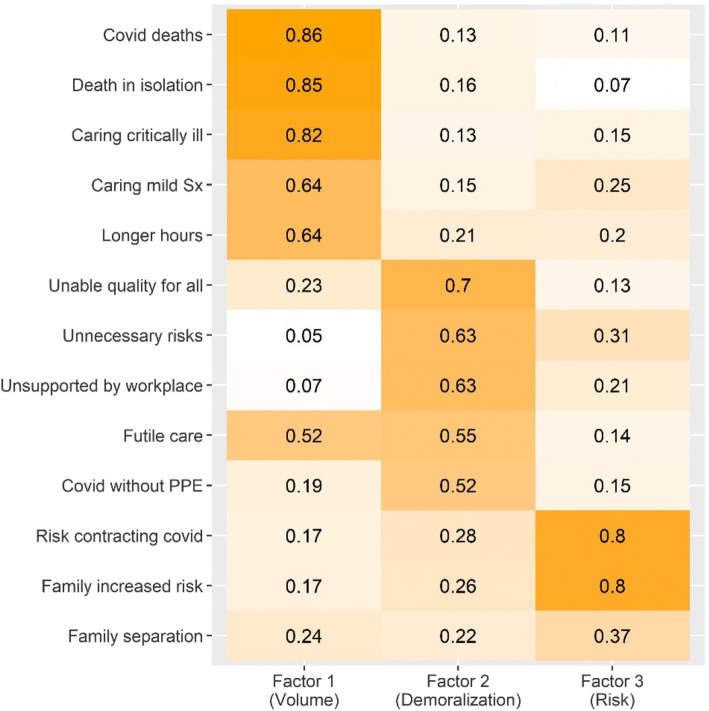
Fig. 1
Fig. 1
Factor analysis of COVID-19-related occupational stressors (CROS). Results of a 3-factor analysis of COVID-19 exposure items into 3 factors, termed volume, demoralization, and risk, based on an interpretation of their most highly weighted items. Color shading is proportional to the numeric weight on each cell, and indicates the weight that item contributes to the factor below. See Appendix A for complete wording of CROS items
Fig. 2
Fig. 2
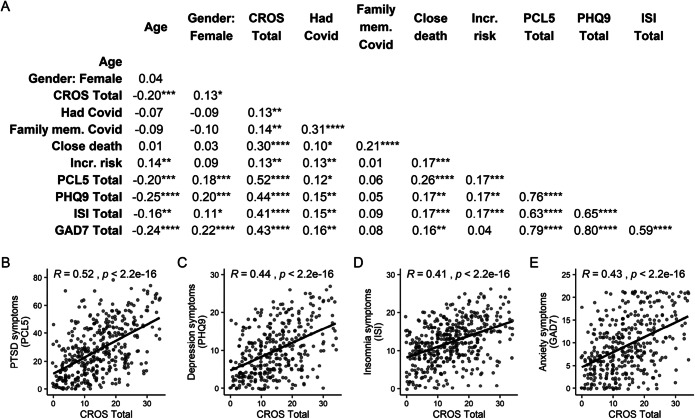
COVID-19-related occupational exposure (CROS total score) is strongly related to increased burden of psychiatric symptoms. A Bivariate relationships between demographic variables, exposure scores, and psychiatric symptom scores are represented by Spearman’s correlation coefficients. Scatter plots are provided for the relationship of CROS total to PTSD symptoms (B), depression symptoms (C), insomnia symptoms (D), and anxiety symptoms (E). *p < .05, **p < .01, ***p < .001, ****p < .0001. “Close death” = death of a family member or close colleague from COVID-19, “Inc risk” = medical condition associated with increased risk from COVID-19 infection
Fig. 3
Fig. 3
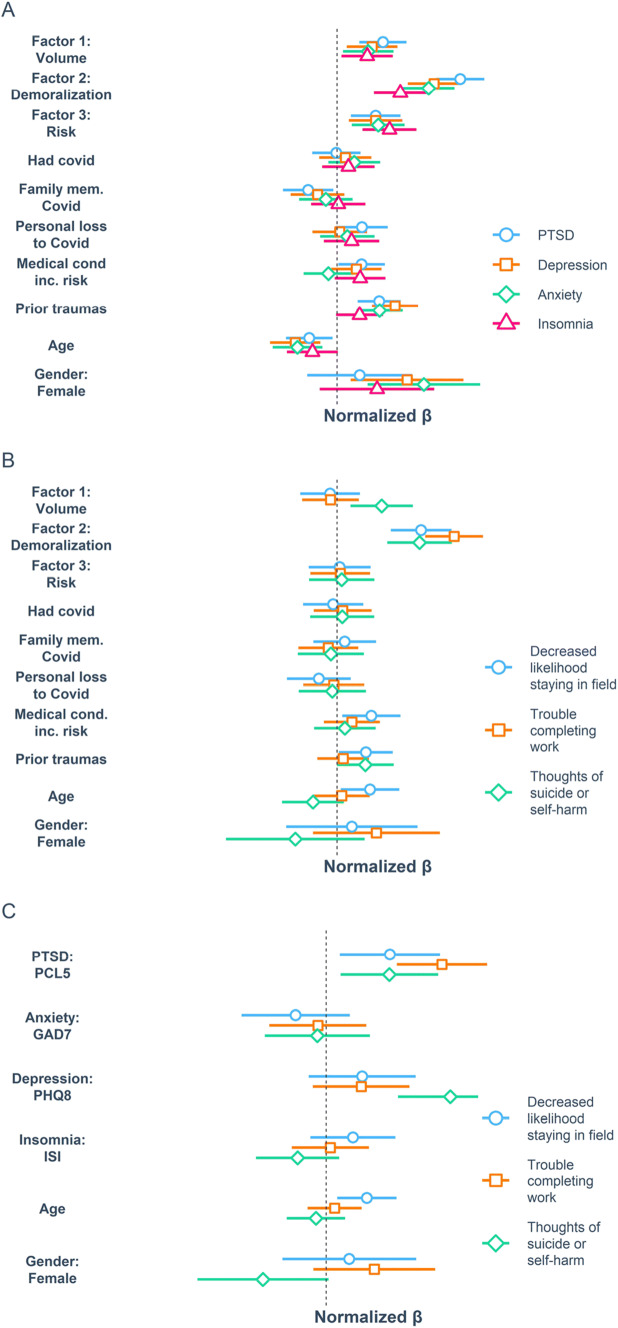
Relationships between different factors of COVID-19-related occupational stressors (CROS factors), psychiatric symptom expression, and functional outcomes. Results of multivariable regression models relating CROS factors and covariates to psychiatric symptom clusters (A) and functional outcome measures along with thoughts of suicide or self-harm (B). C Results of independent multivariable regression models relating symptom clusters as measured by total scores on the PCL5, PHQ9, GAD7, and ISI, along with covariates of age and gender, to functional outcome measures
Fig. 4
Fig. 4
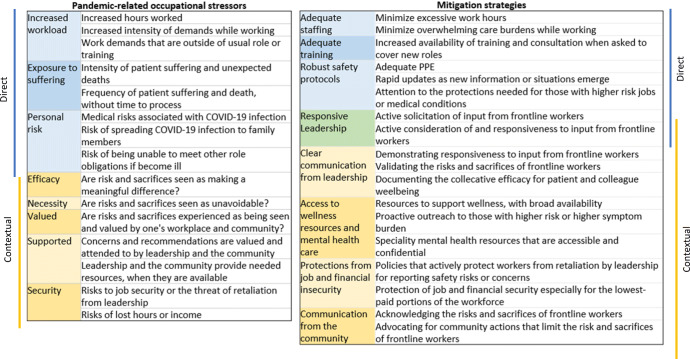
Potential schematic framework for considering direct and contextual factors contributing to occupational stress from the COVID-19 pandemic, and potential mitigation strategies. Stressors (left) and potential mitigation strategies (right) are divided into direct and contextual factors. Direct factors result primarily from the volume of COVID-19-related care being provided by an individual or their institution and resources available for the system to respond to these demands. Contextual factors can be addressed independent of the volume of COVID-19-related care being provided, and include the responsiveness of the system to addressing and supporting HCW/FR’s needs, and ensuring they are not put at unnecessary risk. Stressors represent a synthesis of factors identified from the quantitative and qualitative analyses; mitigation strategies represent concrete examples of ways in which the identified stressors could be modified, minimized, or mitigated. Mitigation or intervention approaches may vary depending on the most relevant occupational stressors for a specific group. For example, the strong relationship between demoralization and both psychiatric symptoms and adverse occupational outcomes in FR, along with the emphasis in free-text responses of fear of or enacted reprisal from leaders and betrayal by colleagues, suggest interventions focused on responsiveness and clear communication from leadership and protections of job and financial security may be particularly important for many FR. The high rates of PTSD symptoms and the relationship of these symptoms to a high likelihood of leaving one’s current field for nurses may suggest that interventions focused on decreasing the risk of PTSD, and increasing the availability and utilization of treatment for PTSD, may be of particularly high priority for nurses. An alternative example of a conceptual framework for planning risk mitigation and interventions based on a literature review can be found in Schwartz et al

References

    1. Griffin BJ, Purcell N, Burkman K, et al. and religious/spiritual (R/S) studies (Doehring. J Trauma Stress. 2019;32:350–362. 10.1002/jts.22362. - PubMed
    1. Smith BN, Taverna EC, Fox AB, Schnurr PP, Matteo RA, Vogt D. The Role of PTSD, Depression, and Alcohol Misuse Symptom Severity in Linking Deployment Stressor Exposure and Post-Military Work and Family Outcomes in Male and Female Veterans. Clin Psychol Sci. 2017;5(4):664–682. doi: 10.1177/2167702617705672. - DOI - PMC - PubMed
    1. Sienkiewicz ME, Amalathas A, Iverson KM, Smith BN, Mitchell KS. Examining the Association between Trauma Exposure and Work-Related Outcomes in Women Veterans. Int J Environ Res Public Health. 2020;17(12):4585. doi: 10.3390/IJERPH17124585. - DOI - PMC - PubMed
    1. Adler DA, Possemato K, Mavandadi S, et al. Psychiatric Status and Work Performance of Veterans of Operations Enduring Freedom and Iraqi Freedom. Psychiatr Serv. 2011;60(7):39–46. doi: 10.1176/ps.60.7.pss6201_0039. - DOI - PubMed
    1. Schwartz R, Sinskey JL, Anand U, Margolis RD. Addressing Postpandemic Clinician Mental Health: A Narrative Review and Conceptual Framework. Ann Intern Med. 2020;173(12):981–988. doi: 10.7326/M20-4199. - DOI - PMC - PubMed

Publication types