Effect of Treatment of Clinical Seizures vs Electrographic Seizures in Full-Term and Near-Term Neonates: A Randomized Clinical Trial
- PMID: 34919132
- PMCID: PMC8683963
- DOI: 10.1001/jamanetworkopen.2021.39604
Effect of Treatment of Clinical Seizures vs Electrographic Seizures in Full-Term and Near-Term Neonates: A Randomized Clinical Trial
Abstract
Importance: Seizures in the neonatal period are associated with increased mortality and morbidity. Bedside amplitude-integrated electroencephalography (aEEG) has facilitated the detection of electrographic seizures; however, whether these seizures should be treated remains uncertain.
Objective: To determine if the active management of electrographic and clinical seizures in encephalopathic term or near-term neonates improves survival free of severe disability at 2 years of age compared with only treating clinically detected seizures.
Design, setting, and participants: This randomized clinical trial was conducted in tertiary newborn intensive care units recruited from 2012 to 2016 and followed up until 2 years of age. Participants included neonates with encephalopathy at 35 weeks' gestation or more and younger than 48 hours old. Data analysis was completed in April 2021.
Interventions: Randomization was to an electrographic seizure group (ESG) in which seizures detected on aEEG were treated in addition to clinical seizures or a clinical seizure group (CSG) in which only seizures detected clinically were treated.
Main outcomes and measures: Primary outcome was death or severe disability at 2 years, defined as scores in any developmental domain more than 2 SD below the Australian mean assessed with Bayley Scales of Neonate and Toddler Development, 3rd ed (BSID-III), or the presence of cerebral palsy, blindness, or deafness. Secondary outcomes included magnetic resonance imaging brain injury score at 5 to 14 days, time to full suck feeds, and individual domain scores on BSID-III at 2 years.
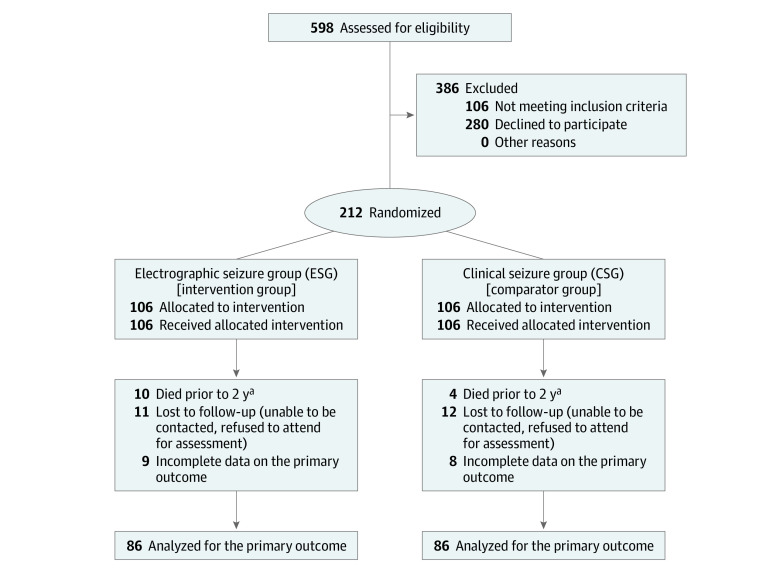
Results: Of 212 randomized neonates, the mean (SD) gestational age was 39.2 (1.7) weeks and 122 (58%) were male; 152 (72%) had moderate to severe hypoxic-ischemic encephalopathy (HIE) and 147 (84%) had electrographic seizures. A total of 86 neonates were included in the ESG group and 86 were included in the CSG group. Ten of 86 (9%) neonates in the ESG and 4 of 86 (4%) in the CSG died before the 2-year assessment. The odds of the primary outcome were not significantly different in the ESG group compared with the CSG group (ESG, 38 of 86 [44%] vs CSG, 27 of 86 [31%]; odds ratio [OR], 1.83; 95% CI, 0.96 to 3.49; P = .14). There was also no significant difference in those with HIE (OR, 1.77; 95% CI, 0.84 to 3.73; P = .26). There was evidence that cognitive outcomes were worse in the ESG (mean [SD] scores, ESG: 97.4 [17.7] vs CSG: 103.8 [17.3]; mean difference, -6.5 [95% CI, -1.2 to -11.8]; P = .01). There was little evidence of a difference in secondary outcomes, including time to suck feeds, seizure burden, or brain injury score.
Conclusions and relevance: Treating electrographic and clinical seizures with currently used anticonvulsants did not significantly reduce the rate of death or disability at 2 years in a heterogeneous group of neonates with seizures.
Trial registration: http://anzctr.org.au Identifier: ACTRN12611000327987.
Conflict of interest statement
Figures
Comment in
-
Subclinical Electrographic Seizures in the Newborn-Is More Treatment Better?JAMA Netw Open. 2021 Dec 1;4(12):e2140677. doi: 10.1001/jamanetworkopen.2021.40677. JAMA Netw Open. 2021. PMID: 34919137 No abstract available.
-
EBNEO Commentary: Effect of treatment of clinical seizures vs electrographic seizures in full-term and near-term neonates: A randomised clinical trial.Acta Paediatr. 2022 Jul;111(7):1462-1463. doi: 10.1111/apa.16334. Epub 2022 Mar 27. Acta Paediatr. 2022. PMID: 35342980 No abstract available.
References
Publication types
MeSH terms
Substances
LinkOut - more resources
Full Text Sources
Medical
Miscellaneous