


Care and referral patterns in a large, dedicated nurse-led atrial fibrillation outpatient clinic
- PMID: 34919210
- PMCID: PMC9270511
- DOI: 10.1007/s12471-021-01651-x
Care and referral patterns in a large, dedicated nurse-led atrial fibrillation outpatient clinic
Abstract
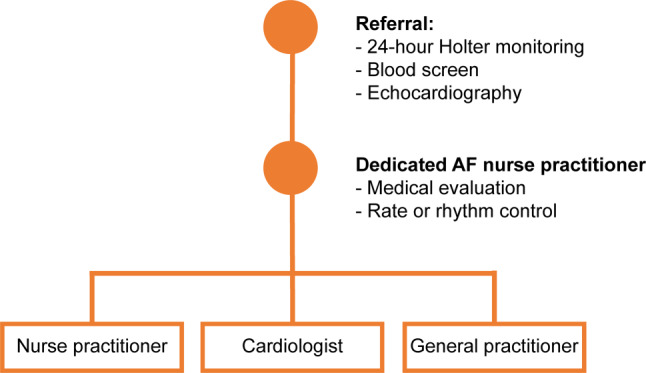
Introduction: Atrial fibrillation (AF) is the most common arrhythmia and imposes a high burden on the healthcare system. A nurse-led AF outpatient clinic may alleviate the burden on the cardiology outpatient clinic by triaging patients who need care by a cardiologist or general practitioner (GP). However, care and referral patterns after initial assessment in a nurse-led AF outpatient clinic are unknown. We examined the proportion of AF patients assessed in a nurse-led clinic without outpatient follow-up by a cardiologist.
Methods: All patients with AF referred to our tertiary medical centre underwent cardiac work-up in the nurse-led AF outpatient clinic and were prospectively followed. Data on patient characteristics, rhythm monitoring and echocardiography were collected and described. Odds ratio (OR) for continuing care in the nurse-led AF outpatient clinic was calculated.
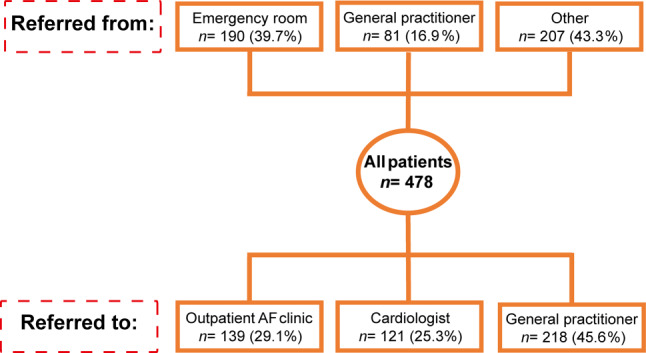
Results: From 2014 to 2018, 478 consecutive individual patients were referred to the nurse-led AF outpatient clinic. After the initial cardiac work-up, 139 patients (29.1%) remained under nurse-led care and 121 (25.3%) were referred to a cardiologist and 218 (45.6%) to a GP. Patients who remained under nurse-led care were significantly younger, were more symptomatic, more often had paroxysmal AF and had less comorbidities than the other two groups. After multivariable testing, CHA2DS2-VASc score ≥ 2 was associated with discontinued nurse-led care (OR 0.57, 95% confidence interval 0.34-0.95).
Conclusion: After initial cardiac assessment in the nurse-led outpatient clinic, about half of the newly referred AF patients were referred back to their GP. This strategy may reduce the burden of AF patients on secondary or tertiary cardiology outpatient clinics.
Keywords: Atrial fibrillation; Nurse practitioner; Outpatient clinic; Referral.
© 2021. The Author(s).
Conflict of interest statement
J.R. de Groot is supported by a personal grant from the Netherlands Organisation for Health Research and Development/Netherlands Organisation for Scientific Research (
Figures
References
-
- Hartstichting. Atriumfibrilleren.
-
- Go AS, Hylek EM, Phillips KA, et al. Prevalence of diagnosed atrial fibrillation in adults: national implications for rhythm management and stroke prevention: the AnTicoagulation and risk factors in atrial fibrillation (ATRIA) study. JAMA. 2001;285:2370–2375. doi: 10.1001/jama.285.18.2370. - DOI - PubMed
-
- Aliot E, Breithardt G, Brugada J, et al. An international survey of physician and patient understanding, perception, and attitudes to atrial fibrillation and its contribution to cardiovascular disease morbidity and mortality. Europace. 2010;12:626–633. doi: 10.1093/europace/euq109. - DOI - PMC - PubMed
-
- Hendriks JM, de Wit R, Crijns HJ, et al. Nurse-led care vs. usual care for patients with atrial fibrillation: results of a randomized trial of integrated chronic care vs. routine clinical care in ambulatory patients with atrial fibrillation. Eur Heart J. 2012;33:2692–2699. doi: 10.1093/eurheartj/ehs071. - DOI - PubMed
LinkOut - more resources
Full Text Sources
