


More passive internal tibial rotation with posterior cruciate ligament retention than with excision in a medial pivot TKA implanted with unrestricted caliper verified kinematic alignment
- PMID: 34921630
- PMCID: PMC9958185
- DOI: 10.1007/s00167-021-06840-0
More passive internal tibial rotation with posterior cruciate ligament retention than with excision in a medial pivot TKA implanted with unrestricted caliper verified kinematic alignment
Abstract
Purpose: Excision of the posterior cruciate ligament (PCL) is recommended when implanting a medial pivot (MP) total knee arthroplasty (TKA) to reduce the risk of limiting flexion by over-tensioning the flexion space. The present study determined whether PCL retention (1) limits internal tibial rotation and (2) causes anterior lift-off of the insert in 90° flexion after implantation of an MP design with unrestricted caliper verified kinematic alignment (KA).
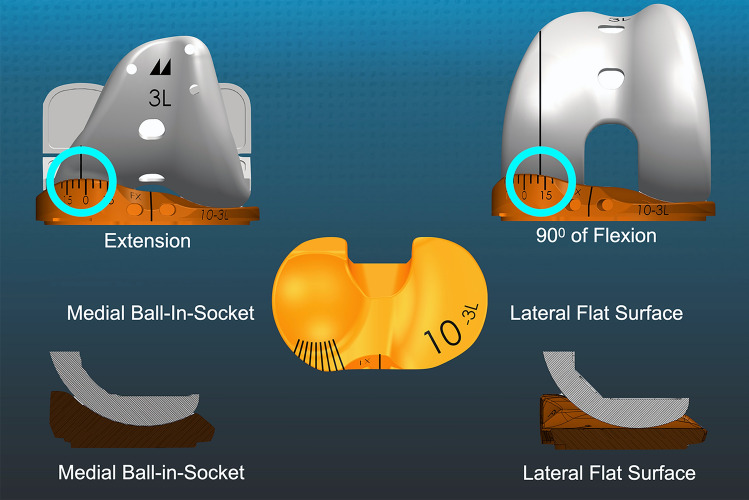
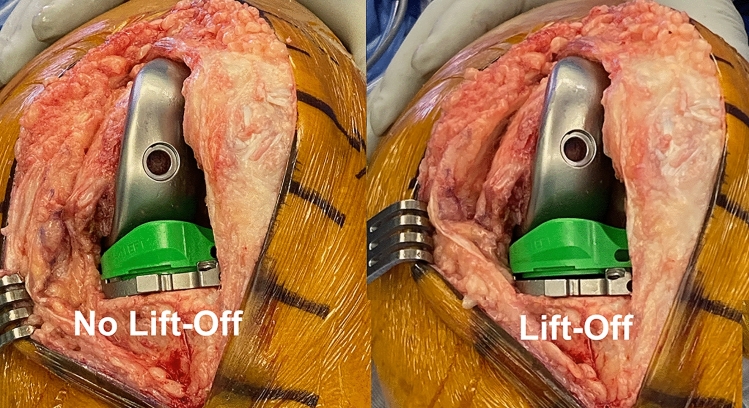
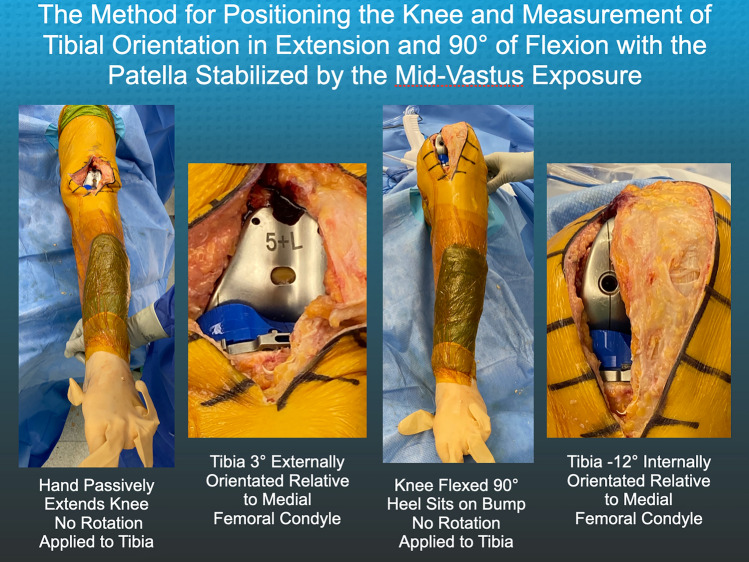
Methods: Four surgeons implanted an MP TKA design with medial ball-in-socket and lateral flat tibial insert in ten fresh-frozen cadaveric knees. Before and after PCL excision, trial inserts with medial goniometric markings measured the angular I-E tibial orientation relative to the trial femoral component's medial condyle in extension and at 90° flexion, and the surgeon recorded the occurrence of anterior lift-off of the insert at 90° flexion.
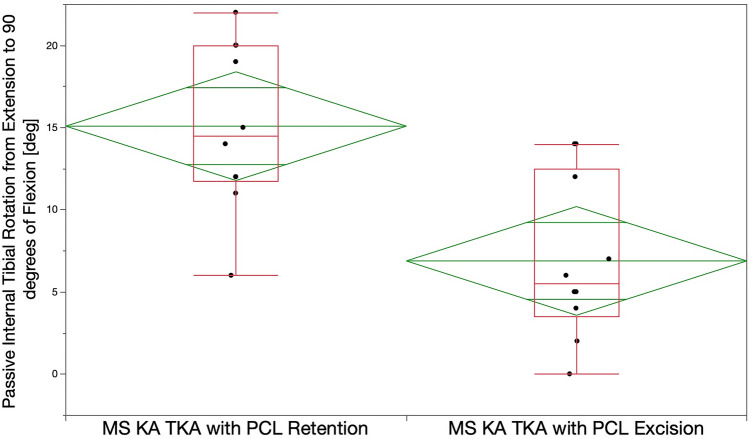
Results: PCL retention resulted in greater internal tibial rotation than PCL excision, with mean values of 15° vs 7° degrees from maximum extension to 90° flexion, respectively (p < 0.0007). At 90° flexion, no TKAs with PCL retention and one TKA with PCL excision had anterior lift-off of the insert (N.S.).
Conclusions: This preliminary study of ten cadaveric knees showed that PCL retention restored more passive internal tibial rotation than PCL excision with a negligible risk of anterior lift-off. However, in vivo analysis from multiple authors with a larger sample size is required to recommend PCL retention with an MP TKA design implanted with unrestricted caliper verified KA.
Keywords: Calipered; Insert thickness; Posterior cruciate ligament; Tibial rotation; Total knee arthroplasty; Total knee replacement.
© 2021. The Author(s).
Conflict of interest statement
A. J. Nedopil is a paid consultant for Medacta USA, Inc., S. M. Howell is a paid consultant for THINK Surgical and Medacta International., M. L. Hull receives research support from Medacta USA, Inc.
Figures
References
-
- Delman CM, Ridenour D, Howell SM, Hull ML. The posterolateral upslope of a low-conforming insert blocks the medial pivot during a deep knee bend in TKA: a comparative analysis of two implants with different insert conformities. Knee Surg Sports Traumatol Arthrosc. 2021 doi: 10.1007/s00167-021-06668-8. - DOI - PubMed
-
- Emerson RH, Jr, Barrington JW, Olugbode SA, Alnachoukati OK. A comparison of 2 tibial inserts of different constraint for cruciate-retaining primary total knee arthroplasty: an additional tool for balancing the posterior cruciate ligament. J Arthroplasty. 2016;31:425–428. doi: 10.1016/j.arth.2015.09.032. - DOI - PubMed
MeSH terms
LinkOut - more resources
Full Text Sources
Medical
Miscellaneous
