. 2022 Jan 24;57(2):180-196.e7.
doi: 10.1016/j.devcel.2021.11.025. Epub 2021 Dec 17.

piRNAs initiate transcriptional silencing of spermatogenic genes during C. elegans germline development

Affiliations

piRNAs initiate transcriptional silencing of spermatogenic genes during C. elegans germline development

Eric Cornes et al. Dev Cell. .

Abstract

Eukaryotic genomes harbor invading transposable elements that are silenced by PIWI-interacting RNAs (piRNAs) to maintain genome integrity in animal germ cells. However, whether piRNAs also regulate endogenous gene expression programs remains unclear. Here, we show that C. elegans piRNAs trigger the transcriptional silencing of hundreds of spermatogenic genes during spermatogenesis, promoting sperm differentiation and function. This silencing signal requires piRNA-dependent small RNA biogenesis and loading into downstream nuclear effectors, which correlates with the dynamic reorganization of two distinct perinuclear biomolecular condensates present in germ cells. In addition, the silencing capacity of piRNAs is temporally counteracted by the Argonaute CSR-1, which targets and licenses spermatogenic gene transcription. The spatial and temporal overlap between these opposing small RNA pathways contributes to setting up the timing of the spermatogenic differentiation program. Thus, our work identifies a prominent role for piRNAs as direct regulators of endogenous transcriptional programs during germline development and gamete differentiation.

Keywords: C. elegans; RNAi; epigenetics; fertility; germ granules; germline development; piRNAs; small RNAs; spermatogenesis; transcriptional silencing.


Conflict of interest statement

Declaration of interests The authors declare no competing interests.

Figures

None
Graphical abstract
Figure 1
Figure 1
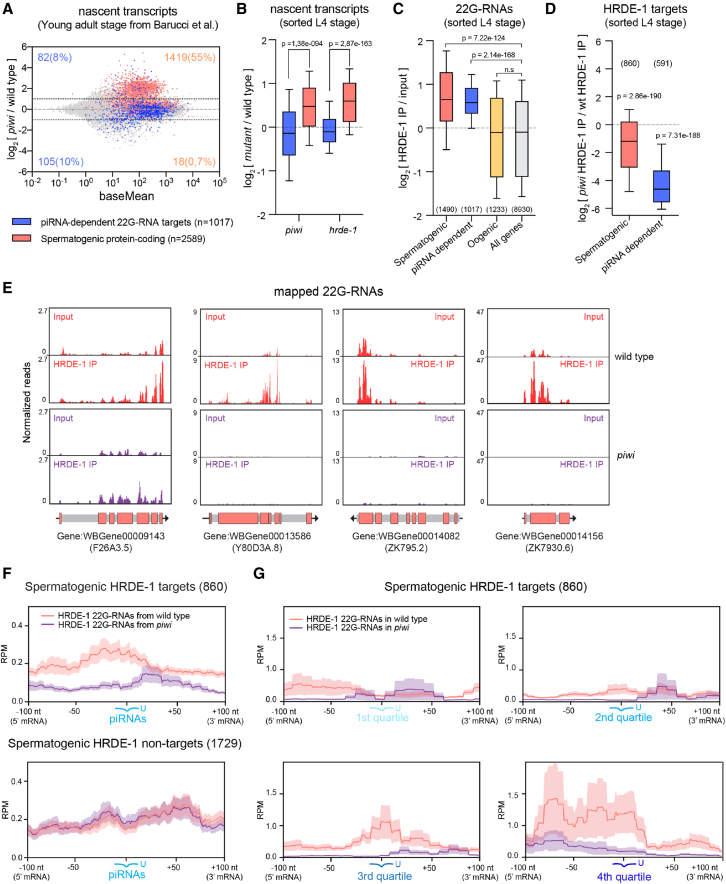
piRNAs target spermatogenic mRNAs to trigger their transcriptional silencing through HRDE-1 (A) MA-plot showing the log2 fold change of protein-coding nascent RNAs (GRO-seq) in piwi mutant versus wild-type young adult worms (data from Barucci et al., 2020). Dashed lines indicate 2-fold changes, and the colored numbers indicate the total number and proportion (in parentheses) of misregulated piRNA-dependent 22G-RNA targets (blue) or spermatogenic-enriched genes (light red) (2-fold changes; adjusted p < 0.05, Wald test). (B) Box plots showing the log2 fold change in nascent RNAs (GRO-seq) for piRNA-dependent 22G-RNA targets (blue) or spermatogenic-enriched genes (light red) in late L4 piwi and hrde-1 mutant worms versus wild-type. (C) Boxplots showing the log2 fold change in 22G-RNAs (sRNA-seq) from HRDE-1 IPs compared with input for different categories of genes. The number of genes in each category is shown in parenthesis, considering only genes with >1 RPM in HRDE-1 IPs. (D) Boxplots showing the log2 fold change in 22G-RNAs (sRNA-seq) from piwi mutant versus wild-type HRDE-1 IPs for HRDE-1 targets. In (B–D), boxplots display median (line), first, and third quartiles (box), and 90th/10th percentile values (whiskers), and two-tailed p values were calculated using Mann-Whitney-Wilcoxon tests. The number of genes is shown in parenthesis. (E) Genomic view of spermatogenic piRNA target genes. Panels show normalized 22G-RNA reads (reads per million, RPM) from total RNA (input) and HRDE-1 IPs in wild-type (red) and piwi mutants (purple). Colored boxes represent coding sequences, and gray boxes correspond to non-coding sequences (introns, UTRs). (F) RPM density of 22G-RNAs from HRDE-1 IPs in a 200-nt window around predicted piRNA targeting sites in wild-type (light red) or piwi (purple) mutants. Spermatogenic HRDE-1 targets and non-targets were analyzed separately. (G) RPM density of 22G-RNAs from HRDE-1 IPs around predicted piRNA-targeting sites on HRDE-1 spermatogenic targets. Data were analyzed based on piRNA expression levels, from least (1st quartile) to most (4th quartile) abundant.
Figure 2
Figure 2
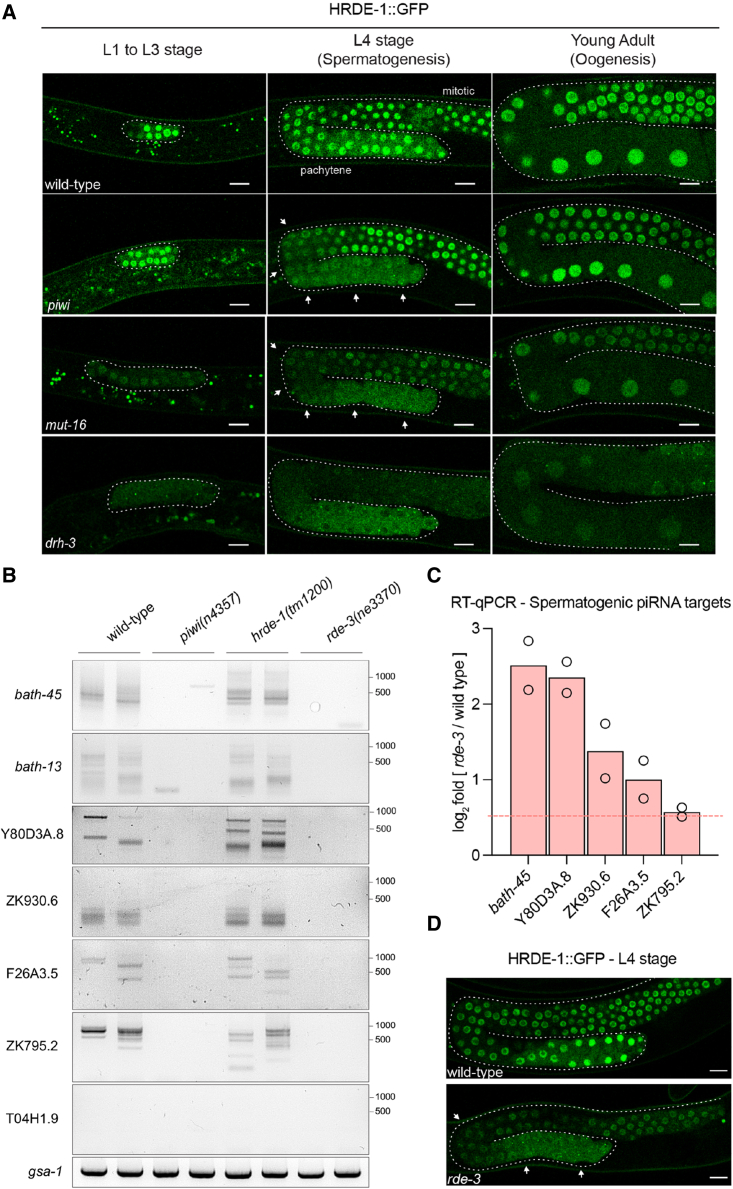
piRNA-dependent 22G-RNAs prime HRDE-1 nuclear localization during spermatogenesis (A) Panels showing a single confocal plane of live animal germlines expressing an HRDE-1::GFP reporter at the indicated developmental time points and genetic backgrounds. Arrows indicate pachytene-specific loss of nuclear HRDE-1 enrichment. Scale bars, 10 μm. (B) Gene-specific pUG assay (Shukla et al., 2020) (see STAR Methods) on the indicated mRNAs and genetic backgrounds. Results from two independent biological replicates. T04H1.9 is a non pUGylated mRNA, and gsa-1 contains a pUG stretch genetically encoded in its 3′ UTR used as a loading control. (C) Expression levels of the indicated mRNAs in sorted L4 rde-3(ne3370) mutant worms by RT-qPCR. mRNA levels were normalized to act-3. Bars show the average levels from two biological replicates. (D) Panels show a single confocal plane of live wild-type and rde-3(ne3370) germlines expressing an HRDE-1::GFP reporter during spermatogenesis.
Figure 3
Figure 3
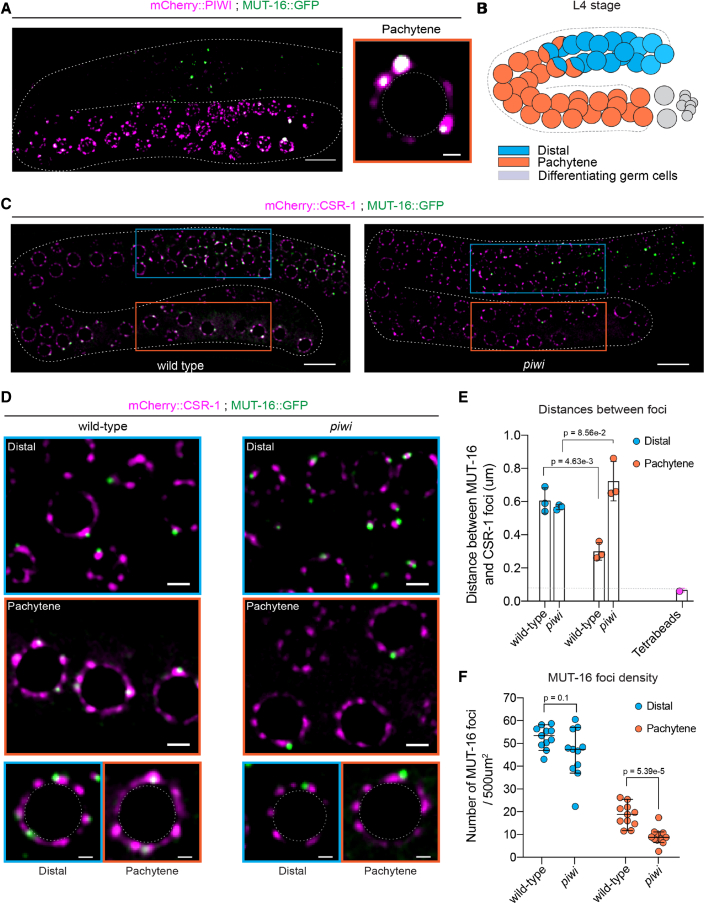
Spatiotemporal dynamics of Mutator foci and P granules during spermatogenesis (A) (Left) Panel showing a confocal z stack of germline surfaces from live animals expressing the indicated fluorescent proteins during the L4 stage. Scale bar, 10 μm. (Right) Fluorescent micrograph of a pachytene germ cell nucleus from animals expressing the indicated fluorescent proteins. Scale bar, 1 μm. (B) Schematic representation of the distal and pachytene regions of an L4 stage germline. Colored circles are germ cell nuclei. (C) Panels show a single confocal plane of live germlines expressing mCherry::CSR-1 and MUT-16::GFP in wild-type and piwi mutant animals during the L4 stage. Rectangular highlight germ cells in the germline’s distal (blue) and pachytene (orange) regions. Scale bars, 10 μm. (D) Distal and pachytene germ cells of animals expressing GFP::MUT-16 and mCherry::CSR-1 in wild-type and piwi mutant animals. Scale bar, 2 μm. Examples of individual germ cell nuclei are shown at the bottom. Scale bar, 1 μm. (E) Distance between the centers of MUT-16::GFP and mCherry::CSR-1 condensates. The bars indicate the mean value, and error bars indicate the standard deviation of 10 granules measured in 3 animals (n = 30 total). The last column shows the chromatic shift measured for tetraspeck beads (n = 30). Two-tailed p values were calculated using an unpaired t test. (F) MUT-16 foci density measured in different regions of live germlines of the indicated genotypes. The bar indicates the median value, and error bars indicate the 95% confidence interval (CI) of the number of MUT-16 foci measured in 10 individual germlines.
Figure 4
Figure 4
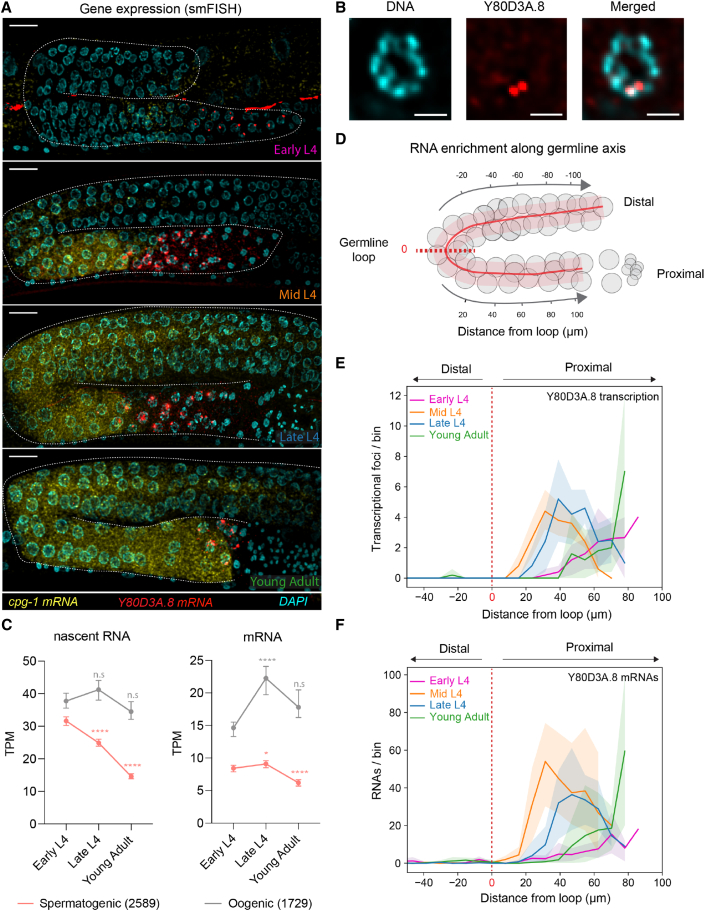
Expression dynamics of spermatogenic piRNA targets during germline development (A) smFISH of spermatogenic Y80D3A.8 mRNAs (red) and oogenic cpg-1 mRNAs (yellow). DNA staining with DAPI (cyan). Scale bars, 10 μm. (B) Magnified view of a pachytene germ cell nucleus expressing Y80D3A.8 (red) and DAPI staining (cyan). Scale bars, 2 μm. (C) Detection of spermatogenic- and oogenic-enriched nascent RNAs (GRO-seq) and mRNAs (RNA-seq) from synchronized and sorted early L4, late L4, and young adult worms. Median levels and 95% confident interval of normalized read abundances in transcript per million (TPM) are shown. Two-tailed p values were calculated using Mann-Whitney-Wilcoxon tests (n.s: p > 0.5; p < 0.5; ∗∗∗∗p < 0.0001); number of genes indicated in parenthesis. (D) Schematic representation of the pipeline for RNA spot detection along the germline axis from smFISH images. (E and F) Average and standard deviation (from n = 5 germlines) of spermatogenic Y80D3A.8 piRNA target transcriptional foci (E) and mRNAs (F) as a function of position in the germlines at the indicated developmental timepoints. RNA counts are attributed for each point along the axes, and data are binned for easier representation. The red dashed line indicates the position of the germline loop.
Figure 5
Figure 5
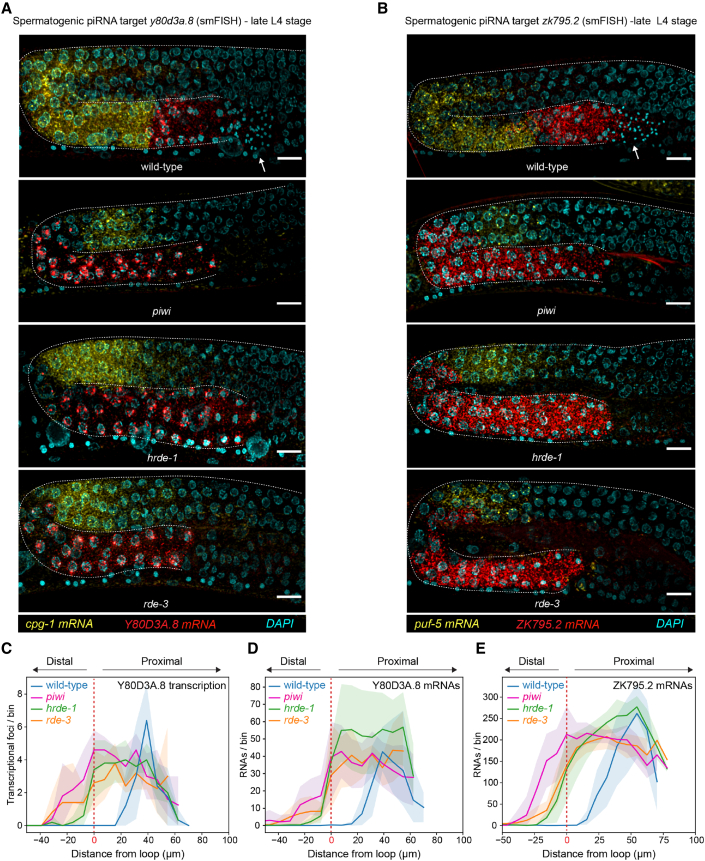
piRNA-mediated transcriptional silencing is required for spermatogenic differentiation (A and B) Late L4 smFISH of spermatogenic Y80D3A.4 (red) and oogenic cpg-1 (yellow) mRNAs (A) or ZK795.2 (red) and puf-5 (yellow) mRNAs (B). DNA staining with DAPI (cyan). Scale bars, 10 μm. (C–E) Average and standard deviation (from n = 5 germlines) of spermatogenic Y80D3A.8 piRNA target transcriptional foci (C) and mRNAs (D) or spermatogenic ZK795.2 piRNA target mRNAs (E) as a function of position in the late L4 germlines of the indicated genotypes. The red dashed line indicates the position of the germline loop.
Figure 6
Figure 6
Transcriptional repression of spermatogenic genes by piRNAs is required for fertility (A) Expression of spermatogenic ZK795.2 piRNA target (red) and oogenic puf-5 mRNAs (yellow) by smFISH in young adult hrde-1 mutant or wild-type germlines. DNA staining with DAPI (cyan). Arrows indicate mature sperm and arrowhead oocytes. Asterisks highlight regions with high background autofluorescence. Scale bars, 15 μm. Upper panels: DIC images. White dashed squares highlight the presence of a fully formed vulva in both wild-type and mutant worms. (B) Boxplots showing the log2 fold change in mRNAs (RNA-seq) for spermatogenic- (light red), oogenic-enriched (yellow), and all genes (gray) in synchronized young adult piwi and hrde-1 mutant worms versus wild-type (data from Barucci et al., 2020). Boxplots display median (line), first, and third quartiles (box), and 90th/10th percentile values (whiskers). Two-tailed p values were calculated using Mann-Whitney-Wilcoxon tests. The number of genes is reported in parenthesis. (C) The presence of oocytes was scored from synchronized young adult individuals of the indicated genotypes and at different time points (n = 50 worms scored per time point and genotype). (D) Brood size of wild-type, piwi, and hrde-1 mutant hermaphrodites. Data points correspond to the number of alive F1 larvae from individual worms. Bars indicate the median brood size value for each population. Two-tailed p values were calculated using Mann-Whitney-Wilcoxon test. (E) hrde-1 and piwi mutant hermaphrodites show fertility defects when mated with wild-type males. Data points correspond to the number of alive F1 larvae from individual worms. Bars indicate the median brood size value for each population. Two-tailed p values were calculated using Mann-Whitney-Wilcoxon test. (F) hrde-1 and piwi mutant males show fertility defects when mated with fog-2 females. Data points correspond to the number of alive F1 larvae from individual worms. Bars indicate the median brood size value for each population. Two-tailed p values were calculated using Mann-Whitney-Wilcoxon test. (G) Representative images of the in vitro sperm activation assay from wild-type, piwi, and hrde-1 mutant males. Pronase-treated mutant spermatids exhibit activation and morphological defects. Scale bars, 5 μm. (H) Percentage of activated, irregular, and inactivated spermatids from a sperm activation assay on males of the indicated genetic backgrounds. At least 10 adult male animals were dissected. A total number of spermatids scored is reported in parenthesis.
Figure 7
Figure 7
Tethering of AGO CSR-1 to a spermatogenic mRNA confers protection against piRNA targeting (A) Boxplots show the log2 fold change of spermatogenic 22G-RNAs (sRNA-seq) in HRDE-1 and CSR-1 IPs compared with input in wild-type animal populations at three developmental time points. Boxplots display median (line), first, and third quartiles (box), and 90th/10th percentile values (whiskers). Two-tailed p values were calculated using Mann-Whitney-Wilcoxon tests; the number of genes is indicated in parenthesis. (B) Histograms show the log2 fold change of CSR-1 loaded 22G-RNAs (sRNA-seq) at early L4 in HRDE-1 IPs compared with input in wild-type animal populations at three developmental time points. Early L4 CSR-1 spermatogenic targets were ranked in quartiles of 22G-RNA density in CSR-1 IPs. The bars indicate the median, and error bars indicate a 95% confidence interval. Numbers in parentheses indicate the portion of CSR-1 targets analyzed in each category. (C) Diagram of the endogenous CSR-1 tethering assay. Colored boxes represent coding sequences, and gray boxes correspond to non-coding sequences (introns, UTRs). (D) RNA immunoprecipitation (RIP) experiments followed by RT-qPCR showing the log10 percentage of input for a known CSR-1 target (csr-1) (Singh et al., 2021), and two spermatogenic piRNA targets (ZK795.2 and Y80D3A.8) from λN::CSR-1 and λN::Cherry IPs at the indicated genetic backgrounds. act-3 was used as a non-specific target gene. The bars indicate the mean value from n = 2 biologically independent experiments. (E) RT-qPCR log2 fold change of the spermatogenic piRNA targets ZK795.2 and Y80D3A.8 in late L4 sorted populations of λN::csr-1;ZK795.2::5boxb (tethered) worms compared with ZK795.2::5boxb control animals. The bar indicates the mean value, and error bars indicate the standard deviation. n = 3 biologically independent experiments. Statistical analysis was performed using two-tailed unpaired t tests. (F) Average and standard deviation (from n = 10 germlines) of ZK795.2::5boxb mRNAs as a function of position in the germlines of λN::csr-1;ZK795.2::5boxb (tethered) worms compared with ZK795.2::5boxb control animals. The red dashed line indicates the position of the germline loop. (G) Representative images of smFISH of the spermatogenic piRNA target ZK795.2 (red) in fixed late L4 germlines from the indicated genetic backgrounds. DNA staining with DAPI (cyan). Scale bars, 10 μm.
Figure 8
Figure 8
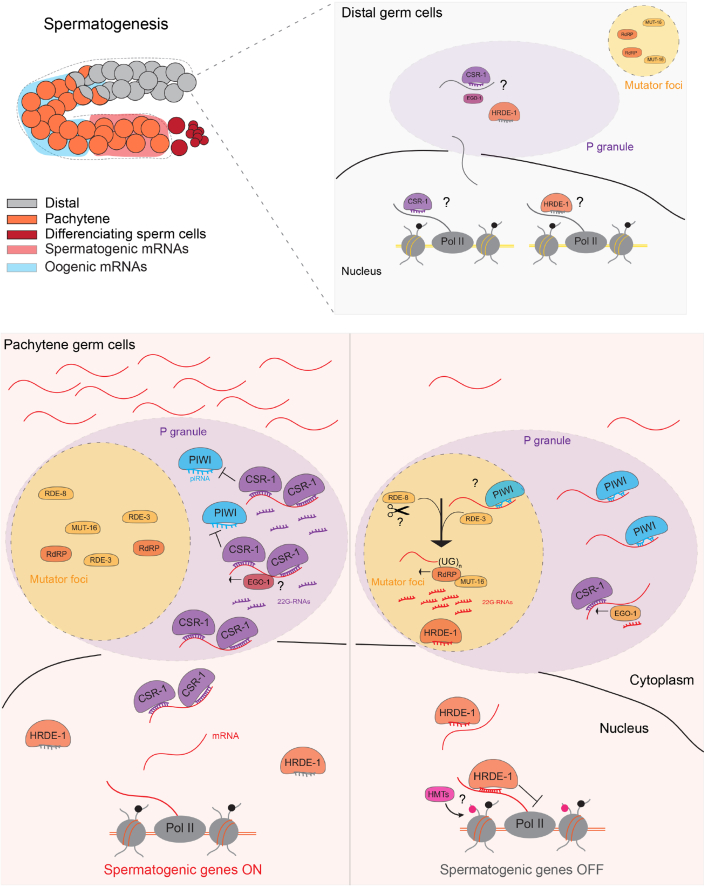
Model for the regulation of spermatogenic transcription by piRNAs During spermatogenesis, P granules and Mutator foci are two distinct condensates in the nuage of distal germ cells. In meiotic germ cells transiting the pachytene region, the expression and localization of PIWI to P granules is associated with the incorporation of the Mutator foci into P granules. This inclusion concentrates upstream and downstream factors required for the biogenesis of piRNA-dependent 22G-RNAs and nuclear piRNA signaling around transcripts exiting from the nuclear pore. CSR-1 targeting provides temporal protection from piRNA silencing in the P granules, licensing spermatogenic transcripts in the proximal region of the germline. As spermatogenic proceeds, loading of 22G-RNA antisense to spermatogenic genes is reduced in CSR-1, favoring piRNA targeting of spermatogenic transcripts and the synthesis and loading of 22G-RNAs in HRDE-1. The RdRP synthesis of piRNA-dependent 22G-RNAs on spermatogenic mRNAs requires the addition of polyUG stretches by RDE-3 on mRNA fragments, possibly cleaved RDE-8. The transcriptional silencing of spermatogenic genes by piRNAs promotes the correct meiotic differentiation of spermatogenic germ cells and confers temporal precision to the developmental switch from sperm to oocyte production.

Comment in

  • PIWI puts spermatogenesis in its place.
    Charlesworth AG, Nitschko V, Renaud MS, Claycomb JM. Charlesworth AG, et al. Dev Cell. 2022 Jan 24;57(2):149-151. doi: 10.1016/j.devcel.2022.01.001. Dev Cell. 2022. PMID: 35077678

References

    1. Angeles-Albores D., Lee R.Y., Chan J., Sternberg P.W. Two new functions in the WormBase Enrichment Suite. MicroPubl. Biol. 2018;2018 doi: 10.17912/W25Q2N. - DOI - PMC - PubMed
    1. Aravin A., Gaidatzis D., Pfeffer S., Lagos-Quintana M., Landgraf P., Iovino N., Morris P., Brownstein M.J., Kuramochi-Miyagawa S., Nakano T., et al. A novel class of small RNAs bind to MILI protein in mouse testes. Nature. 2006;442:203–207. - PubMed
    1. Ashe A., Sapetschnig A., Weick E.M., Mitchell J., Bagijn M.P., Cording A.C., Doebley A.L., Goldstein L.D., Lehrbach N.J., Le Pen J., et al. PiRNAs can trigger a multigenerational epigenetic memory in the germline of C. elegans. Cell. 2012;150:88–99. - PMC - PubMed
    1. Bagijn M.P., Goldstein L.D., Sapetschnig A., Weick E.M., Bouasker S., Lehrbach N.J., Simard M.J., Miska E.A. Function, targets, and evolution of Caenorhabditis elegans piRNAs. Science. 2012;337:574–578. - PMC - PubMed
    1. Barucci G., Cornes E., Singh M., Li B., Ugolini M., Samolygo A., Didier C., Dingli F., Loew D., Quarato P., Cecere G. Small-RNA-mediated transgenerational silencing of histone genes impairs fertility in piRNA mutants. Nat. Cell Biol. 2020;22:235–245. - PMC - PubMed

Publication types

MeSH terms

Substances