


Social isolation, social support and loneliness as predictors of cardiovascular disease incidence and mortality
- PMID: 34922471
- PMCID: PMC8684069
- DOI: 10.1186/s12877-021-02602-2
Social isolation, social support and loneliness as predictors of cardiovascular disease incidence and mortality
Abstract
Background: Poor social health is associated with increased risk of cardiovascular disease (CVD). Recent research suggests that different social health domains should be considered separately as the implications for health and possible interventions may differ.
Aim: To assess social isolation, low social support and loneliness as predictors of CVD.
Methods: Secondary analysis of 11,486 community-dwelling, Australians, aged 70 years and over, free of CVD, dementia, or significant physical disability, from the ASPirin in Reducing Events in the Elderly (ASPREE) trial. Social isolation, social support (Revised Lubben Social Network Scale), and loneliness were assessed as predictors of CVD using Cox proportional-hazard regression. CVD events included fatal CVD, heart failure hospitalization, myocardial infarction and stroke. Analyses were adjusted for established CVD risk factors.
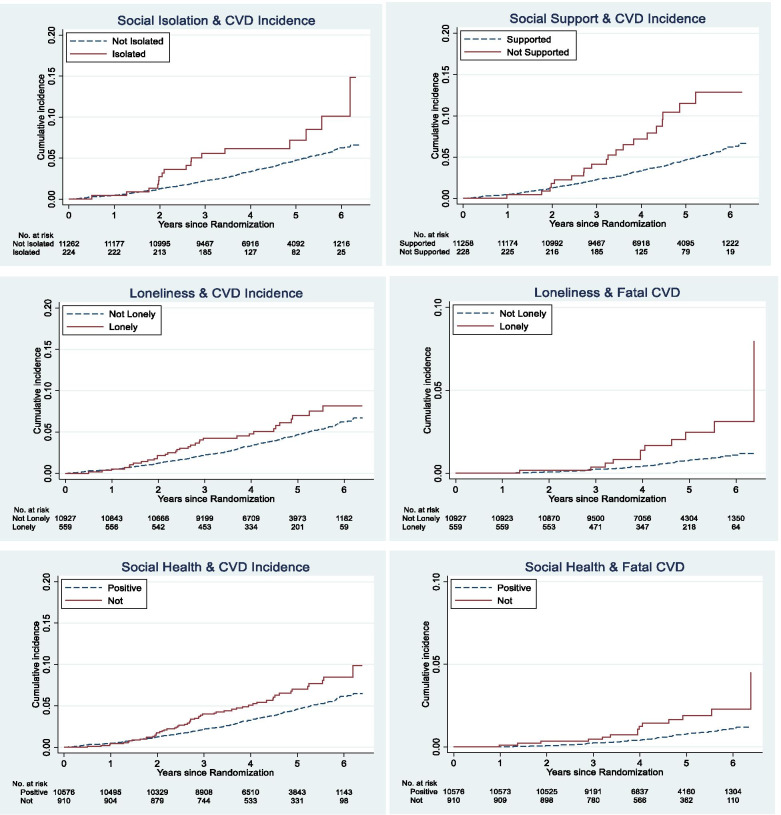
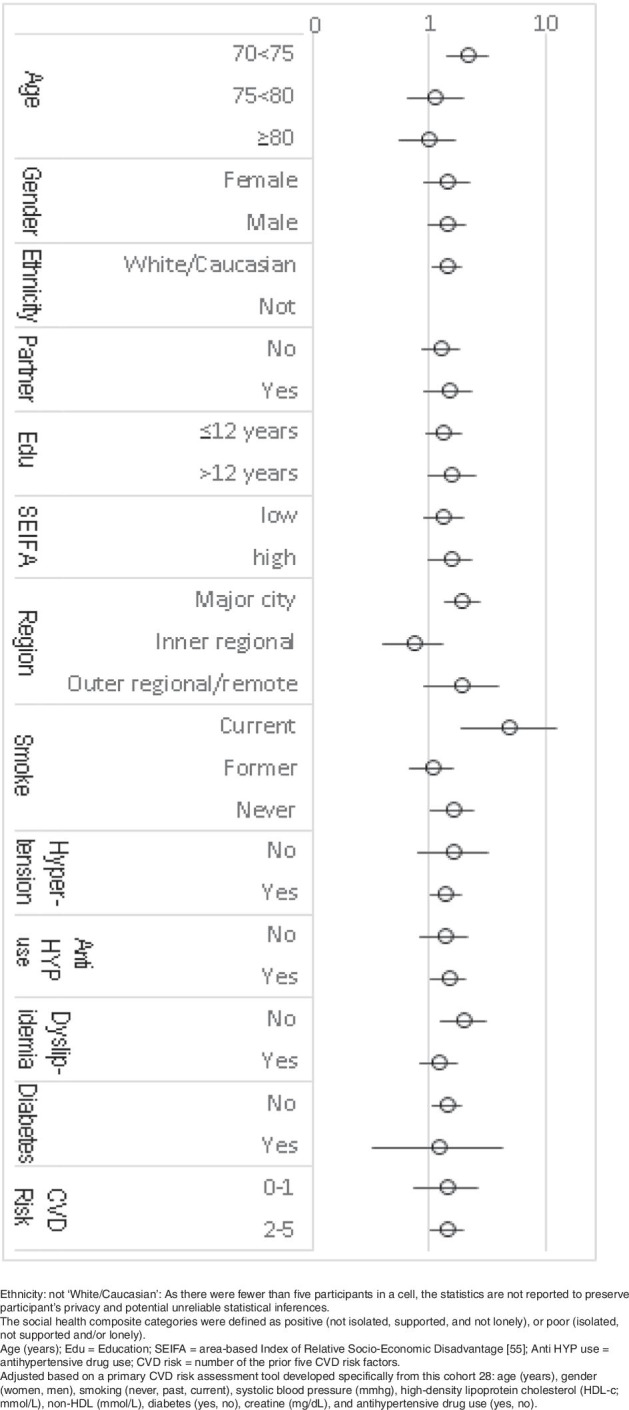
Results: Individuals with poor social health were 42 % more likely to develop CVD (p = 0.01) and twice as likely to die from CVD (p = 0.02) over a median 4.5 years follow-up. Interaction effects indicated that poorer social health more strongly predicted CVD in smokers (HR 4.83, p = 0.001, p-interaction = 0.01), major city dwellers (HR 1.94, p < 0.001, p-interaction=0.03), and younger older adults (70-75 years; HR 2.12, p < 0.001, p-interaction = 0.01). Social isolation (HR 1.66, p = 0.04) and low social support (HR 2.05, p = 0.002), but not loneliness (HR 1.4, p = 0.1), predicted incident CVD. All measures of poor social health predicted ischemic stroke (HR 1.73 to 3.16).
Conclusions: Among healthy older adults, social isolation and low social support may be more important than loneliness as cardiovascular risk factors. Social health domains should be considered in future CVD risk prediction models.
Keywords: Aging; Cardiovascular Diseases; Geriatrics; Interpersonal Relations; Loneliness; Social Isolation; Social Support.
© 2021. The Author(s).
Conflict of interest statement
None declared. The data collection, analysis and interpretation of data; the writing of the manuscript; and the decision to submit the manuscript for publication were solely at the discretion of the researchers, independent of the funders.
Figures
References
-
- Mendis S, Puska P, Norrving B. Global Atlas on Cardiovascular Disease Prevention and Control Geneva. Switzerland: World Health Organization (WHO); 2011.
-
- World Health Organization (WHO). Fact sheets: Cardiovascular diseases (CVDs). 2020. www.who.int/en/news-room/fact-sheets/detail/cardiovascular-diseases-(cvds) [Accessed 21/1/2021].
-
- Bloom DE, Cafiero ET, Jané-Llopis E, Abrahams-Gessel S, Bloom LR, Fathima S, Feigl AB, Gaziano T, Mowafi M, Pandya A, Prettner K, Rosenberg L, Seligman B, Stein AZ, Weinstein C. The Global Economic Burden of Noncommunicable Diseases. Geneva: World Economic Forum; 2011.
-
- Valtorta NK, Kanaan M, Gilbody S, Ronzi S, Hanratty B. Loneliness and social isolation as risk factors for coronary heart disease and stroke: systematic review and meta-analysis of longitudinal observational studies. Heart. 2016;102(13):1009–16. doi: 10.1136/heartjnl-2015-308790. - DOI - PMC - PubMed
-
- National Academies of Sciences E, Medicine . Social Isolation and Loneliness in Older Adults: Opportunities for the Health Care System. Washington, DC: The National Academies Press; 2020. - PubMed
Publication types
MeSH terms
LinkOut - more resources
Full Text Sources
