


Global, regional, and national burden of cervical cancer for 195 countries and territories, 2007-2017: findings from the Global Burden of Disease Study 2017
- PMID: 34922503
- PMCID: PMC8684284
- DOI: 10.1186/s12905-021-01571-3
Global, regional, and national burden of cervical cancer for 195 countries and territories, 2007-2017: findings from the Global Burden of Disease Study 2017
Abstract
Background: Cervical cancer is one of the most common cancers among women worldwide. The formulation or evaluation on prevention strategies all require an accurate understanding of the burden for cervical cancer burden. We aimed to report the up-to-date estimates of cervical cancer burden at global, regional, and national levels.
Methods: Data were extracted from the Global Burden of Diseases, Injuries, and Risk Factors Study (GBD) 2017 study. The counts, age-standardized rates, and percentage changes of incidence, disability-adjusted life-years (DALYs), and death attributed to cervical cancer at the global, regional, and national levels in all 195 countries and territories from 21 regions during 2007 to 2017 by age and by Socio-demographic Index (SDI) were measured. All estimates were reported with 95% uncertainty intervals (UIs).
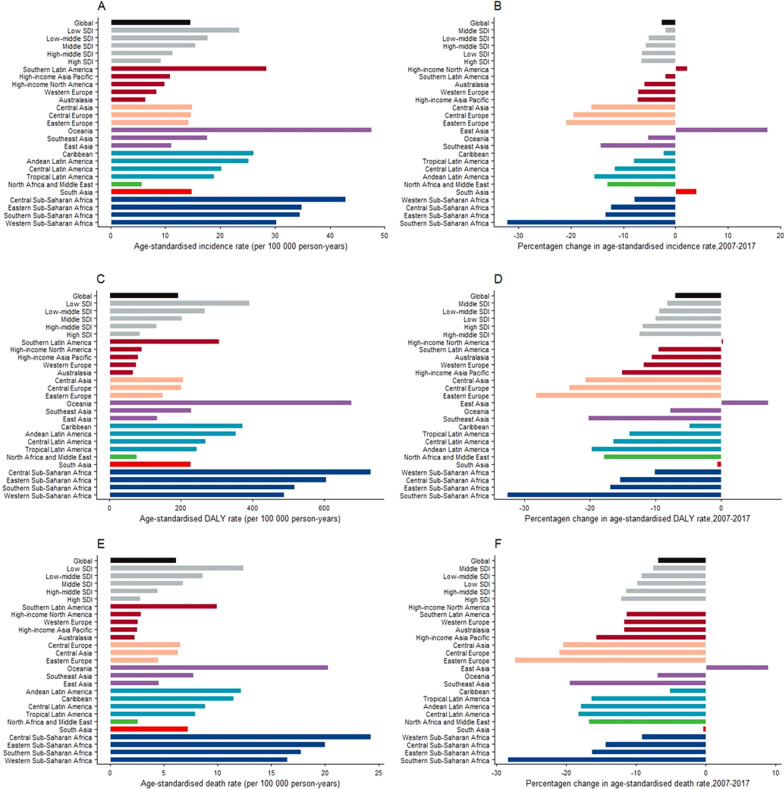
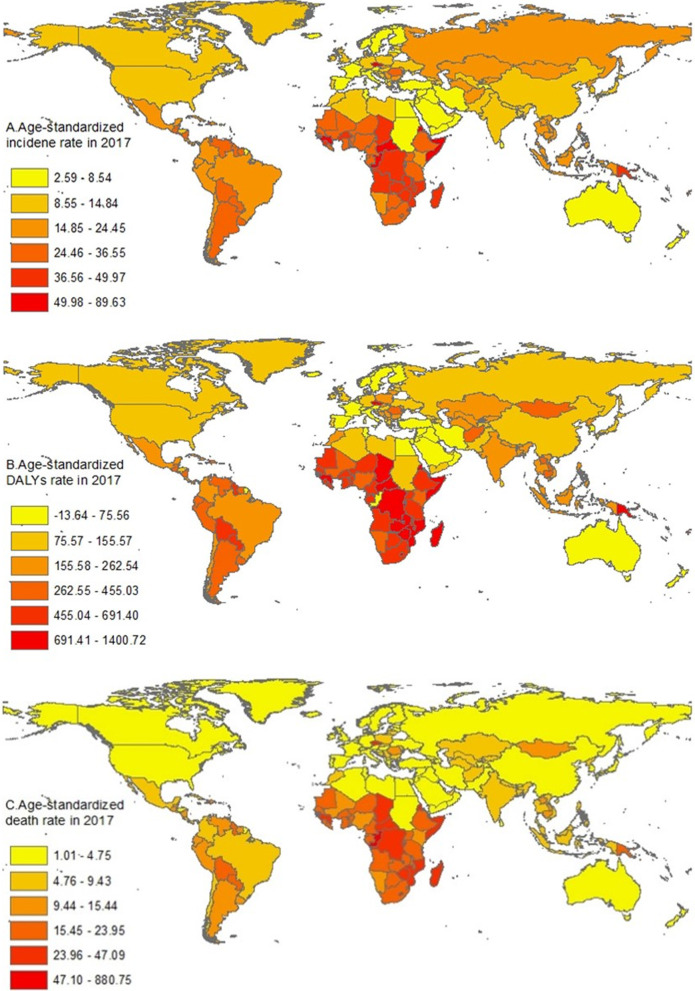
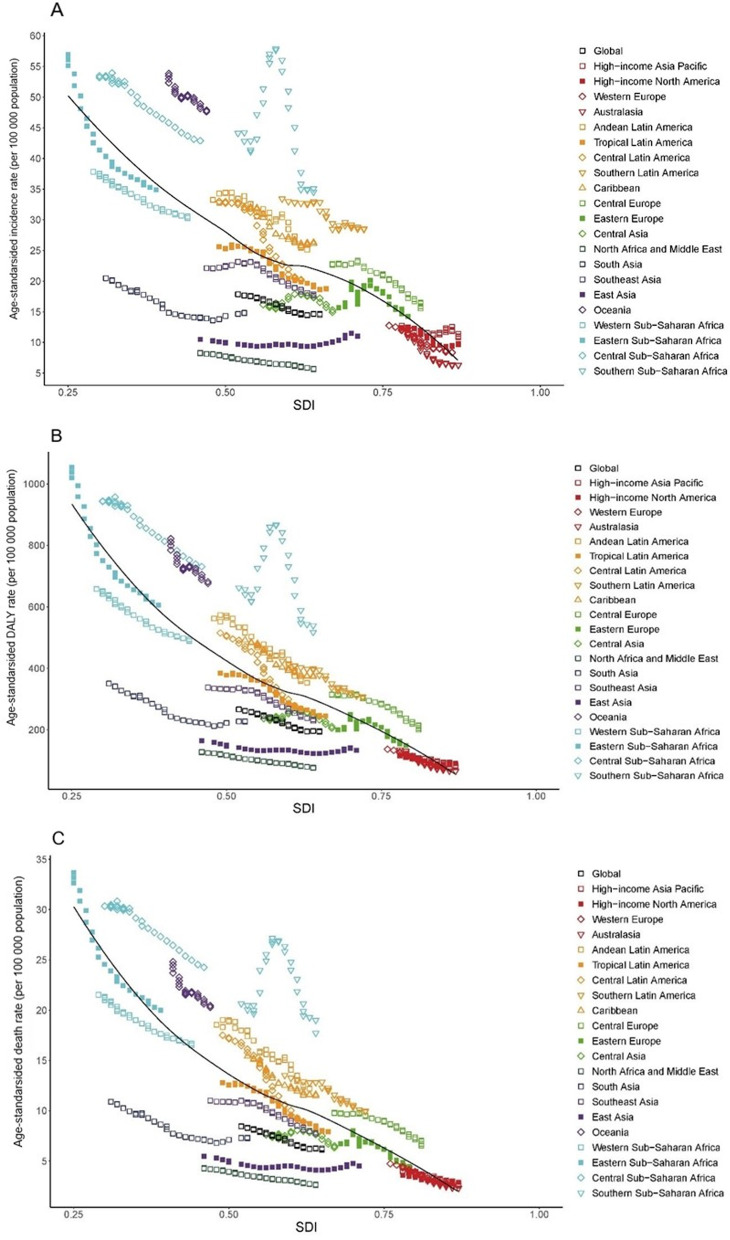
Results: In 2017, 601,186 (95% UI 554,455 to 625,402) incident cases of cervical cancer were reported worldwide, which caused 8,061,667 (7,527,014 to 8,401,647) DALYs and 259,671 (241,128 to 269,214) deaths. The age-standardized rates for incidence, DALYs and death decreased by - 2.8% (- 7.8% to 0.6%), - 7.1% [- 11.8% to - 3.9%] and - 6.9% [- 11.5% to - 3.7%] from 2007 to 2017, respectively. The highest age-standardized incidence, DALYs and death rates in 2017 were observed in the low SDI quintile, Oceania, Central and Eastern Sub-Saharan Africa. During 2007 to 2017, only East Asia showed increase in these rates despite not significant. At the national level, the highest age-standardized rates for incidence, DALYs, and death in 2017 were observed in Kiribati, Somalia, Eritrea, and Central African Republic; and Georgia showed the largest increases in all these rates during 2007 to 2017.
Conclusion: Although the age-standardized rates for incidence, DALYs, and death of cervical cancer have decreased in most parts of the world from 2007 to 2017, cervical cancer remains a major public health concern in view of the absolute number of cervical cancer cases, DALYs, and deaths increased during this period. The challenge is more prone to in the low SDI quintile, Oceania, Central and Eastern Sub-Saharan Africa, East Asia, and some countries, suggesting an urgent to promote human papillomavirus vaccination in these regions.
Keywords: Cervical cancer; Death; Disability-adjusted life-years; Global Burden of Disease; Human papillomavirus; Incidence.
© 2021. The Author(s).
Conflict of interest statement
The authors declare that they have no competing interests.
Figures
References
-
- Bray F, Ferlay J, Soerjomataram I, Siegel RL, Torre LA, Jemal A. Global cancer statistics 2018: GLOBOCAN estimates of incidence and mortality worldwide for 36 cancers in 185 countries. CA Cancer J Clin. 2018;68(6):394–424. - PubMed
-
- WHO . Draft: global strategy towards eliminating cervical cancer as a public health problem. WHO; 2020.
-
- Zur HH. Papillomavirus infections—a major cause of human cancers. Biochim Biophys Acta. 1996;1288(2):F55–F78. - PubMed
-
- Muñoz N, Bosch FX, Castellsagué X, Díaz M, de Sanjose S, Hammouda D, Shah KV, Meijer CJLM. Against which human papillomavirus types shall we vaccinate and screen? The international perspective. Int J Cancer. 2004;111(2):278–285. - PubMed
Publication types
MeSH terms
Substances
LinkOut - more resources
Full Text Sources
Medical
