


Anal cancer incidence in men with HIV who have sex with men: are black men at higher risk?
- PMID: 34923519
- PMCID: PMC10115425
- DOI: 10.1097/QAD.0000000000003151
Anal cancer incidence in men with HIV who have sex with men: are black men at higher risk?
Abstract
Objective: To assess differences in anal cancer incidence between racial/ethnic groups among a clinical cohort of men with HIV who have sex with men.
Design: Clinical cohort study.
Methods: We studied men who have sex with men (MSM) in the Centers for AIDS Research Network of Integrated Clinical Systems (CNICS) who initiated antiretroviral therapy (ART) under HIV care in CNICS. We compared anal cancer incidence between Black and non-Black men and calculated hazard ratios controlling for demographic characteristics (age, CNICS site, year of ART initiation), HIV disease indicators (nadir CD4+, peak HIV RNA), and co-infection/behavioral factors including hepatitis B virus (HBV), hepatitis C virus (HCV), tobacco smoking and alcohol abuse.
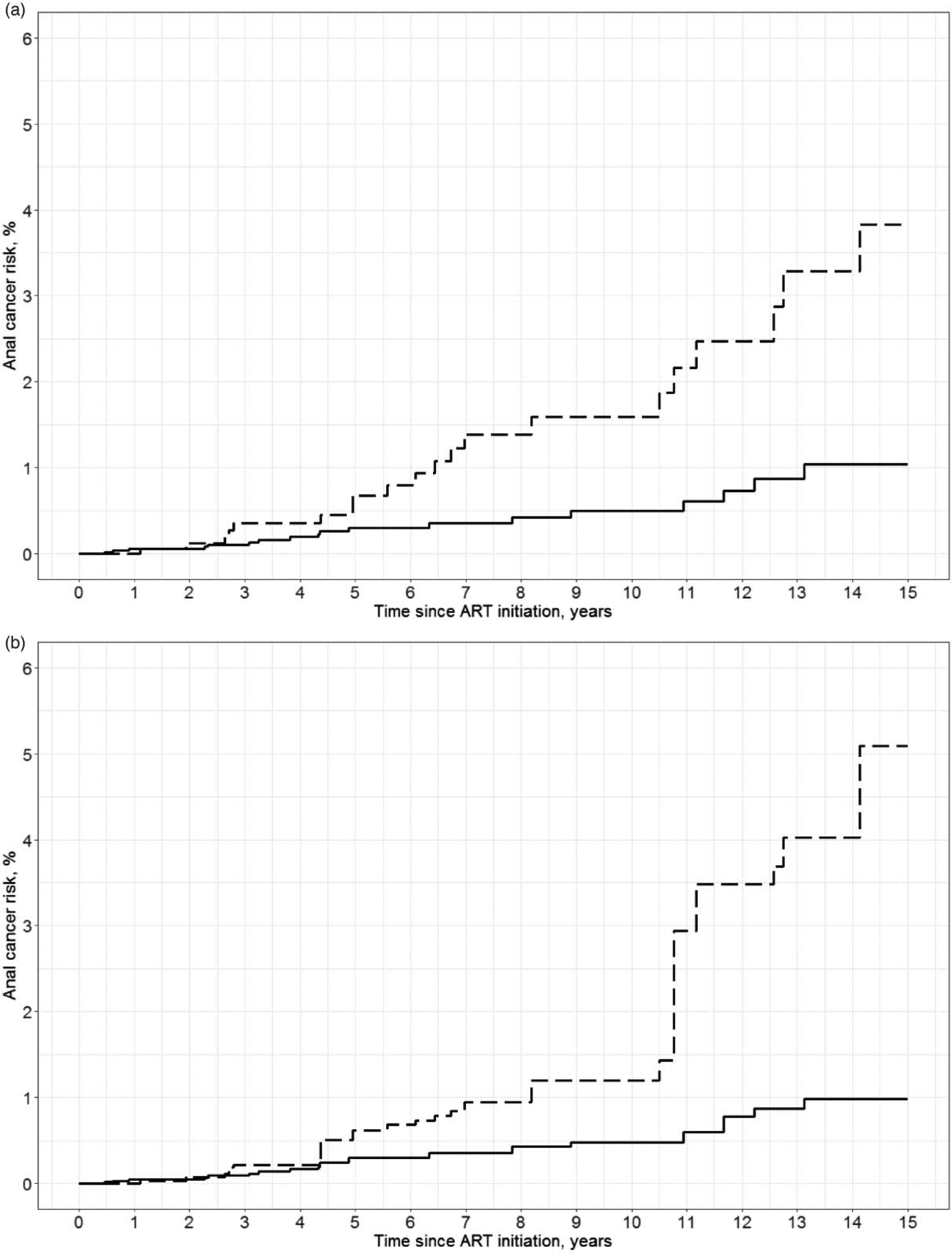
Results: We studied 7473 MSM with HIV who contributed 41 810 person-years of follow-up after initiating ART between 1996 and 2014 in CNICS. Forty-one individuals had an incident diagnosis of anal cancer under observation. Crude rates of anal cancer were 204 versus 61 per 100 000 person-years among Black versus non-Black MSM. The weighted hazard ratio for anal cancer in Black MSM (adjusting for demographics, HIV disease factors, and co-infection/behavioral factors) was 2.37 (95% confidence interval: 1.17, 4.82) compared to non-Black MSM.
Conclusions: In this large multicenter cohort, Black MSM were at significantly increased risk for anal cancer compared to non-Black MSM. Further detailed studies evaluating factors impacting anal cancer incidence and outcomes in Black men with HIV are necessary. Inclusion of more diverse study cohorts may elucidate modifiable factors associated with increased anal cancer risk experienced by Black MSM.
Copyright © 2021 Wolters Kluwer Health, Inc. All rights reserved.
Conflict of interest statement
Conflicts of interest
There are no conflicts of interest.
Figures

References
-
- National Cancer Institute. SEER Cancer Statistics Review, 1975–2017. Howlader N, Noone AM, Krapcho M, Miller D, Brest A, Yu M, et al. (eds.). Bethesda, MD. Available at: https://seer.cancer.gov/csr/1975_2017/, based on November 2019. SEER data.
-
- Bertisch B, Franceschi S, Lise M, Vernazza P, Keiser O, Schöni-Affolter F, et al. Risk factors for anal cancer in persons infected with HIV: a nested case–control study in the Swiss HIV Cohort Study. Am J Epidemiol 2013; 178:877–884. - PubMed
Publication types
MeSH terms
Grants and funding
- P30 AI027767/AI/NIAID NIH HHS/United States
- P30 AI094189/AI/NIAID NIH HHS/United States
- U01 DA036935/DA/NIDA NIH HHS/United States
- R24 AI067039/AI/NIAID NIH HHS/United States
- UM1 AI068636/AI/NIAID NIH HHS/United States
- P30 AI060354/AI/NIAID NIH HHS/United States
- P30 AI036219/AI/NIAID NIH HHS/United States
- P30 AI050410/AI/NIAID NIH HHS/United States
- P30 AI027763/AI/NIAID NIH HHS/United States
- U01 AI069918/AI/NIAID NIH HHS/United States
- P30 AI036214/AI/NIAID NIH HHS/United States
- P30 AI027757/AI/NIAID NIH HHS/United States
