Review
. 2022 May;307(1):145-160.
doi: 10.1111/imr.13058. Epub 2021 Dec 18.

ZAP70, too little, too much can lead to autoimmunity

Affiliations
Review

ZAP70, too little, too much can lead to autoimmunity

Judith F Ashouri et al. Immunol Rev. 2022 May.

Abstract

Establishing both central and peripheral tolerance requires the appropriate TCR signaling strength to discriminate self- from agonist-peptide bound to self MHC molecules. ZAP70, a cytoplasmic tyrosine kinase, directly interacts with the TCR complex and plays a central and requisite role in TCR signaling in both thymocytes and peripheral T cells. By studying ZAP70 hypomorphic mutations in mice and humans with a spectrum of hypoactive or hyperactive activities, we have gained insights into mechanisms of central and peripheral tolerance. Interestingly, both hypoactive and hyperactive ZAP70 can lead to the development of autoimmune diseases, albeit through distinct mechanisms. Immature thymocytes and mature T cells rely on normal ZAP70 function to complete their development in the thymus and to modulate T cell responses in the periphery. Hypoactive ZAP70 function compromises key developmental checkpoints required to establish central tolerance, allowing thymocytes with potentially self-reactive TCRs a greater chance to escape negative selection. Such 'forbidden clones' may escape into the periphery and may pose a greater risk for autoimmune disease development since they may not engage negative regulatory mechanisms as effectively. Hyperactive ZAP70 enhances thymic negative selection but some thymocytes will, nonetheless, escape negative selection and have greater sensitivity to weak and self-ligands. Such cells must be controlled by mechanisms involved in anergy, expansion of Tregs, and upregulation of inhibitory receptors or signaling molecules. However, such potentially autoreactive cells may still be able to escape control by peripheral negative regulatory constraints. Consistent with findings in Zap70 mutants, the signaling defects in at least one ZAP70 substrate, LAT, can also lead to autoimmune disease. By dissecting the similarities and differences among mouse models of patient disease or mutations in ZAP70 that affect TCR signaling strength, we have gained insights into how perturbed ZAP70 function can lead to autoimmunity. Because of our work and that of others on ZAP70, it is likely that perturbations in other molecules affecting TCR signaling strength will be identified that also overcome tolerance mechanisms and cause autoimmunity. Delineating these molecular pathways could lead to the development of much needed new therapeutic targets in these complex diseases.

Keywords: LAT; TCR signaling; ZAP70; autoimmunity; tolerance and anergy.


Conflict of interest statement

All authors declare they have no conflicts of interest to disclose.

Figures
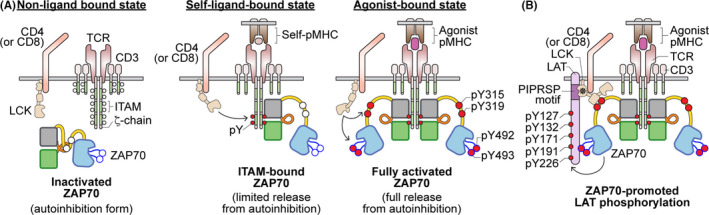
FIGURE 1
FIGURE 1
Illustration of ZAP70 activities during TCR recognition of self‐pMHC or agonist‐pMHC. (A) In the resting state, when the TCR does not interact with any pMHC, ITAMs are not phosphorylated and ZAP70 remains in an autoinhibited state in the cytoplasm. When the TCR recognizes a self‐pMHC, the interaction with self‐pMHC delivers a sufficient tonic signal to lead to ITAM phosphorylation by the kinase LCK. This then results in the recruitment of ZAP70 to the phosphorylated ITAM motifs but ZAP70 does not become phosphorylated. The degree of self‐reactivity is associated with the amount of ζ‐chain phosphorylation. Upon recognition of agonist pMHC, coreceptor‐associated LCK is brought into the vicinity of engaged TCR and CD3 complexes long enough to phosphorylate ITAMs and recruit as well as phosphorylate ZAP70 that is bound to phosphorylated‐ITAMs. Phosphorylation of ZAP70 by LCK on Y315, Y319 and Y493 leads to its activation. (B) Activated ZAP70 subsequently phosphorylates LAT on five key tyrosine residues. Notably, the SH3 domain of LCK (marked with *) interacts with the PIPRSP motif of LAT to actively recruit LAT to the activated ZAP70. This active recruitment of LAT by LCK enhances ZAP70‐mediated LAT phosphorylation and augments T cell sensitivity towards weak ligand stimuli. Furthermore, phosphorylated LAT and another ZAP70 substrate, SLP76, can function as scaffold proteins to recruit other downstream signaling proteins and events, which can eventually lead to T cell activation
FIGURE 2
FIGURE 2
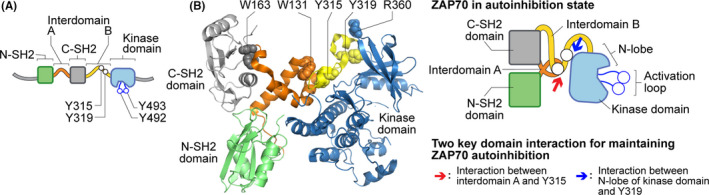
Illustration of ZAP70 structure and signaling domains. (A) Cartoon of ZAP70 structural domains, including the N‐terminal and C‐terminal SH2 domains, interdomain A and B, and a kinase domain. Some of the tyrosine residues that are phosphorylated by LCK are also shown (red open circles). (B) A crystal structural model (left) or a schematic (right) of autoinhibited ZAP70. The key amino acid residues (illustrated by spheres) at which the mutations in ZAP70 described in this review are also labeled (W131, W163, Y315, Y319 and R360). The red and blue arrows indicate the key interaction among different structural domains of ZAP70 to maintain ZAP70 in the autoinhibitory state
FIGURE 3
FIGURE 3
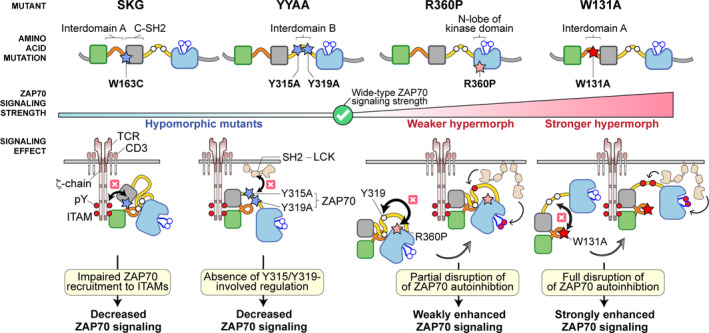
Allelic ZAP70 mutations directly impact T cell signaling strength. Hypomorphic and hypermorphic ZAP70 mutants and the resulting signaling defects are summarized. The stars represent the location of individual amino acid mutations: the blue stars represent hypomorphic mutants, the pink star represents weaker hypermorphic mutant and the red star represents the stronger hypermorphic mutant. All the signaling effects resulting from individual mutations are illustrated (black arrows and cross symbols). Red‐filled circles represent phosphorylated tyrosine residues
FIGURE 4
FIGURE 4
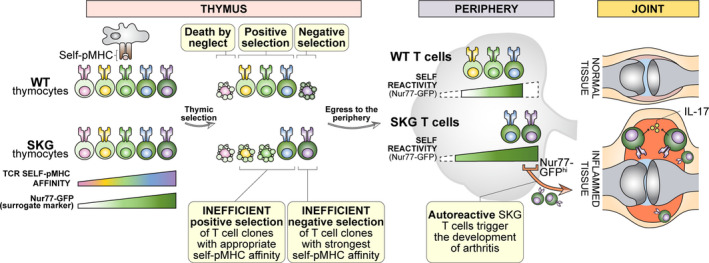
Properties of SKGNur77 GFPhi T cells. Impaired TCR signaling in SKG mice and an altered T cell repertoire along with chronic endogenous antigen encounter confer increased arthritogenicity of selfreactive T cell clones in SKG mice. The most self‐reactive clones (depicted in purple) that have escaped negative selection are marked by the highest levels of Nur77‐eGFP expression (GFPhi). These cells respond more robustly to self‐antigen, are hypersensitive to cytokines like IL‐6, and differentiate more readily into IL‐17 producing T cells. As a consequence, they cause more severe joint tissue damage during early stages of arthritis (Ashouri et al, 2019)
FIGURE 5
FIGURE 5
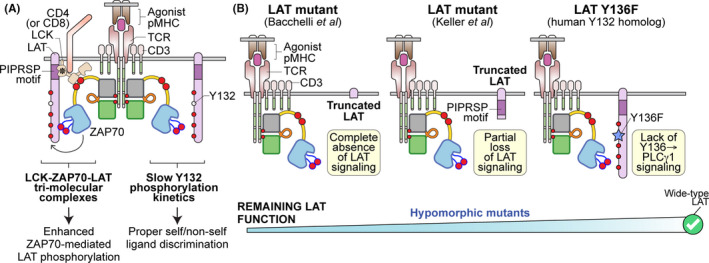
Mutation of LAT. (A) Upon recognition of an agonist MHC, LAT is phosphorylated by active ZAP70 on LAT's five key tyrosine residues. The phosphorylation kinetics of LAT plays an essential role in determining TCR sensitivity and ligand discrimination. First, LCK may bridge active ZAP70 with LAT to facilitate ZAP70‐mediated LAT phosphorylation. This tri‐molecular complex (LCK‐ZAP70‐LAT) enhances T cell sensitivity toward weak ligand. Secondly, the slow phosphorylation of LAT Y132 (human) or Y136 (mouse) is a key signaling bottleneck to ensure that only a bona‐fide activating signal can trigger T cell activation. (B) Hypomorphic LAT mutants and the resulting signaling effects are illustrated

References

    1. Cho JH, Sprent J. TCR tuning of T cell subsets. Immunol Rev. 2018;283(1):129‐137. - PubMed
    1. Myers DR, Zikherman J, Roose JP. Tonic signals: why do lymphocytes bother? Trends Immunol. 2017;38(11):844‐857. - PMC - PubMed
    1. Zinzow‐Kramer WM, Weiss A, Au‐Yeung BB. Adaptation by naïve CD4(+) T cells to self‐antigen‐dependent TCR signaling induces functional heterogeneity and tolerance. Proc Natl Acad Sci USA. 2019;116(30):15160‐15169. - PMC - PubMed
    1. Morris GP, Allen PM. How the TCR balances sensitivity and specificity for the recognition of self and pathogens. Nat Immunol. 2012;13(2):121‐128. - PubMed
    1. Huang J, Brameshuber M, Zeng X, et al. A single peptide‐major histocompatibility complex ligand triggers digital cytokine secretion in CD4(+) T cells. Immunity. 2013;39(5):846‐857. - PMC - PubMed

Publication types

Substances