


Therapeutic Options for Coronavirus Disease 2019 (COVID-19): Where Are We Now?
- PMID: 34924819
- PMCID: PMC8665318
- DOI: 10.1007/s11908-021-00769-8
Therapeutic Options for Coronavirus Disease 2019 (COVID-19): Where Are We Now?
Abstract
Purpose of review: Rapidly evolving treatment paradigms of coronavirus disease 2019 (COVID-19) introduce challenges for clinicians to keep up with the pace of published literature and to critically appraise the voluminous data produced. This review summarizes the clinical evidence from key studies examining the place of therapy of recommended drugs and management strategies for COVID-19.
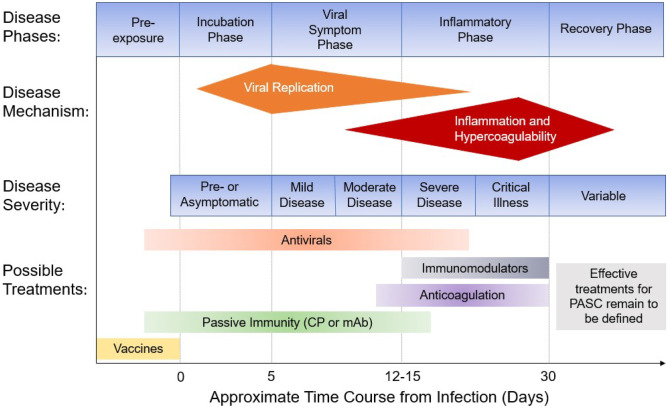
Recent findings: The global magnitude and duration of the pandemic have resulted in a flurry of interventional treatment trials evaluating both novel and repurposed drugs targeting various aspects of the viral life cycle. Additionally, clinical observations have documented various stages or phases of COVID-19 and underscored the importance of timing for the efficacy of studied therapies. Since the start of the COVID-19 pandemic, many observational, retrospective, and randomized controlled studies have been conducted to guide management of COVID-19 using drug therapies and other management strategies. Large, randomized, or adaptive platform trials have proven the most informative to guide recommended treatments to-date. Antimicrobial stewardship programs can play a pivotal role in ensuring appropriate use of COVID-19 therapies based on evolving clinical data and limiting unnecessary antibiotics given low rates of co-infection.
Summary: Given the rapidly evolving medical literature and treatment paradigms, it is recommended to reference continuously updated, curated guidelines from national and international sources. While the drugs and management strategies mentioned in this review represent the current state of recommendations, many therapies are still under investigation to further define optimal COVID-19 treatment.
Supplementary information: The online version contains supplementary material available at 10.1007/s11908-021-00769-8.
Keywords: Anticoagulation; Antimicrobial stewardship; Antivirals; COVID-19; Immunomodulators; SARS-CoV-2.
© The Author(s), under exclusive licence to Springer Science+Business Media, LLC, part of Springer Nature 2021.
Conflict of interest statement
Esther Golnabi, James Sanders, Meagan Johns, Kevin Lin, Jessica Ortwine, Wenjing Wei, and Norman Mang declare that they have no conflict of interest. James Cutrell reports non-financial support from the NIH, Gilead, and Regeneron from COVID-19 treatment trials outside of this work.
Figures
References
-
- The Johns Hopkins University. COVID-19 dashboard by the Center for Systems Science and Engineering (CSSE) at Johns Hopkins University (JHU). https://coronavirus.jhu.edu/map.html. Accessed 7 October 2021.
-
- • COVID-19 Treatment Guidelines Panel. Coronavirus Disease 2019 (COVID-19) Treatment Guidelines. National Institutes of Health. 2021. https://www.covid19treatmentguidelines.nih.gov/. Accessed 20 September 2021. The guidelines for the management of coronavirus disease 2019 developed by the US National Institutes of Health (NIH) that continue to be updated with newly emerging clinical data.
-
- • World Health Organization. Novel Coronavirus (2019-nCoV) technical guidance. https://www.who.int/emergencies/diseases/novel-coronavirus-2019/technica.... Accessed 15 June 2021. The international guidelines for the management of coronavirus disease 2019 developed by the World Health Organization (WHO).
Publication types
LinkOut - more resources
Full Text Sources
Research Materials
Miscellaneous
