. 2021 Nov 12;4(6):1818-1834.
doi: 10.1021/acsptsci.1c00223. eCollection 2021 Dec 10.

Comprehensive in Vitro Characterization of the LSD1 Small Molecule Inhibitor Class in Oncology

Affiliations

Comprehensive in Vitro Characterization of the LSD1 Small Molecule Inhibitor Class in Oncology

Natalia Sacilotto et al. ACS Pharmacol Transl Sci. .

Abstract

Lysine-specific demethylase 1 (LSD1 or KDM1A) is a chromatin modifying enzyme playing a key role in the cell cycle and cell differentiation and proliferation through the demethylation of histones and nonhistone substrates. In addition to its enzymatic activity, LSD1 plays a fundamental scaffolding role as part of transcription silencing complexes such as rest co-repressor (CoREST) and nucleosome remodeling and deacetylase (NuRD). A host of classical amine oxidase inhibitors such as tranylcypromine, pargyline, and phenelzine together with LSD1 tool compounds such as SP-2509 and GSK-LSD1 have been extensively utilized in LSD1 mechanistic cancer studies. Additionally, several optimized new chemical entities have reached clinical trials in oncology such as ORY-1001 (iadademstat), GSK2879552, SP-2577 (seclidemstat), IMG-7289 (bomedemstat), INCB059872, and CC-90011 (pulrodemstat). Despite this, no single study exists that characterizes them all under the same experimental conditions, preventing a clear interpretation of published results. Herein, we characterize the whole LSD1 small molecule compound class as inhibitors of LSD1 catalytic activity, disruptors of SNAIL/GFI1 (SNAG)-scaffolding protein-protein interactions, inducers of cell differentiation, and potential anticancer treatments for hematological and solid tumors to yield an updated, unified perspective of this field. Our results highlight significant differences in potency and selectivity among the clinical compounds with iadademstat being the most potent and reveal that most of the tool compounds have very low activity and selectivity, suggesting some conclusions derived from their use should be taken with caution.


Conflict of interest statement

The authors declare no competing financial interest.

Figures
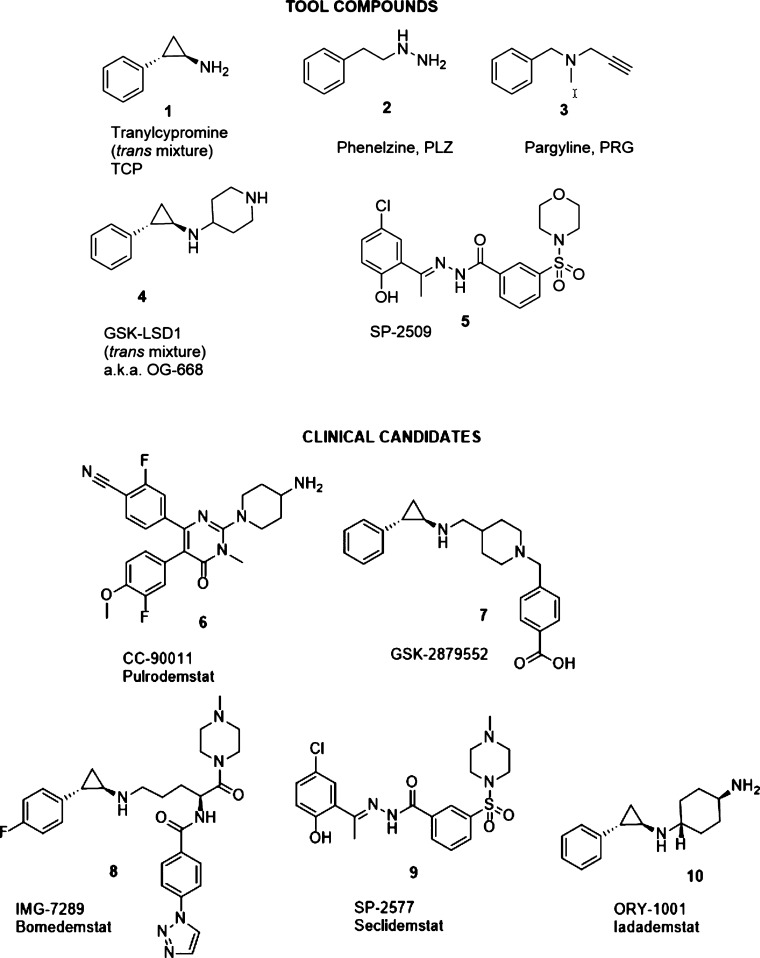
Figure 1
Figure 1
2D structures of representative LSD1 ligands with tool compounds 15 and clinical stage inhibitors 610.
Figure 2
Figure 2
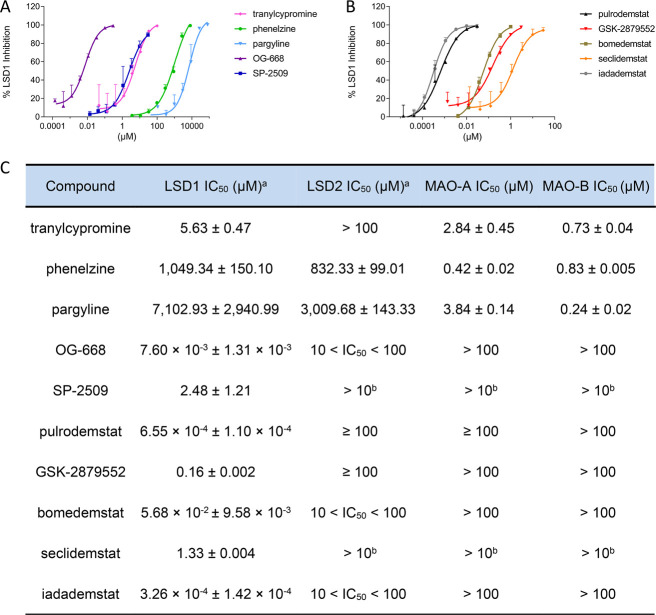
Biochemical characterization of LSD1 inhibitors. Dose–response curves of LSD1 inhibition for tool compounds (A) and clinical stage inhibitors (B) determined with the HTRF assay. Selectivity of compounds vs other FAD-dependent enzymes (C). aValues obtained with the HTRF assay. bCompound not soluble at 100 μM. Data are represented as mean ± SD of N = 2, n = 2 or 3.
Figure 3
Figure 3
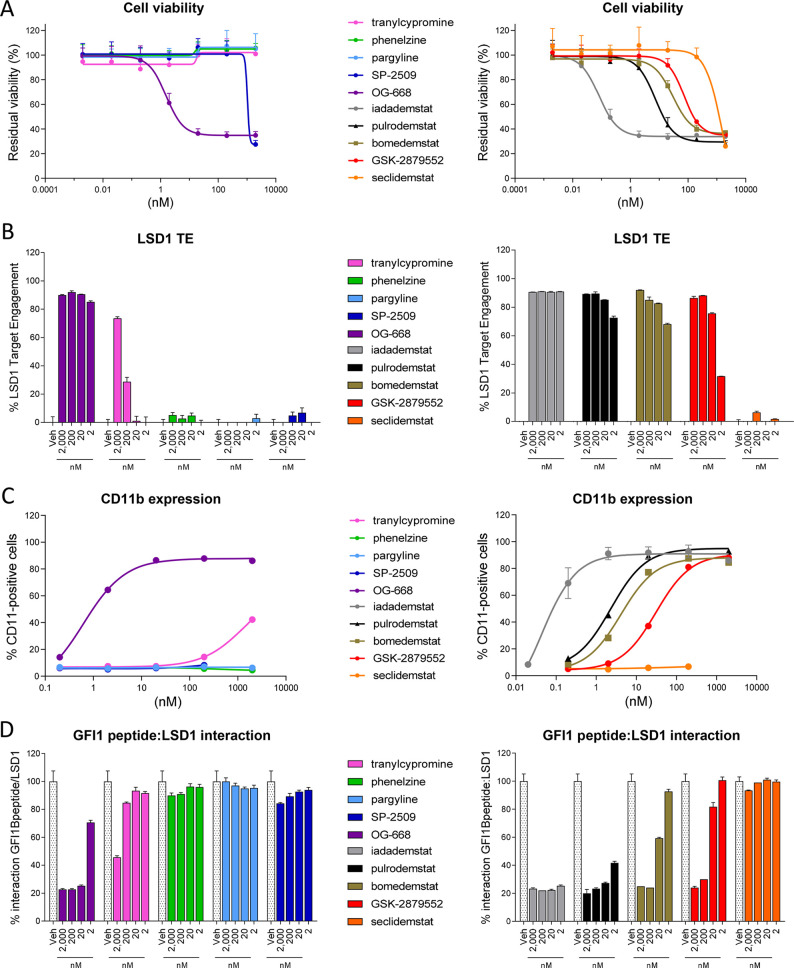
Efficacy in AML. (A) Effect of tool (left) and clinical stage (right) LSD1 inhibitors on cell viability in the AML cell line TF-1a following 96 h of incubation at concentrations ranging from 0.002 to 2000 nM (N = 2, n = 3). (B) Assessment of LSD1 target engagement in the AML cell line MV(4;11) treated with tool (left) and clinical stage (right) LSD1 inhibitors following 24 h of incubation at 2000, 200, 20, and 2 nM (N = 1, n = 3). (C) CD11b protein levels were assessed by flow cytometry in THP-1 cells following 96 h of incubation with tool (left) and clinical stage (right) LSD1 inhibitors at concentrations ranging from 0.02 to 2000 nM (N = 2 for iadademstat, N = 1 for the rest). (D) The effect of tool (left) and clinical stage (right) compounds on SNAG-domain/LSD1 interaction was assessed using a modified ELISA assay testing the binding of recombinant LSD1 previously incubated with LSD1 inhibitors to a peptide containing the GFI1B SNAG domain (N = 1, n = 3). All data are expressed as relative to the vehicle condition and represented as mean ± SD.
Figure 4
Figure 4
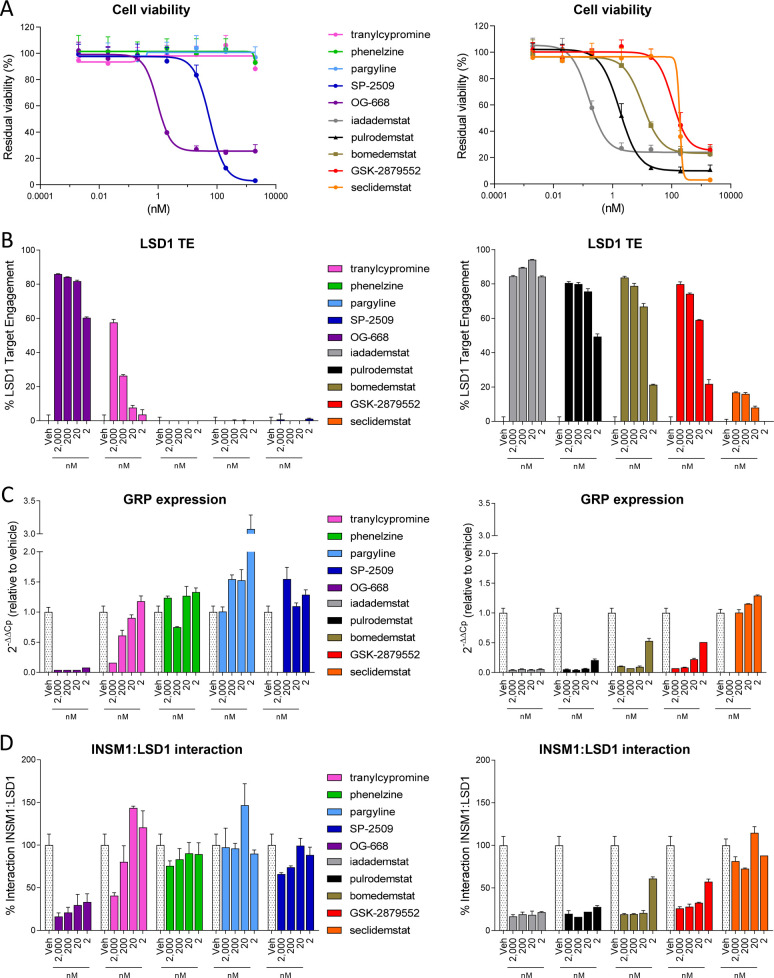
Efficacy in SCLC. (A) Effect of tool (left) and clinical stage (right) LSD1 inhibitors on cell viability in the SCLC cell line NCI-H510A following 10 days of incubation at concentrations ranging from 0.002 to 2000 nM (N = 2, n = 3). (B) Assessment of LSD1 target engagement in the NCI-H510A cells treated with tool (left) and clinical stage (right) LSD1 inhibitors following 24 h of incubation at 2000, 200, 20, and 2 nM (N = 1, n = 3). (C) GRP gene expression levels were assessed by qRT-PCR in NCI-H510A cells following 6 days of incubation with tool (left) and clinical stage (right) LSD1 inhibitors at 2000, 200, 20, and 2 nM (N = 1, n = 3). Data were calculated using the 2–ΔΔCt method, normalized by GUSB. (D) The effect of tool (left) and clinical stage (right) compounds on the SNAG-domain/LSD1 interaction was assessed using an INSM1/LSD1 interaction ELISA assay performed on nondenaturing cell lysates of NCI-H510A cells following 24 h of incubation with compounds at 2000, 200, 20, and 2 nM (N = 1, n = 3). All data are expressed as relative to the vehicle condition and represented as mean ± SD.
Figure 5
Figure 5
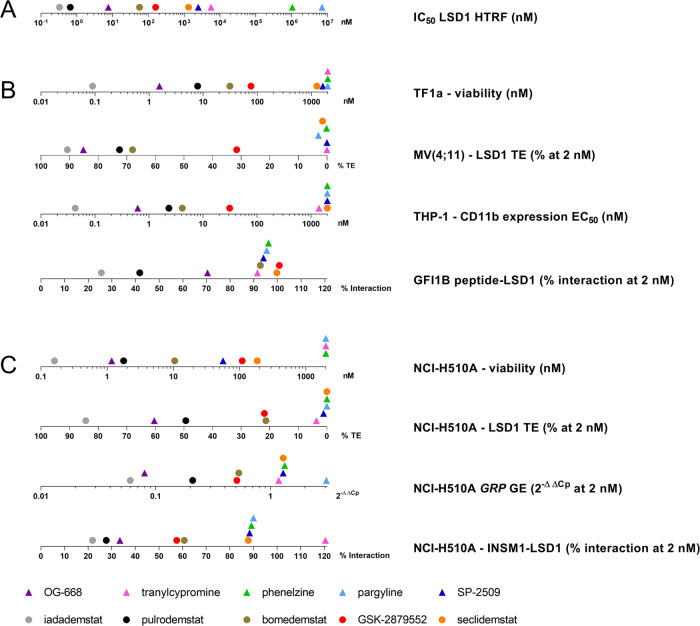
Summary of compound performance. (A) LSD1 IC50 values obtained with the HTRF assay. (B) Efficacy in AML cell lines. (C) Efficacy in the SCLC cell line. The graphs were generated with GraphPad Prism 9 using data discussed previously. Clinical stage compounds are represented as circles; tool compounds are represented as triangles.

References

    1. Ganesan A.; Arimondo P. B.; Rots M. G.; Jeronimo C.; Berdasco M. The Timeline of Epigenetic Drug Discovery: From Reality to Dreams. Clin. Epigenet. 2019, 11 (1), 174.10.1186/s13148-019-0776-0. - DOI - PMC - PubMed
    1. Bates S. E. Epigenetic Therapies for Cancer. N. Engl. J. Med. 2020, 383 (7), 650–663. 10.1056/NEJMra1805035. - DOI - PubMed
    1. Verma M.; Kumar V.. Epigenetic Drugs for Cancer and Precision Medicine. In Epigenetics of Aging and Longevity; Elsevier, 2018; pp 439–451;10.1016/B978-0-12-811060-7.00021-8. - DOI
    1. Lundstrom K. Epigenetics: Rethinking of Drug Research and Development. Future Med. Chem. 2019, 10.4155/fmc-2019-0174. - DOI - PMC - PubMed
    1. Shi Y.-J.; Matson C.; Lan F.; Iwase S.; Baba T.; Shi Y. Regulation of LSD1 Histone Demethylase Activity by Its Associated Factors. Mol. Cell 2005, 19 (6), 857–864. 10.1016/j.molcel.2005.08.027. - DOI - PubMed