. 2021 Dec;7(12):000719.
doi: 10.1099/mgen.0.000719.

Genome-wide analysis of fitness-factors in uropathogenic Escherichia coli during growth in laboratory media and during urinary tract infections

Affiliations

Genome-wide analysis of fitness-factors in uropathogenic Escherichia coli during growth in laboratory media and during urinary tract infections

Vanesa García et al. Microb Genom. 2021 Dec.

Abstract

Uropathogenic Escherichia coli (UPEC) UTI89 is a well-characterized strain, which has mainly been used to study UPEC virulence during urinary tract infection (UTI). However, little is known on UTI89 key fitness-factors during growth in lab media and during UTI. Here, we used a transposon-insertion-sequencing approach (TraDIS) to reveal the UTI89 essential-genes for in vitro growth and fitness-gene-sets for growth in Luria broth (LB) and EZ-MOPS medium without glucose, as well as for human bacteriuria and mouse cystitis. A total of 293 essential genes for growth were identified and the set of fitness-genes was shown to differ depending on the growth media. A modified, previously validated UTI murine model, with administration of glucose prior to infection was applied. Selected fitness-genes for growth in urine and mouse-bladder colonization were validated using deletion-mutants. Novel fitness-genes, such as tusA, corA and rfaG; involved in sulphur-acquisition, magnesium-uptake, and LPS-biosynthesis, were proved to be important during UTI. Moreover, rfaG was confirmed as relevant in both niches, and therefore it may represent a target for novel UTI-treatment/prevention strategies.

Keywords: EZ-MOPS; LB; TraDIS; Uropathogenic E. coli; essentiality; fitness; human bacteriuria; mouse cystitis; urinary tract infection.


Conflict of interest statement

The authors declare that there are no conflicts of interest.

Figures
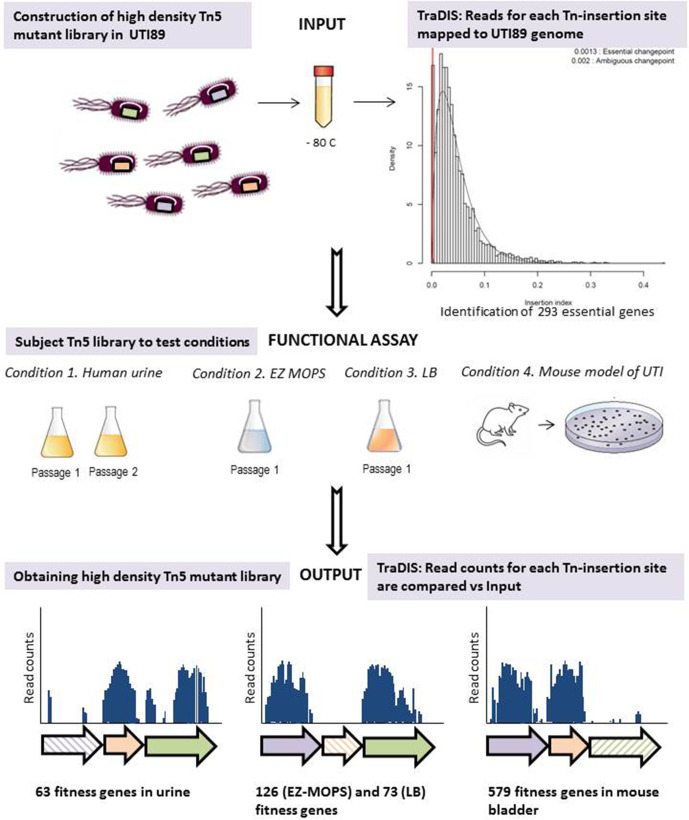
Fig. 1.
Fig. 1.
TraDIS as a research approach in UPEC to identify genes relevant for UTI and growth in laboratory media. Schematic representation of the UPEC UTI89 Tn5 mutant library and growth conditions tested in this work. The graph for identification of growth essential-genes has been obtained using the Bio::Tradis analysis pipeline (https://github.com/sanger-pathogens/bio-tradis).
Fig. 2.
Fig. 2.
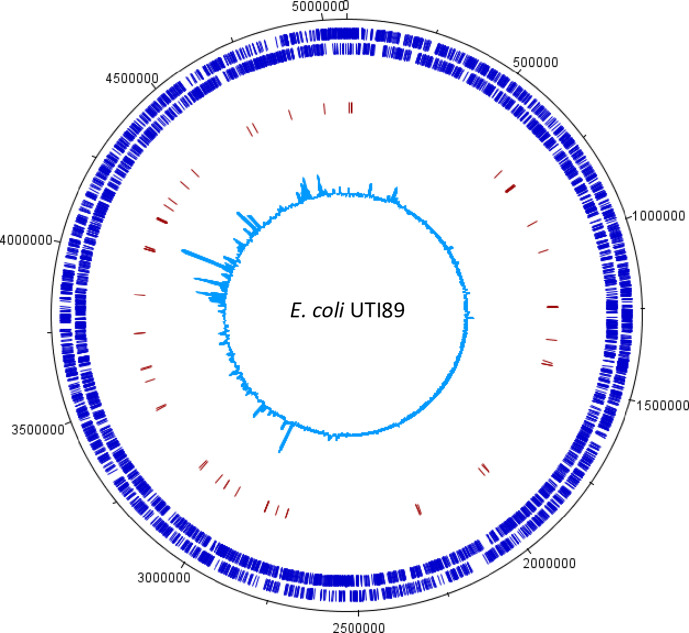
Genome-wide transposon insertion sites mapped to E. coli UTI89 strain. The outermost track in black marks the E. coli genome in base pairs starting at the annotation origin. The next inner track (dark blue) corresponds to sense and antisense CDS, respectively, followed by a red track depicting the fitness-genes predicted by TraDIS in UTI89 during growth in human urine. The innermost circle (light blue) corresponds to the frequency and location of transposon insertion sequences mapped successfully to the E. coli UTI89 genome after identification of a transposon sequence. This figure was created using DNAPlotter.
Fig. 3.
Fig. 3.
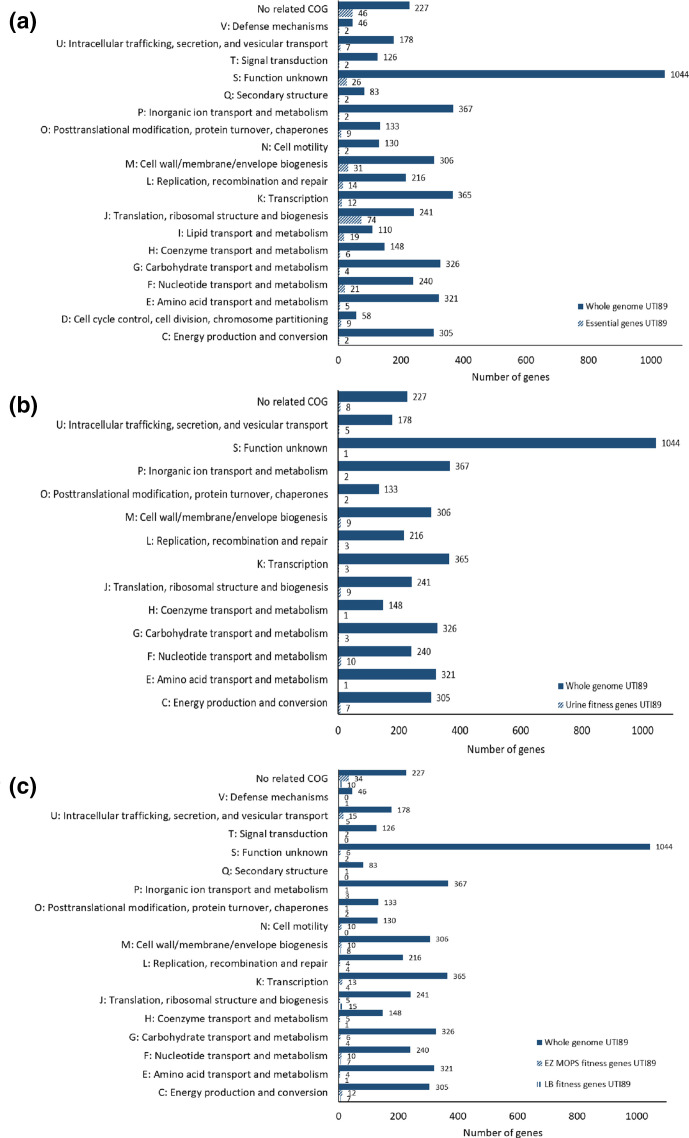
Functional classification of essential- and fitness-genes in UPEC UTI89. Essential-genes for growth in LB agar media supplemented with Kn (a) and fitness-genes for growth in human urine (b) predicted in E. coli UTI89 were functionally categorized using the EggNOG database (illustrated on the vertical axis). (c) shows the functional classification of fitness-genes predicted in E. coli UTI89 for growth in EZ-MOPS and LB media. The numbers indicate the essential/fitness-genes in each functional category compared with the total number of genes in the reference strain and belonging to the same category.
Fig. 4.
Fig. 4.
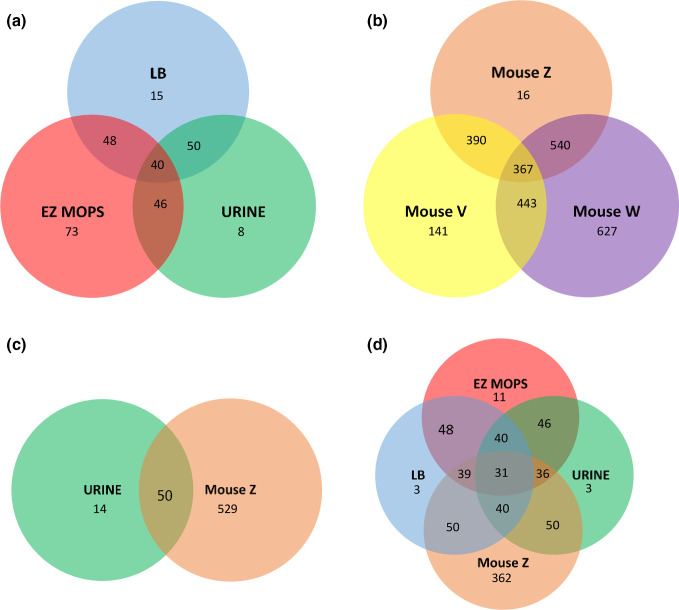
Venn diagrams showing the number of common and differential predicted fitness-genes in UPEC UTI89 between the tested conditions using TraDIS. (a) Fitness-genes during growth in LB, EZ-MOPS and human urine. (b) Fitness-genes during mice infection. (c) Fitness-genes during UTI caused by E. coli UTI89. (d) Fitness-genes during growth in LB, EZ-MOPS, human urine and mice infection. Mouse V: list of fitness-genes for single mouse V, mouse W: list of fitness-genes for single mouse W, mouse Z: list of fitness-genes for sample Z representing all 11 mice under study (see Table S6 for more details).
Fig. 5.
Fig. 5.
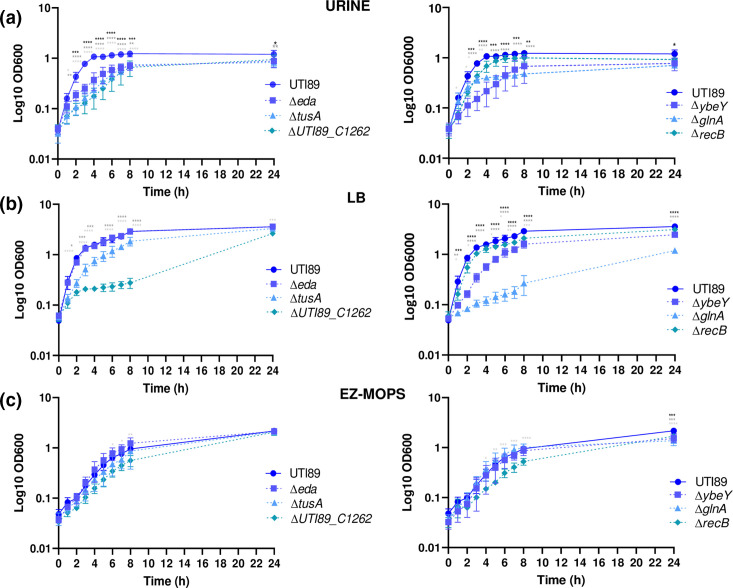
Growth curves obtained for E. coli UTI89 and its mutant derivatives in urine (a), LB (b) and EZ-MOPS (c). The data shown are means±standard deviations of three biological replicates. Statistical significance (****P < 0.0001; ***P < 0.001; **P < 0.01; *P < 0.05) was determined by one-sample t-test or ANOVA and Sidak’s post-test. Black, dark and light grey asterisks show significant differences between E. coli UTI89 and the mutants (∆eda or ∆ybeY, ∆tusA or ∆glnA and ∆UTI89_C1262 or ∆recB), respectively. Only results for validated genes in urine are shown.
Fig. 6.
Fig. 6.
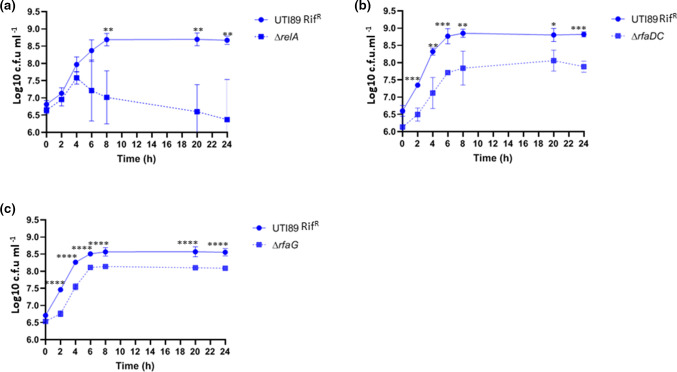
Competition assays of the E. coli UTI89 rifampicin resistant strain (UTI89 RifR) and the mutants ΔrelA (a), ΔrfaDC (b) and ΔrfaG (c) in human urine. The data shown are means±standard deviations of at least three biological replicates. Statistical significance (****P< 0.0001; ***P< 0.001; **P< 0.01; *P < 0.05) was determined by one-sample t-test at each time point tested. Only results for validated genes are shown.

References

    1. Vejborg RM, de Evgrafov MR, Phan MD, Totsika M, Schembri MA, et al. Identification of genes important for growth of asymptomatic bacteriuria Escherichia coli in urine. Infect Immun. 2012;80:3179–3188. doi: 10.1128/IAI.00473-12. - DOI - PMC - PubMed
    1. Tandogdu Z, Cai T, Koves B, Wagenlehner F, Bjerklund-Johansen TE. Urinary Tract Infections in Immunocompromised Patients with Diabetes. Chronic Kidney Disease, and Kidney Transplant Eur Urol Focus. 2016;2:394–399. doi: 10.1016/j.euf.2016.08.006. - DOI - PubMed
    1. Mann R, Mediati DG, Duggin IG, Harry EJ, Bottomley AL. Metabolic adaptations of uropathogenic e. coli in the urinary tract. Front Cell Infect Microbiol. 2017;7:241. doi: 10.3389/fcimb.2017.00241. - DOI - PMC - PubMed
    1. Mazzariol A, Bazaj A, Cornaglia G. Multi-drug-resistant Gram-negative bacteria causing urinary tract infections: a review. J Chemother. 2017;29:2–9. doi: 10.1080/1120009X.2017.1380395. - DOI - PubMed
    1. Lüthje P, Brauner A. Virulence factors of uropathogenic E. coli and their interaction with the host. Adv Microb Physiol. 2014;65:337–372. - PubMed

Publication types

MeSH terms

LinkOut - more resources