


Subclonal heterogeneity and evolution in breast cancer
- PMID: 34934048
- PMCID: PMC8692469
- DOI: 10.1038/s41523-021-00363-0
Subclonal heterogeneity and evolution in breast cancer
Abstract
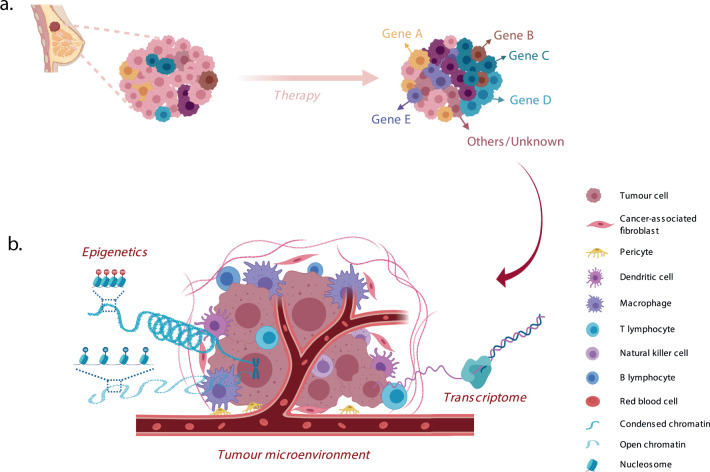
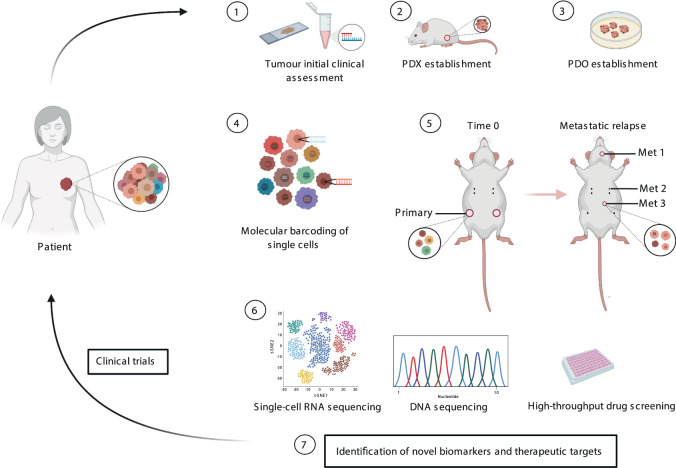
Subclonal heterogeneity and evolution are characteristics of breast cancer that play a fundamental role in tumour development, progression and resistance to current therapies. In this review, we focus on the recent advances in understanding the epigenetic and transcriptomic changes that occur within breast cancer and their importance in terms of cancer development, progression and therapy resistance with a particular focus on alterations at the single-cell level. Furthermore, we highlight the utility of using single-cell tracing and molecular barcoding methodologies in preclinical models to assess disease evolution and response to therapy. We discuss how the integration of single-cell profiling from patient samples can be used in conjunction with results from preclinical models to untangle the complexities of this disease and identify biomarkers of disease progression, including measures of intra-tumour heterogeneity themselves, and how enhancing this understanding has the potential to uncover new targetable vulnerabilities in breast cancer.
© 2021. The Author(s).
Conflict of interest statement
R.N. has grants and nonfinancial support from Pfizer and is an associate editor of The Journal of Pathology and Cancer Research Communications. The remaining authors declare no competing interests.
Figures
References
-
- Ellsworth RE, Blackburn HL, Shriver CD, Soon-Shiong P, Ellsworth DL. Molecular heterogeneity in breast cancer: State of the science and implications for patient care. Semin Cell Dev. Biol. 2017;64:65–72. - PubMed
-
- Koren S, Bentires-Alj M. Breast tumor heterogeneity: source of fitness, hurdle for therapy. Mol. Cell. 2015;60:537–546. - PubMed
-
- Harbeck N, et al. Breast cancer. Nat. Rev. Dis. Prim. 2019;5:66. - PubMed
-
- Perou CM, et al. Molecular portraits of human breast tumours. Nature. 2000;406:747–752. - PubMed
Publication types
Grants and funding
- Programme Funding to the Breast Cancer Now Toby Robins Research Centre to R.N/Breast Cancer Now (BCN)
- 1K22CA241113-01/Foundation for the National Institutes of Health (Foundation for the National Institutes of Health, Inc.)
- K22 CA241113/CA/NCI NIH HHS/United States
- Programmatic funding to RN/Breast Cancer Now (BCN)
- RR200009/Cancer Prevention and Research Institute of Texas (Cancer Prevention Research Institute of Texas)
LinkOut - more resources
Full Text Sources
