


Improving Equity of Care for Patients with Limited English Proficiency Using Quality Improvement Methodology
- PMID: 34934875
- PMCID: PMC8677944
- DOI: 10.1097/pq9.0000000000000486
Improving Equity of Care for Patients with Limited English Proficiency Using Quality Improvement Methodology
Abstract
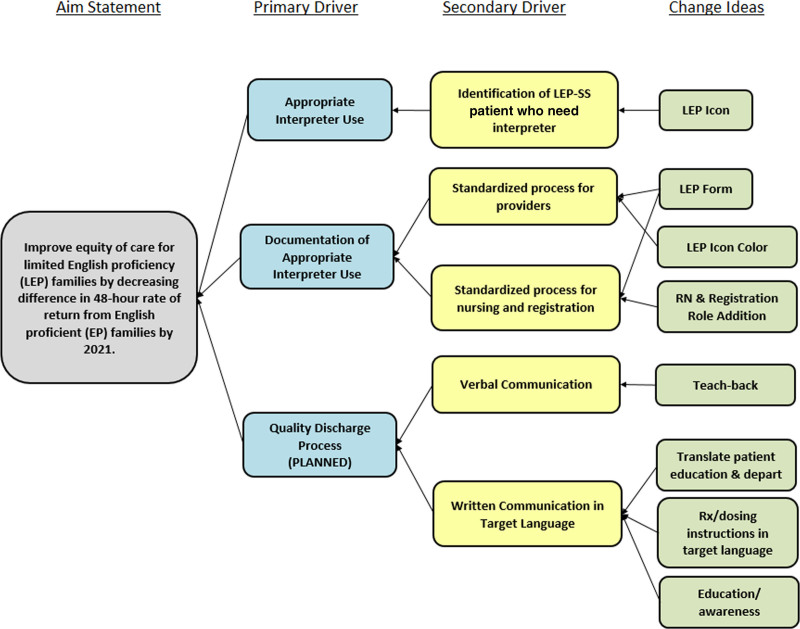
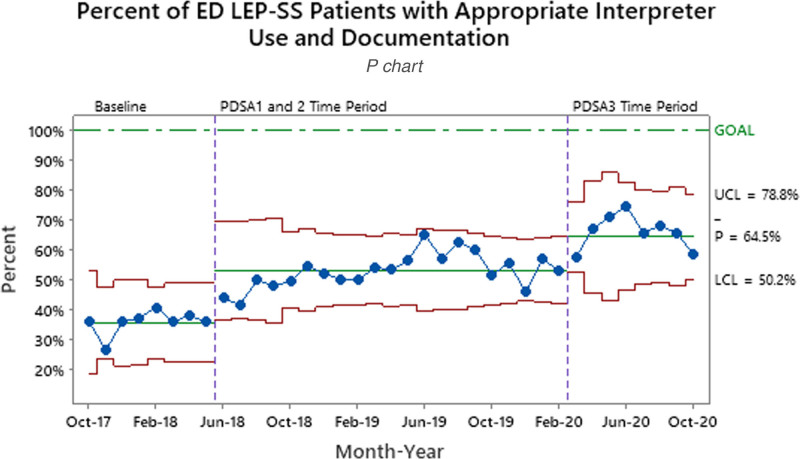
Disparate clinical outcomes have been reported for patients with Limited English Proficiency (LEP) in the emergency department setting, including increased length of stay, diagnostic error rates, readmission rates, and dissatisfaction. Our emergency department had no standard processes for LEP patient identification or interpreter encounter documentation and a higher rate of 48-hour LEP return visits (RV) than English proficient patients. The aim was to eliminate gaps by increasing appropriate interpreter use and documentation (AIUD) for Spanish-speaking LEP (LEP-SS) patients from 35.7% baseline (10/17-05/18) to 100% by October 2020.
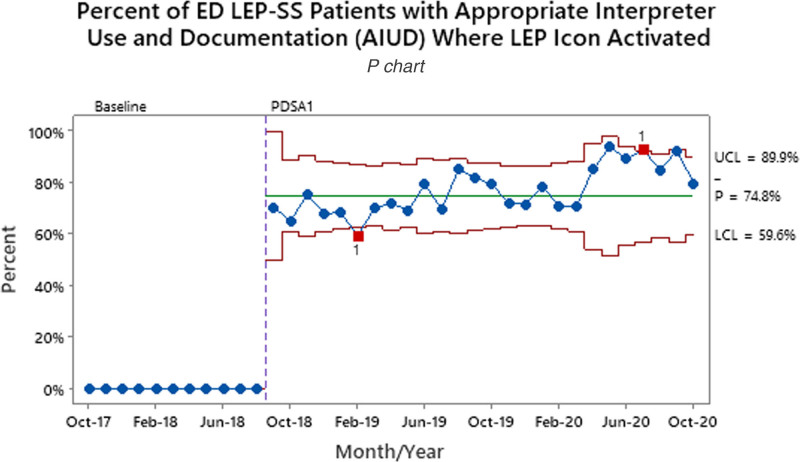
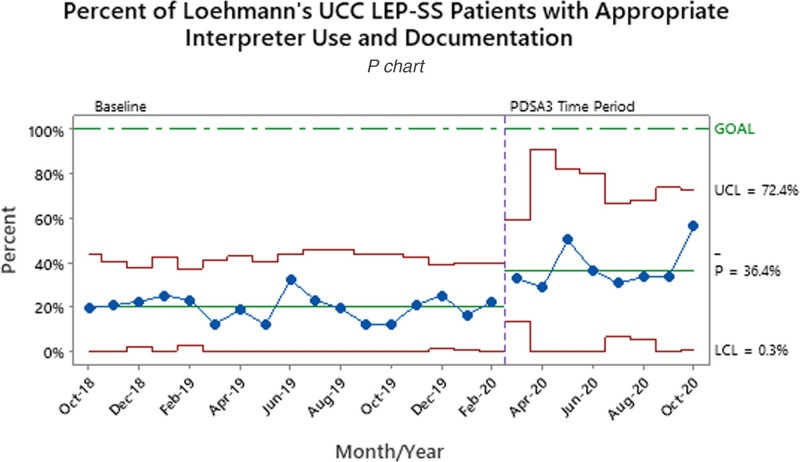
Methods: LEP-SS patient data were reviewed in the electronic medical record to determine the AIUD and RV rates. Using the Model for Improvement and multiple Plan-Do-Study-Act (PDSA) cycles, a multi-disciplinary team encouraged stakeholder engagement and identified improvement opportunities, implemented an electronic tracking board LEP icon (PDSA1), standardized documentation using an LEP Form linked to the icon (PDSA2), and included color changes to the icon for team situational awareness (PDSA3).
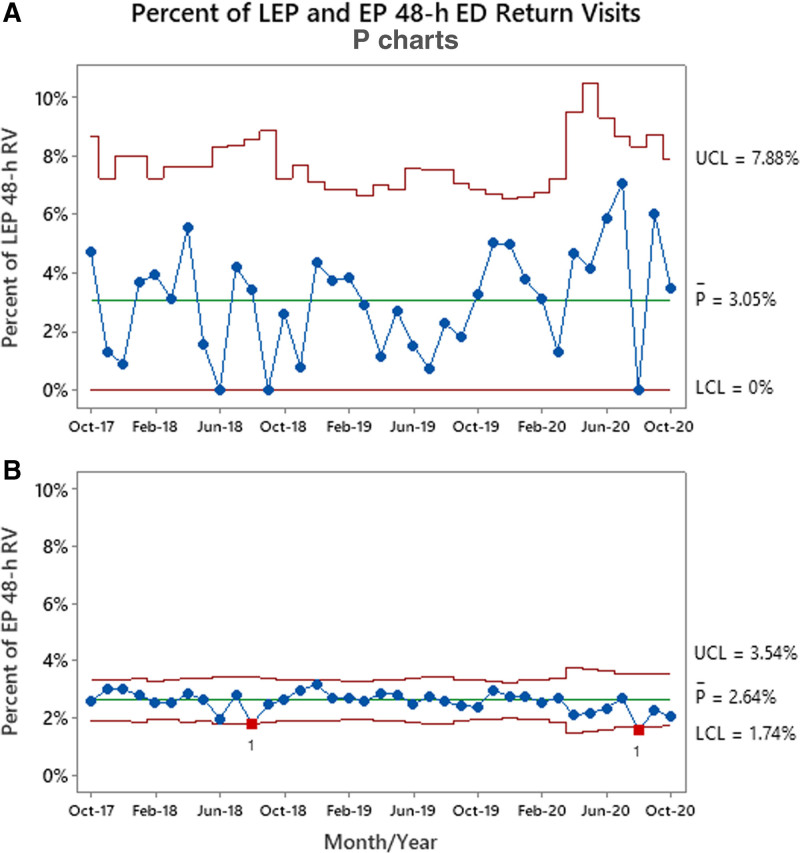
Results: The mean of LEP-SS patients with AIUD improved from 35.7% to 64.5% without significant changes in balancing measures. During the postintervention period (6/1/2018-10/31/2020), no special cause variation was noted from the baseline 48-hour emergency department RV rates for LEP patients (3.1%) or English proficient patients (2.6%).
Conclusions: While the RV rate was not affected, this project is part of a multi-faceted approach aiming to positively impact this outcome measure. Significant improvements in AIUD were achieved without affecting balancing measures.
Copyright © 2021 the Author(s). Published by Wolters Kluwer Health, Inc.
Figures
References
-
- Flores G, Abreu M, Barone CP, et al. . Errors of medical interpretation and their potential clinical consequences: a comparison of professional versus ad hoc versus no interpreters. Ann Emerg Med. 2012;60:545–553. - PubMed
-
- Civil Rights Act of 1964, Pub.L. 88-352, 78 Stat. 241. 1964.
-
- Patient Protection and Affordable Care Act, 42 U.S.C. § 18001 et seq. 2010.
-
- U.S. Census Bureau. The Hispanic Population in the US: 2019. 2019. Available at https://www.census.gov/data/tables/2019/demo/hispanic-origin/2019-cps.html. Accessed June 30, 2020.
-
- U.S. Census Bureau. Detailed languages spoken at home and ability to speak English for the population 5 years and over: 2009–2013. 2019. Available at https://www.census.gov/data/tables/2013/demo/2009-2013-lang-tables.html. Accessed June 30, 2020.
LinkOut - more resources
Full Text Sources
Miscellaneous