


A nationwide genomic study of clinical Klebsiella pneumoniae in Norway 2001-15: introduction and spread of ESBLs facilitated by clonal groups CG15 and CG307
- PMID: 34935048
- PMCID: PMC8865009
- DOI: 10.1093/jac/dkab463
A nationwide genomic study of clinical Klebsiella pneumoniae in Norway 2001-15: introduction and spread of ESBLs facilitated by clonal groups CG15 and CG307
Abstract
Objectives: To use the nationwide Norwegian surveillance programme on resistant microbes in humans (NORM) to address longitudinal changes in the population structure of Klebsiella pneumoniae isolates from 2001-15, focusing on the emergence and dissemination of ESBL-producing K. pneumoniae in Norway.
Methods: Among blood (n = 6124) and urinary tract (n = 5496) surveillance isolates from 2001-15, we used Illumina technology to whole genome sequence 201 ESBL-producing isolates from blood (n = 130) and urine (n = 71), and 667 non-ESBL isolates from blood. Complete genomes for four isolates were resolved with Oxford Nanopore sequencing.
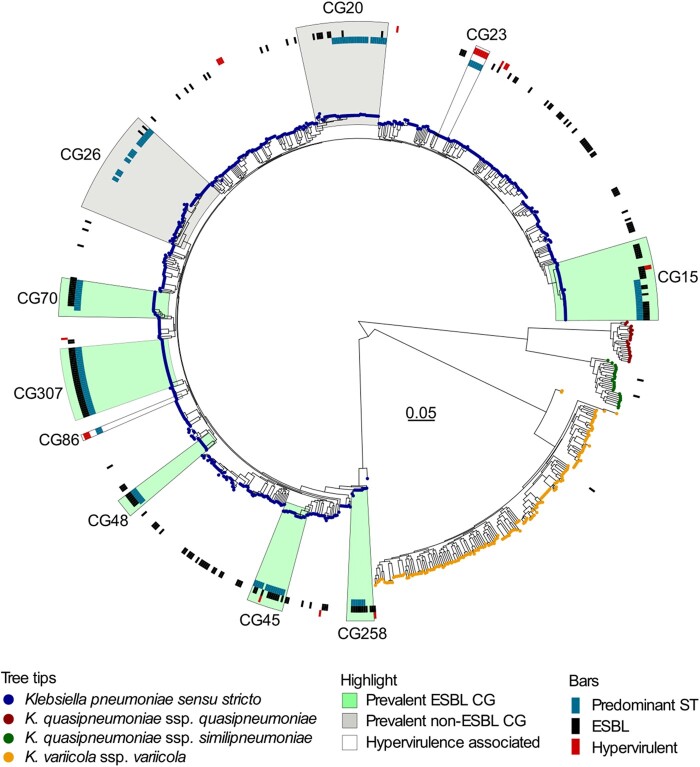
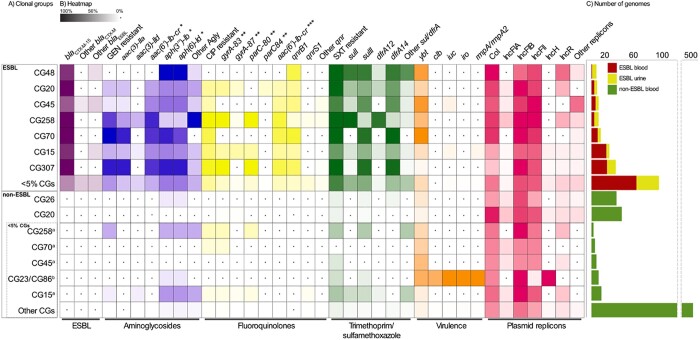
Results: In a highly diverse collection, Klebsiella variicola ssp. variicola caused 24.5% of Klebsiella pneumoniae species complex (KpSC) bacteraemias. ESBL production was limited to K. pneumoniae sensu stricto (98.5%). A diverse ESBL population of 57 clonal groups (CGs) were dominated by MDR CG307 (17%), CG15 (12%), CG70 (6%), CG258 (5%) and CG45 (5%) carrying blaCTX-M-15. Yersiniabactin was significantly more common in ESBL-positive (37.8%) compared with non-ESBL K. pneumoniae sensu stricto isolates (12.7%), indicating convergence of virulence and resistance determinants. Moreover, we found a significantly lower prevalence of yersiniabactin (3.0%, 37.8% and 17.3%), IncFIB (58.7%, 87.9% and 79.4%) and IncFII plasmid replicons (40.5%, 82.8% and 54.2%) in K. variicola ssp. variicola compared with ESBL- and non-ESBL K. pneumoniae sensu stricto isolates, respectively.
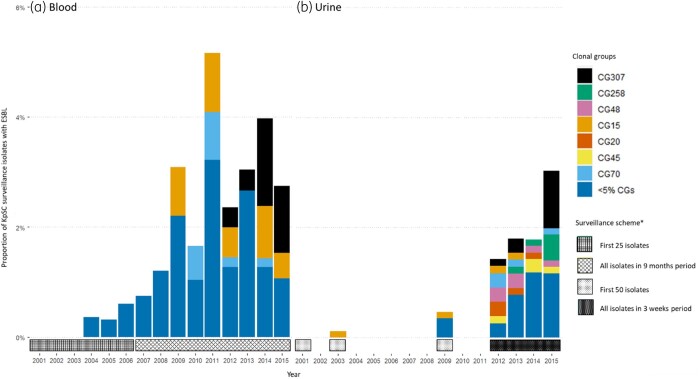
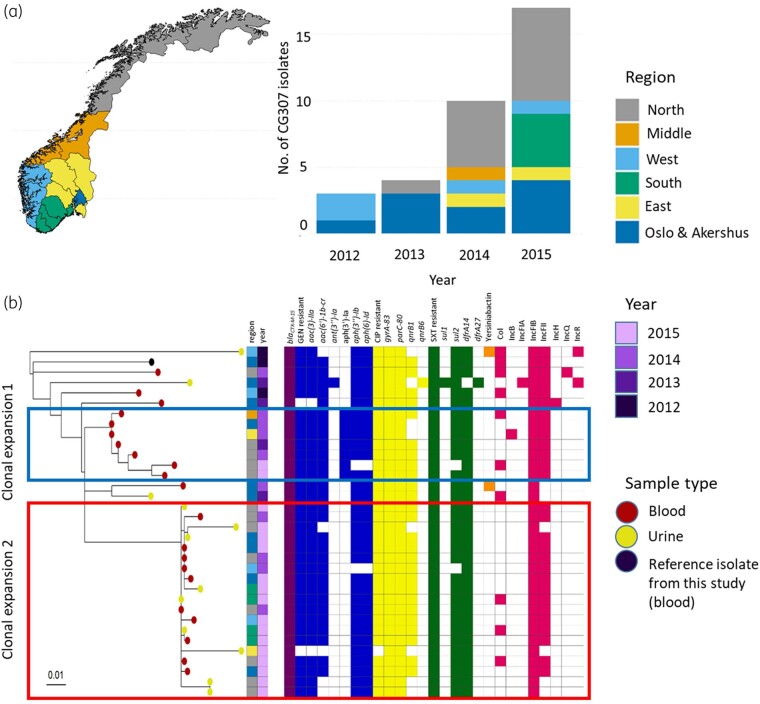
Conclusions: The increase in Norwegian ESBL-producing KpSC during 2010-15 was driven by CG307 and CG15 carrying blaCTX-M-15. K. variicola ssp. variicola was a frequent cause of invasive KpSC infection, but rarely carried ESBLs.
© The Author(s) 2021. Published by Oxford University Press on behalf of the British Society for Antimicrobial Chemotherapy.
Figures
References
-
- Navon-Venezia S, Kondratyeva K, Carattoli A.. Klebsiella pneumoniae: a major worldwide source and shuttle for antibiotic resistance. FEMS Microbiol Rev 2017; 41: 252–75. - PubMed
-
- Tacconelli E, Carrara E, Savoldi A. et al. Discovery, research, and development of new antibiotics: the WHO priority list of antibiotic-resistant bacteria and tuberculosis. Lancet Infect Dis 2018; 18: 318–27. - PubMed
-
- Magiorakos AP, Srinivasan A, Carey RB. et al. Multidrug-resistant, extensively drug-resistant and pandrug-resistant bacteria: an international expert proposal for interim standard definitions for acquired resistance. Clin Microbiol Infect 2012; 18: 268–81. - PubMed
-
- Wyres KL, Holt KE.. Klebsiella pneumoniae population genomics and antimicrobial-resistant clones. Trends Microbiol 2016; 24: 944–56. - PubMed
