. 2022 Feb 1;79(2):151-159.
doi: 10.1001/jamapsychiatry.2021.3749.

Immediate and Longer-Term Changes in the Mental Health and Well-being of Older Adults in England During the COVID-19 Pandemic

Affiliations

Immediate and Longer-Term Changes in the Mental Health and Well-being of Older Adults in England During the COVID-19 Pandemic

Paola Zaninotto et al. JAMA Psychiatry. .

Abstract

Importance: Despite the emphasis placed on the psychological impact of the COVID-19 pandemic, evidence from representative studies of older adults including pre-COVID-19 data and repeated assessments during the pandemic is scarce.

Objective: To examine changes in mental health and well-being before and during the initial and later phases of the COVID-19 pandemic and test whether patterns varied with sociodemographic characteristics in a representative sample of older adults living in England.

Design, setting, and participants: This longitudinal cohort study analyzed data from 5146 older adults participating in the English Longitudinal Study of Ageing who provided data before the COVID-19 pandemic (2018 and 2019) and at 2 occasions in 2020 (June or July as well as November or December).

Exposures: The COVID-19 pandemic and sociodemographic characteristics, including sex, age, partnership status, and socioeconomic position.

Main outcomes and measures: Changes in depression (8-item Centre for Epidemiological Studies Depression scale), anxiety (7-item Generalized Anxiety Disorder scale), quality of life (12-item Control, Autonomy, Self-realization, and Pleasure scale), and loneliness (3-item Revised University of California, Los Angeles, loneliness scale) were tested before and during the COVID-19 pandemic using fixed-effects regression models.

Results: Of 5146 included participants, 2723 (52.9%) were women, 4773 (92.8%) were White, and the mean (SD) age was 67.7 (10.6) years. The prevalence of clinically significant depressive symptoms increased from 12.5% (95% CI, 11.5-13.4) before the COVID-19 pandemic to 22.6% (95% CI, 21.6-23.6) in June and July 2020, with a further rise to 28.5% (95% CI, 27.6-29.5) in November and December 2020. This was accompanied by increased loneliness and deterioration in quality of life. The prevalence of anxiety rose from 9.4% (95% CI, 8.8-9.9) to 10.9% (95% CI, 10.3-11.5) from June and July 2020 to November and December 2020. Women and nonpartnered people experienced worse changes in mental health. Participants with less wealth had the lowest levels of mental health before and during the COVID-19 pandemic. Higher socioeconomic groups had better mental health overall but responded to the COVID-19 pandemic with more negative changes.

Conclusions and relevance: In this longitudinal cohort study of older adults living in England, mental health and well-being continued to worsen as the COVID-19 pandemic progressed, and socioeconomic inequalities persisted. Women and nonpartnered people experienced greater deterioration in mental health.


Conflict of interest statement

Conflict of Interest Disclosures: None reported.

Figures

Figure 1.
Figure 1.. Predicted Outcome Trajectories Before and During the COVID-19 Pandemic
A total of 5146 individuals participated in the English Longitudinal Study of Ageing COVID-19 longitudinal sample. Weighted pooled estimates are from 2-way fixed-effects linear models across 20 imputed data sets. Error bars indicate 95% CIs. A, Depression scores were calculated using the 8-item Center for Epidemiologic Studies Depression Scale (CESD-8) (binary score defined as total CESD-8 score greater than or equal to 4). B, Quality of life scores were calculated using the 12-item Control, Autonomy, Self-realization and Pleasure scale (total continuous score). C, Loneliness scores were calculated using the University of California, Los Angeles, loneliness scale plus additional loneliness question (total continuous score). D, Anxiety scores were calculated using the 7-item Generalized Anxiety Disorder Assessment (GAD-7) (binary score defined as total GAD-7 score equal to or greater than 10).
Figure 2.
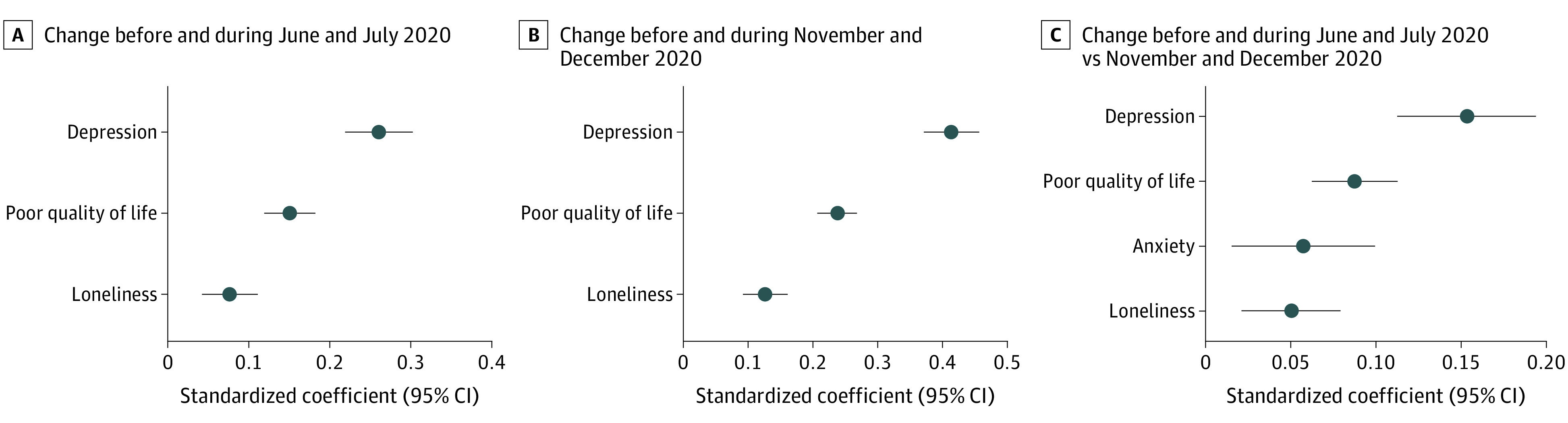
Figure 2.. Standardized Changes in Mental Health Before and During the COVID-19 Pandemic
A total of 5146 individuals participated in the English Longitudinal Study of Ageing COVID-19 longitudinal sample. Weighted pooled estimates are from 2-way fixed-effects linear models across 20 imputed data sets. Depression scores were calculated using the 8-item Center for Epidemiologic Studies Depression Scale (CESD-8) (binary score defined as total CESD-8 score greater than or equal to 4). Quality of life scores were calculated using the 12-item Control, Autonomy, Self-realization and Pleasure scale (total continuous score). Loneliness scores were calculated using the University of California, Los Angeles, loneliness scale plus additional loneliness question (total continuous score). Anxiety scores were calculated using the 7-item Generalized Anxiety Disorder Assessment (GAD-7) (binary score defined as total GAD-7 score equal to or greater than 10).
Figure 3.
Figure 3.. Interaction Effects Between Changes in Mental Health and Sex and Wealth
A total of 5146 individuals participated in the English Longitudinal Study of Ageing COVID-19 longitudinal sample. Predicted values of the outcomes by sociodemographic characteristics were derived from mutually adjusted 2-way fixed-effects linear models; weighted pooled estimates are across 20 imputed data sets. Error bars indicate 95% CIs.

References

    1. Office For National Statistics . Coronavirus and depression in adults, Great Britain: June 2020. Accessed December 8, 2021. https://www.ons.gov.uk/peoplepopulationandcommunity/wellbeing/articles/c...
    1. Kola L, Kohrt BA, Hanlon C, et al. COVID-19 mental health impact and responses in low-income and middle-income countries: reimagining global mental health. Lancet Psychiatry. 2021;8(6):535-550. doi: 10.1016/S2215-0366(21)00025-0 - DOI - PMC - PubMed
    1. Salari N, Hosseinian-Far A, Jalali R, et al. Prevalence of stress, anxiety, depression among the general population during the COVID-19 pandemic: a systematic review and meta-analysis. Global Health. 2020;16(1):57. doi: 10.1186/s12992-020-00589-w - DOI - PMC - PubMed
    1. Fancourt D, Steptoe A, Bu F. Trajectories of anxiety and depressive symptoms during enforced isolation due to COVID-19 in England: a longitudinal observational study. Lancet Psychiatry. 2021;8(2):141-149. doi: 10.1016/S2215-0366(20)30482-X - DOI - PMC - PubMed
    1. O’Connor RC, Wetherall K, Cleare S, et al. Mental health and well-being during the COVID-19 pandemic: longitudinal analyses of adults in the UK COVID-19 Mental Health & Wellbeing study. Br J Psychiatry. 2020;218(6):1-8. doi: 10.1192/BJP.2020.212 - DOI - PMC - PubMed