Review
. 2021 Dec 22;79(1):8.
doi: 10.1007/s00018-021-04066-4.

Sexual determination in zebrafish

Affiliations
Review

Sexual determination in zebrafish

Devora Aharon et al. Cell Mol Life Sci. .

Abstract

Zebrafish have emerged as a major model organism to study vertebrate reproduction due to their high fecundity and external development of eggs and embryos. The mechanisms through which zebrafish determine their sex have come under extensive investigation, as they lack a definite sex-determining chromosome and appear to have a highly complex method of sex determination. Single-gene mutagenesis has been employed to isolate the function of genes that determine zebrafish sex and regulate sex-specific differentiation, and to explore the interactions of genes that promote female or male sexual fate. In this review, we focus on recent advances in understanding of the mechanisms, including genetic and environmental factors, governing zebrafish sex development with comparisons to gene functions in other species to highlight conserved and potentially species-specific mechanisms for specifying and maintaining sexual fate.

Keywords: Genetics; Ovary; RNA binding protein; Sex determination; Testis.


Conflict of interest statement

The authors declare no conflict of interest.

Figures
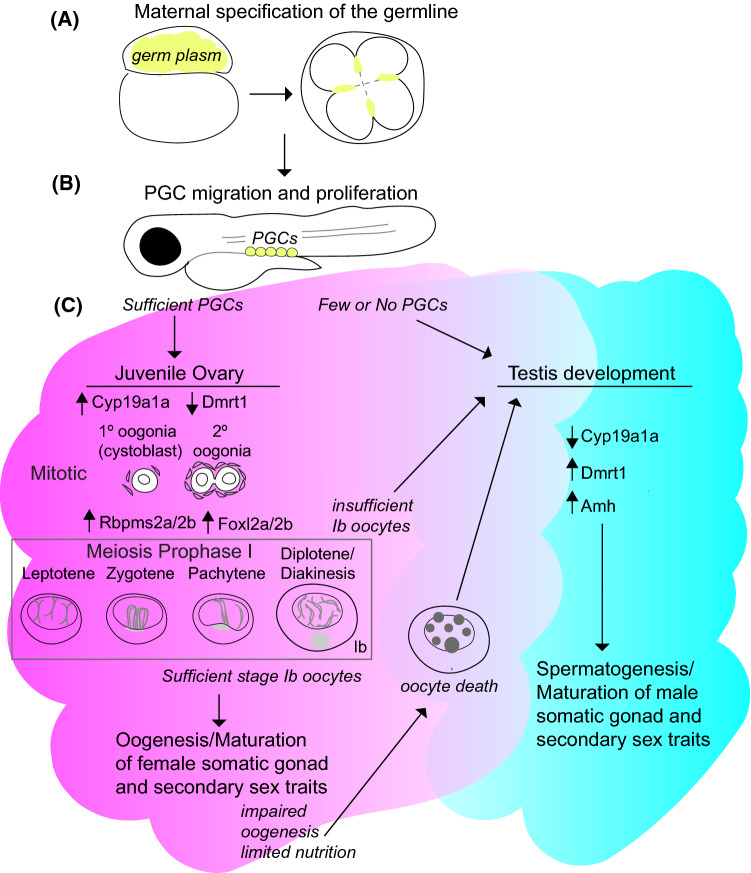
Fig. 1
Fig. 1
Overview of germline specification and sexual differentiation. (A) The zebrafish germline is specified by inheritance of maternal germ plasm (yellow) which can be seen at the animal pole and in select cleavage furrows of the early embryo (cartoon is animal pole view of 4-cell stage). (B) After specification, PGCs proliferate and migrate to the gonad anlage. (C) If PGC numbers are limiting then the developing fish will begin differentiation as a male. If sufficient PGCs are present, then a bi-potential ovary develops and meiosis I and progression of oogenesis commences through diplotene arrest at the end of prophase I. If adequate stage Ib oocytes are produced, then the somatic gonad and oocyte differentiate further but if there are insufficient stage Ib oocytes, male promoting factors increase in abundance and the juvenile ovary is replaced by a male gonad. Even after the ovary matures, sustained communication between the germline and the somatic gonad cells are required to maintain the expression of pro-female factors and female fate and to prevent oocyte death and transdifferentiation as a male
Fig. 2
Fig. 2
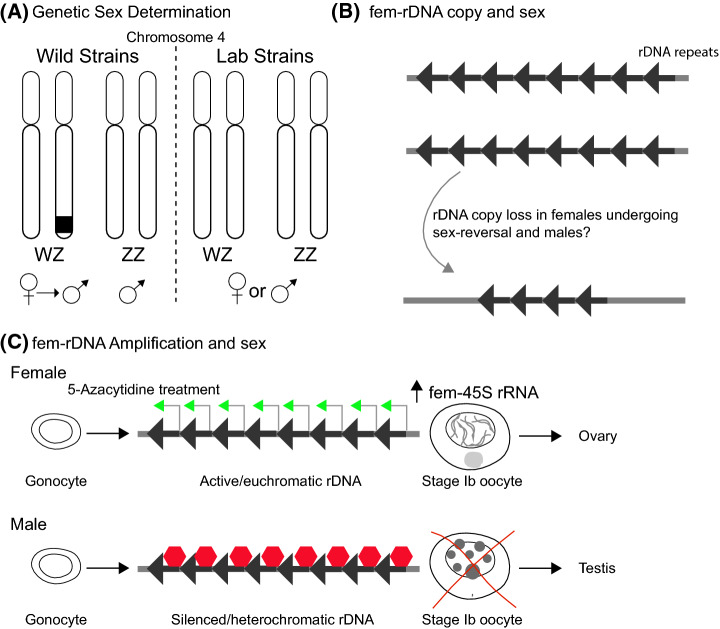
Sex determination in zebrafish. (A) Zebrafish strains in the wild have a WZ and ZZ sex determination system with heterozygous (WZ) females that can adopt male fates. (B) An 11.5 kB repeat encoding a maternal-specific 45S rDNA resides on chromosome 4 and overlaps the sex-determining region on chromosome 4 of wild strains and is (C) amplified in stage Ib oocytes—the stage required to sustain female development. Treating zebrafish with the DNA methyltransferase inhibitor, 5-Azacytidine, results in female sex bias. Thus, female fate may be induced by amplification and or stabilization of fem-rRNA and oogenesis, while demethylation and silencing of this site, and potentially others, could promote oocyte loss and male fate. Red hexagons indicate silencing and repression
Fig. 3
Fig. 3
Models for potential candidates and mechanisms to spark sex determination in zebrafish. The bi-potential gonad (purple) contains RNAs that are required for either female (pink) or male (blue) differentiation. Because the bi-potential gonad is more female in character, resembling an early ovary, it is likely that the RNAs encoding male factors are translationally repressed, while those required for female differentiation are translated. Rbpms2 is a candidate regulator because it is essentially for female fates even in the absence of Dmrt1—it could act to translationally repress male RNAs while simultaneously promoting translation of factors required for female fate, either directly or with a corepressor of co-activating RNAbp. Because fem-rDNA amplification is required for female fate, methyltransferases and their regulators are compelling triggers for female differentiation. Likewise, their loss could trigger male differentiation. How fem-rDNA contributes to sexual differentiation is not known; however, given the presence of both female and male RNAs in the bi-potential gonad, it is tempting to speculate that the state of fem-rDNA (high in females and low in males) dictates which RNAs are translated. Genetic evidence indicates that loss of Rbpms2 is sufficient for male development, and that Dmrt1 antagonizes Rbpms2. If Rbpms2 represses male RNAs then eliminating Rbpms2 so that another male-specific RNAbp could bind and promote male-factor RNA translation would be sufficient to trigger female fates. These models and the cue that initiates sex determination in zebrafish await experimental verification

References

    1. Gempe T, Beye M. Function and evolution of sex determination mechanisms, genes and pathways in insects. BioEssays. 2011;33(1):52–60. doi: 10.1002/bies.201000043. - DOI - PMC - PubMed
    1. Bachtrog D, et al. Sex determination: why so many ways of doing it? PLoS Biol. 2014;12(7):e1001899. doi: 10.1371/journal.pbio.1001899. - DOI - PMC - PubMed
    1. Trukhina AV, et al. The variety of vertebrate mechanisms of sex determination. Biomed Res Int. 2013;2013:587460. doi: 10.1155/2013/587460. - DOI - PMC - PubMed
    1. Herpin A, Schartl M. Plasticity of gene-regulatory networks controlling sex determination: of masters, slaves, usual suspects, newcomers, and usurpators. EMBO Rep. 2015;16(10):1260–1274. doi: 10.15252/embr.201540667. - DOI - PMC - PubMed
    1. Kossack ME, Draper BW. Genetic regulation of sex determination and maintenance in zebrafish (Danio rerio) Curr Top Dev Biol. 2019;134:119–149. doi: 10.1016/bs.ctdb.2019.02.004. - DOI - PMC - PubMed

LinkOut - more resources