Application of artificial intelligence for diagnosis of pancreatic ductal adenocarcinoma by EUS: A systematic review and meta-analysis
- PMID: 34937308
- PMCID: PMC8887033
- DOI: 10.4103/EUS-D-20-00219
Application of artificial intelligence for diagnosis of pancreatic ductal adenocarcinoma by EUS: A systematic review and meta-analysis
Abstract
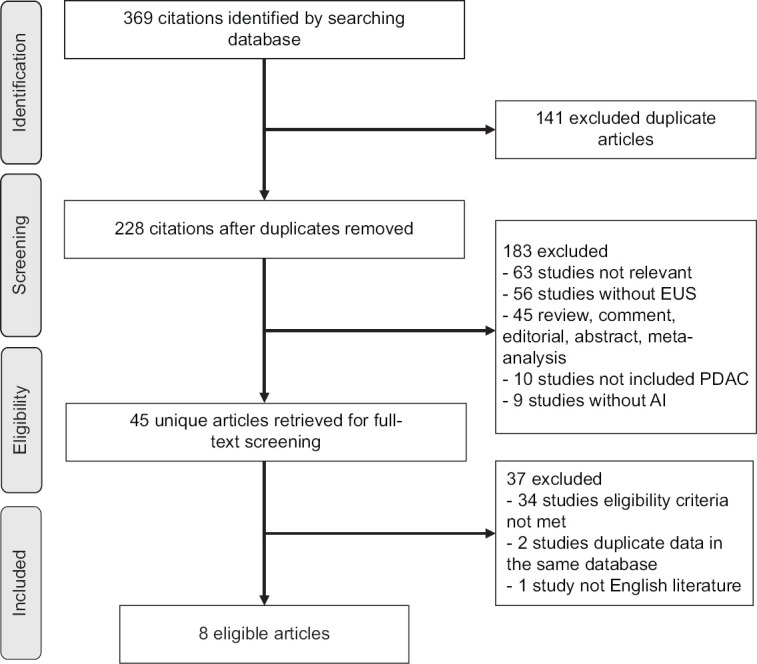
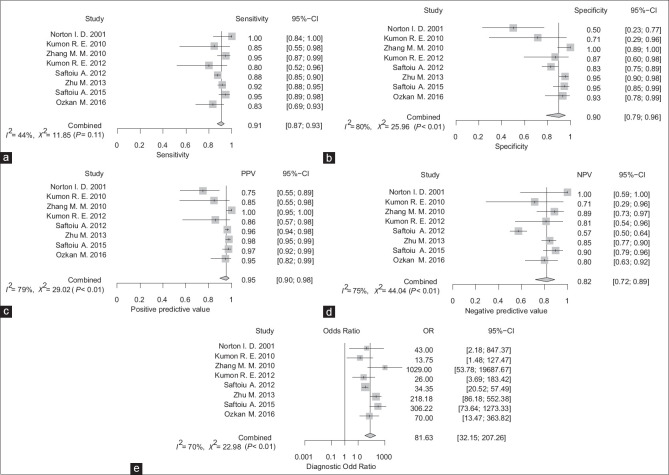
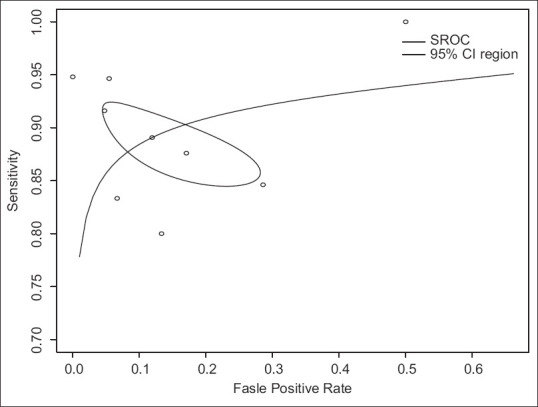
EUS-guided tissue acquisition carries certain risks from unnecessary needle puncture in the low-likelihood lesions. Artificial intelligence (AI) system may enable us to resolve these limitations. We aimed to assess the performance of AI-assisted diagnosis of pancreatic ductal adenocarcinoma (PDAC) by off-line evaluating the EUS images from different modes. The databases PubMed, EMBASE, SCOPUS, ISI, IEEE, and Association for Computing Machinery were systematically searched for relevant studies. The pooled sensitivity, specificity, diagnostic odds ratio (DOR), and summary receiver operating characteristic curve were estimated using R software. Of 369 publications, 8 studies with a total of 870 PDAC patients were included. The pooled sensitivity and specificity of AI-assisted EUS were 0.91 (95% confidence interval [CI], 0.87-0.93) and 0.90 (95% CI, 0.79-0.96), respectively, with DOR of 81.6 (95% CI, 32.2-207.3), for diagnosis of PDAC. The area under the curve was 0.923. AI-assisted B-mode EUS had pooled sensitivity, specificity, positive predictive value (PPV), and negative predictive value (NPV) of 0.91, 0.90, 0.94, and 0.84, respectively; while AI-assisted contrast-enhanced EUS and AI-assisted EUS elastography had sensitivity, specificity, PPV, and NPV of 0.95, 0.95, 0.97, and 0.90; and 0.88, 0.83, 0.96 and 0.57, respectively. AI-assisted EUS has a high accuracy rate and may potentially enhance the performance of EUS by aiding the endosonographers to distinguish PDAC from other solid lesions. Validation of these findings in other independent cohorts and improvement of AI function as a real-time diagnosis to guide for tissue acquisition are warranted.
Keywords: EUS; artificial intelligence; computer-assisted diagnosis; computer-assisted image analysis; machine learning; pancreatic cancer.
Conflict of interest statement
None
Figures
References
-
- Whiting PF, Rutjes AW, Westwood ME, et al. QUADAS-2: a revised tool for the quality assessment of diagnostic accuracy studies. Ann Intern Med. 2011;155:529–36. - PubMed
-
- Bray F, Ferlay J, Soerjomataram I, et al. Global cancer statistics 2018: GLOBOCAN estimates of incidence and mortality worldwide for 36 cancers in 185 countries. CA Cancer J Clin. 2018;68:394–424. - PubMed
-
- Corral JE, Mareth KF, Riegert-Johnson DL, et al. Diagnostic yield from screening asymptomatic individuals at high risk for pancreatic cancer: A meta-analysis of cohort studies. Clin Gastroenterol Hepatol. 2019;17:41–53. - PubMed