


Recent Insights Into Processing Approaches and Potential Health Benefits of Goat Milk and Its Products: A Review
- PMID: 34938763
- PMCID: PMC8685332
- DOI: 10.3389/fnut.2021.789117
Recent Insights Into Processing Approaches and Potential Health Benefits of Goat Milk and Its Products: A Review
Abstract
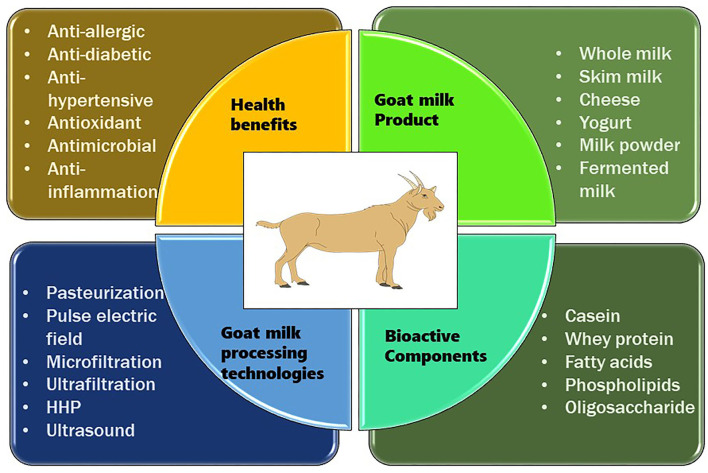
Goat milk is considered to be a potential source of various macro- and micro-nutrients. It contains a good proportion of protein, fat, carbohydrates, and other nutritional components which help in promoting nutritional and desirable health benefits. Goat milk is considered to be superior in terms of numerous health benefits, and lower risk of allergy, when compared to the milk of other species. Several processing techniques such as pasteurization, ultrafiltration, microfiltration, and ultrasound have been employed to enhance the quality and shelf life of goat milk and its products. The diverse range of goat milk-based products such as yogurt, cheese, fermented milk, goat milk powder, and others are available in the market and are prepared by the intervention of advanced processing technologies. Goats raised in pasture-based feeding systems are shown to have a better milk nutritional composition than its counterpart. Goat milk contains potential bioactive components, which aids in the maintenance of the proper metabolism and functioning of the human body. This review gives insight into the key nutritional ingredients and bioactive constituents present in goat milk and their potential role in the development of various functional foods using different processing technologies. Goat milk could be considered as a significant option for milk consumption in infants, as compared to other milk available.
Keywords: goat milk; health benefits; milk products; pasturized milk; processing.
Copyright © 2021 Nayik, Jagdale, Gaikwad, Devkatte, Dar, Dezmirean, Bobis, Ranjha, Ansari, Hemeg and Alotaibi.
Conflict of interest statement
The authors declare that the research was conducted in the absence of any commercial or financial relationships that could be construed as a potential conflict of interest.
Figures
References
-
- Park YW. Goat milk – chemistry and nutrition. In: Park YW, Haenlein GFW, Wendorff WL. editors. Handbook of Milk of Non-Bovine Mammals. Oxford: John Wiley & Sons, Ltd; (2017). p. 42–83. 10.1002/9781119110316.ch2.2 - DOI
-
- Zobel G, Nawroth C. Current state of knowledge on the cognitive capacities of goats and its potential to inform species-specific enrichment. Small Rumin Res. (2020) 192:106208. 10.1016/j.smallrumres.2020.106208 - DOI
-
- Verruck S, Dantas A, Prudencio ES. Functionality of the components from goat's milk, recent advances for functional dairy products development and its implications on human health. J Funct Foods. (2019) 52:243–57. 10.1016/j.jff.2018.11.017 - DOI
-
- Watkins PJ, Jaborek JR, Teng F, Day L, Castada HZ, Baringer S, et al. . Branched chain fatty acids in the flavour of sheep and goat milk and meat: a review. Small Rumin Res. (2021) 200:106398. 10.1016/j.smallrumres.2021.106398 - DOI
Publication types
LinkOut - more resources
Full Text Sources
Medical
