. 2022 May;130(5):284-292.
doi: 10.1111/apm.13202. Epub 2022 Jan 26.

Detection methods targeting the positive- and negative-sense RNA transcripts from plus-stranded RNA viruses

Affiliations

Detection methods targeting the positive- and negative-sense RNA transcripts from plus-stranded RNA viruses

Signe Ravn Warncke et al. APMIS. 2022 May.

Abstract

The largest group of viruses in the Baltimore classification system comprises viruses with a positive-sense, single-stranded RNA genome. Once the viral genome is released into the cytoplasm of a specific host cell following virus entry, it functions directly as an mRNA, and the virus-encoded proteins that are essential for genome replication are produced by the translation apparatus of the host cell. The positive-sense genome is replicated in two stages, initially the positive strand is copied to make a negative-sense RNA, which then functions as the template for transcription of many new positive-sense genomes. Virus infections can be detected at different stages throughout the infection cycle for diagnostic and scientific purposes. Here, the advantages and disadvantages of some of the relevant methods for genome detection will be briefly reviewed with special emphasis on techniques allowing strand-specific RNA detection. Furthermore, tools of the future are considered.

Keywords: Plus-stranded RNA viruses; RT-PCR; genome; methods; replication; strand-specific detection.


Conflict of interest statement

All authors declare no potential conflict of interest.

Figures

Fig. 1
Fig. 1
Life cycle of positive‐sense RNA viruses. After virus entry into the host cell, the viral genome is released (blue bar, step 1) and virus‐encoded proteins, including the RdRp, are produced by translation of the RNA (different colours and shapes, step 2). The genome also functions as template for transcription of a complementary negative‐sense RNA molecule (red bar, step 3), from which many new positive‐sense genomes are made (step 4). These genomes are either used for further protein production (step 5) or packaged into new virions (step 6).
Fig. 2
Fig. 2
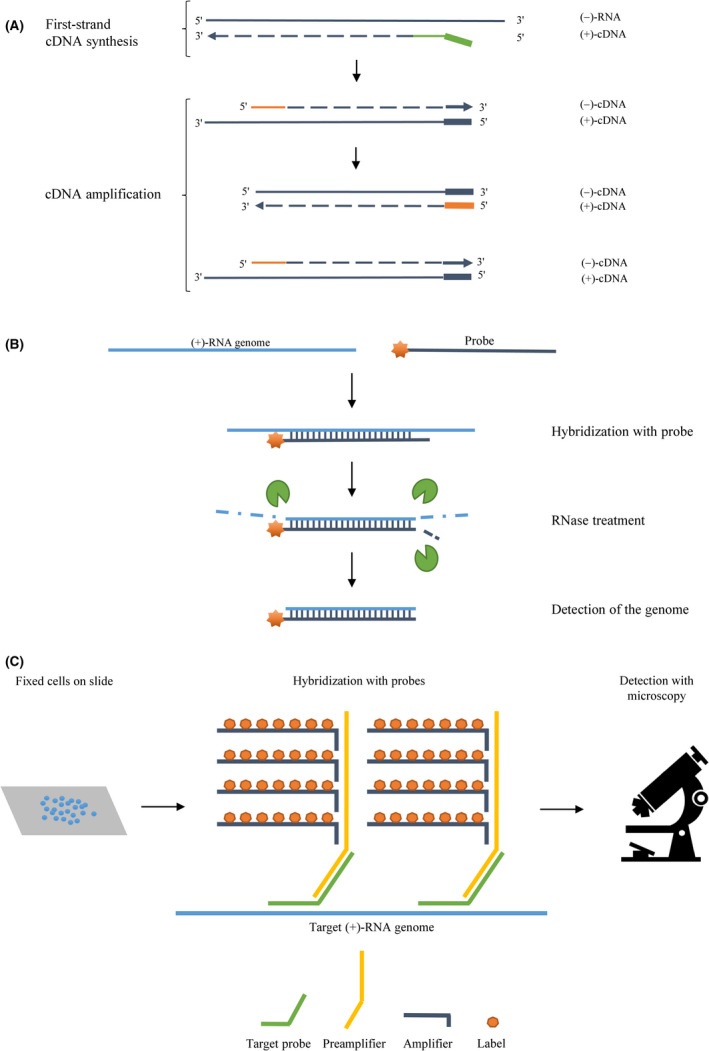
Illustrations of the principles behind strand‐specific tagged RT‐PCRs, RNase protection assays and in situ hybridization assays with branched DNA probes. (A) During tagged RT‐PCR, first‐strand cDNA synthesis is carried out using a strand‐specific reverse transcription primer (green) with a non‐viral 5′ tag‐sequence (bold). One tag‐specific and one sequence‐specific primer (both in orange; tag‐specific primer in bold) are used for subsequent cDNA amplification by PCR. Dashed lines indicate newly synthesized DNA, and the sense of the nucleic acids strands is shown on the right. (B) In an RNase protection assay, a fluorescently or radioactively labelled probe (dark blue with an orange star) hybridizes to the target RNA (light blue). RNases (green) degrade single‐stranded regions, while the labelled double‐stranded region is detected. (C) During in situ hybridization with branched DNA probes, cells are fixed on slides, and the intracellular target RNA (light blue) is first hybridized with the target probe (green) and subsequently the preamplifier (yellow). Lastly, amplifiers with multiple labels (dark blue with orange heptagons) are added to hybridize with the preamplifier and visualization is possible using the appropriate type of microscopy.

References

    1. Baltimore D. Expression of animal virus genomes. Bacteriol Rev. 1971;35(3):235–41. - PMC - PubMed
    1. Callanan J, Stockdale SR, Shkoporov A, Draper LA, Ross RP, Hill C. RNA phage biology in a metagenomic era. Viruses. 2018;10(7):386. - PMC - PubMed
    1. Choo QL, Kuo G, Weiner AJ, Overby LR, Bradley DW, Houghton M. Isolation of a cDNA clone derived from a blood‐borne non‐A, non‐B viral hepatitis genome. Science. 1989;244(4902):359–62. - PubMed
    1. Racaniello VR, Baltimore D. Cloned poliovirus complementary DNA is infectious in mammalian cells. Science. 1981;214(4523):916–9. - PubMed
    1. Wenjie T, Xiang Z, Xuejun M, Wenling W, Peihua N, Wenbo X, et al. A novel coronavirus genome identified in a cluster of pneumonia cases—Wuhan, China 2019–2020. China CDC Weekly. 2020;2(4):61–2. - PMC - PubMed