Review
. 2021 Nov 29;11(12):813.
doi: 10.3390/metabo11120813.

Effect of Exercise on Brain Health: The Potential Role of Lactate as a Myokine

Affiliations
Review

Effect of Exercise on Brain Health: The Potential Role of Lactate as a Myokine

Takeshi Hashimoto et al. Metabolites. .

Abstract

It has been well established in epidemiological studies and randomized controlled trials that habitual exercise is beneficial for brain health, such as cognition and mental health. Generally, it may be reasonable to say that the physiological benefits of acute exercise can prevent brain disorders in late life if such exercise is habitually/chronically conducted. However, the mechanisms of improvement in brain function via chronic exercise remain incompletely understood because such mechanisms are assumed to be multifactorial, such as the adaptation of repeated acute exercise. This review postulates that cerebral metabolism may be an important physiological factor that determines brain function. Among metabolites, the provision of lactate to meet elevated neural activity and regulate the cerebrovascular system and redox states in response to exercise may be responsible for exercise-enhanced brain health. Here, we summarize the current knowledge regarding the influence of exercise on brain health, particularly cognitive performance, with the underlying mechanisms by means of lactate. Regarding the influence of chronic exercise on brain function, the relevance of exercise intensity and modality, particularly high-intensity interval exercise, is acknowledged to induce "metabolic myokine" (i.e., lactate) for brain health.

Keywords: angiogenesis; brain-derived neurotrophic factor; cerebral blood flow; executive function; insulin-like growth factor-1; mental health; neurogenesis; nicotinamide adenine dinucleotide hydrate; vascular endothelial growth factor.


Conflict of interest statement

The authors declare no conflict of interest.

Figures
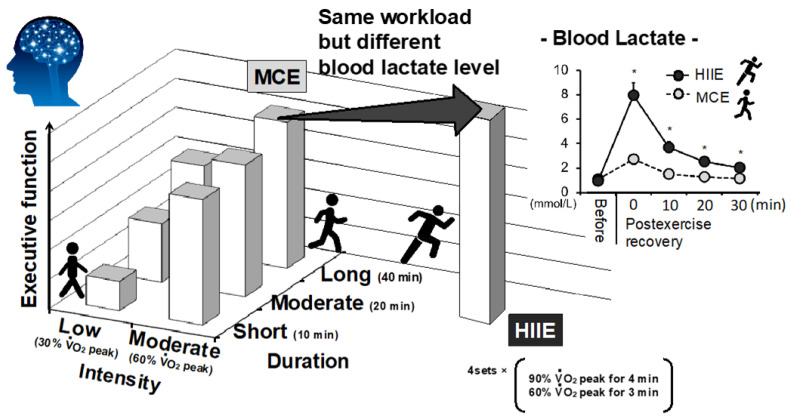
Figure 1
Figure 1
Impact of exercise intensity, duration, and modality on acute enhancement of executive function. The graph is illustrated by the authors based on previous studies [7,8,18]. HIIE could improve EF rather than volume-matched (i.e., same workload) MCE with more lactate production during postexercise recovery period [7]. * p < 0.05 vs. MCE.
Figure 2
Figure 2
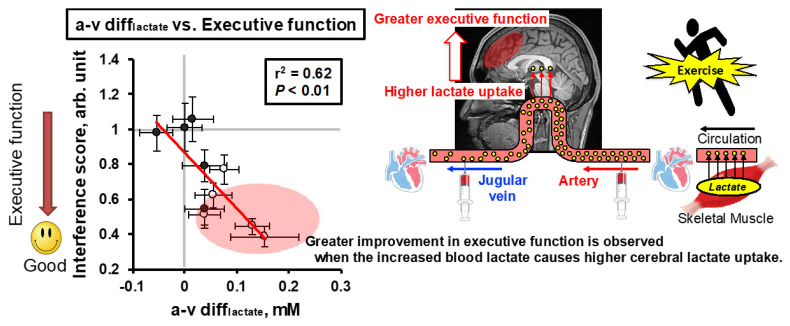
Relationship between a-v difflactate and Δinterference score (i.e., executive function) during postexercise recovery. The open circles indicate the average of each time point during the post-first bout of HIIE recovery, and the solid circles indicate the average of each time point during the post-second bout of HIIE recovery in which a lower systemic lactate concentration is observed. This result suggests that brain lactate uptake is associated with better executive function. Values are the means ± SEM. Modified/adopted from Hashimoto et al. [67].
Figure 3
Figure 3
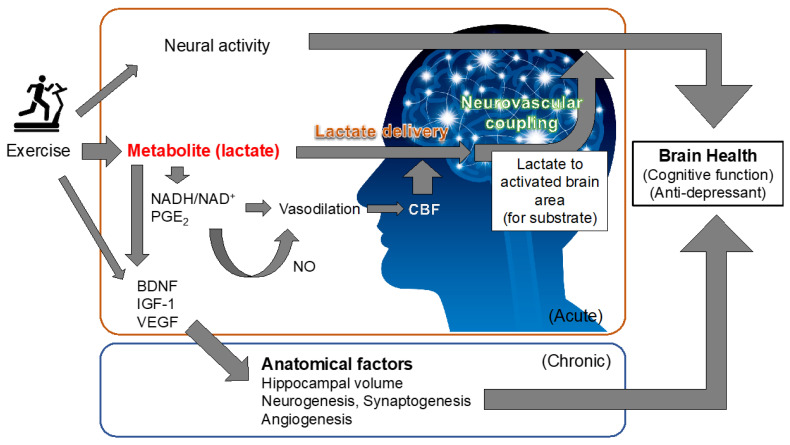
Potential acute and chronic effects of exercise-induced lactate on brain health. Scheme illustrating the potential acute and chronic effects of exercise-induced lactate on brain health.

References

    1. Gomez-Pinilla F., Hillman C. The influence of exercise on cognitive abilities. Compr. Physiol. 2013;3:403–428. doi: 10.1002/cphy.c110063. - DOI - PMC - PubMed
    1. Mandolesi L., Polverino A., Montuori S., Foti F., Ferraioli G., Sorrentino P., Sorrentino G. Effects of Physical Exercise on Cognitive Functioning and Wellbeing: Biological and Psychological Benefits. Front. Psychol. 2018;9:509. doi: 10.3389/fpsyg.2018.00509. - DOI - PMC - PubMed
    1. Fiuza-Luces C., Garatachea N., Berger N.A., Lucia A. Exercise is the real polypill. Physiology. 2013;28:330–358. doi: 10.1152/physiol.00019.2013. - DOI - PubMed
    1. Pedersen B.K. Physical activity and muscle-brain crosstalk. Nat. Rev. Endocrinol. 2019;15:383–392. doi: 10.1038/s41574-019-0174-x. - DOI - PubMed
    1. Goodwin M.L., Harris J.E., Hernández A., Gladden L.B. Blood lactate measurements and analysis during exercise: A guide for clinicians. J. Diabetes Sci. Technol. 2007;1:558–569. doi: 10.1177/193229680700100414. - DOI - PMC - PubMed

LinkOut - more resources