Review
. 2021 Dec 15;19(12):708.
doi: 10.3390/md19120708.

Advanced Strategies for 3D Bioprinting of Tissue and Organ Analogs Using Alginate Hydrogel Bioinks

Affiliations
Review

Advanced Strategies for 3D Bioprinting of Tissue and Organ Analogs Using Alginate Hydrogel Bioinks

Qiqi Gao et al. Mar Drugs. .

Abstract

Alginate is a natural polysaccharide that typically originates from various species of algae. Due to its low cost, good biocompatibility, and rapid ionic gelation, the alginate hydrogel has become a good option of bioink source for 3D bioprinting. However, the lack of cell adhesive moieties, erratic biodegradability, and poor printability are the critical limitations of alginate hydrogel bioink. This review discusses the pivotal properties of alginate hydrogel as a bioink for 3D bioprinting technologies. Afterward, a variety of advanced material formulations and biofabrication strategies that have recently been developed to overcome the drawbacks of alginate hydrogel bioink will be focused on. In addition, the applications of these advanced solutions for 3D bioprinting of tissue/organ mimicries such as regenerative implants and in vitro tissue models using alginate-based bioink will be systematically summarized.

Keywords: 3D bioprinting strategy; alginate hydrogel; bioink formulation; biomedical applications.


Conflict of interest statement

The authors declare no conflict of interest.

Figures
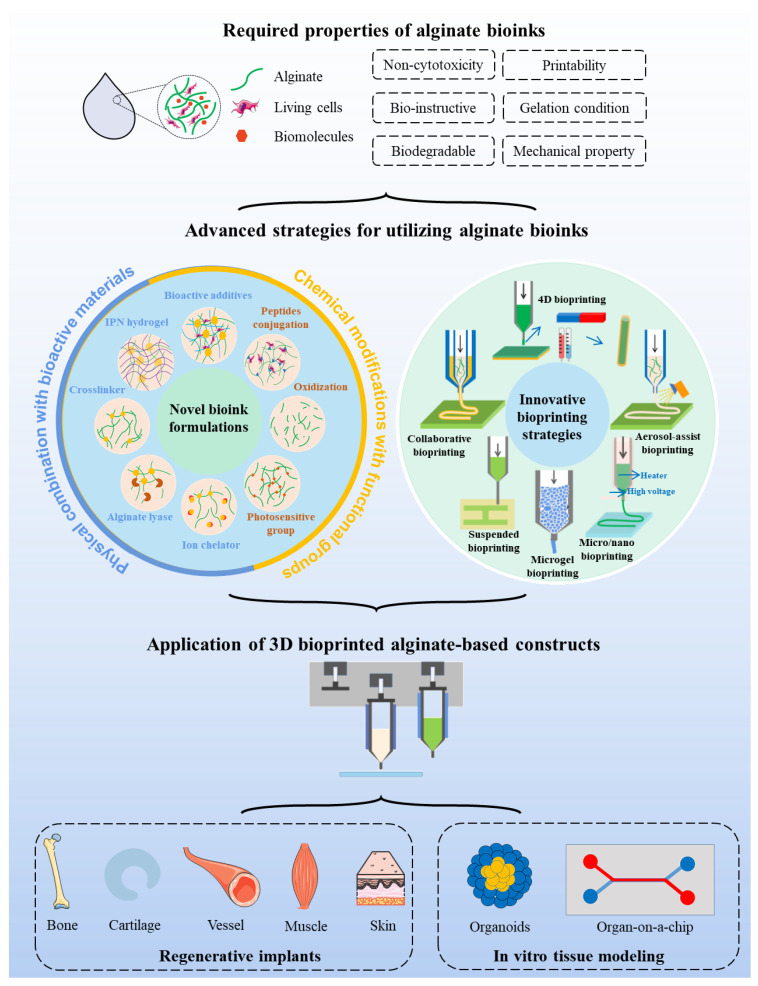
Figure 1
Figure 1
Schematic illustration representing advanced strategies for improving the performances of alginate bioinks, as well as their applications in 3D bioprinting of regenerative implants and in vitro tissue models. This figure was prepared using a template on the Sevier medical art website (http://www.sevier.fr/sevier-medical-art, accessed on 25 November 2021).
Figure 2
Figure 2
Schematic illustration showing the working principles of prevalent 3D bioprinting techniques. (A) inkjet-based 3D bioprinting, (B) extrusion-based 3D bioprinting, (C) (i) laser-assisted jetting, and (ii) stereolithography.
Figure 3
Figure 3
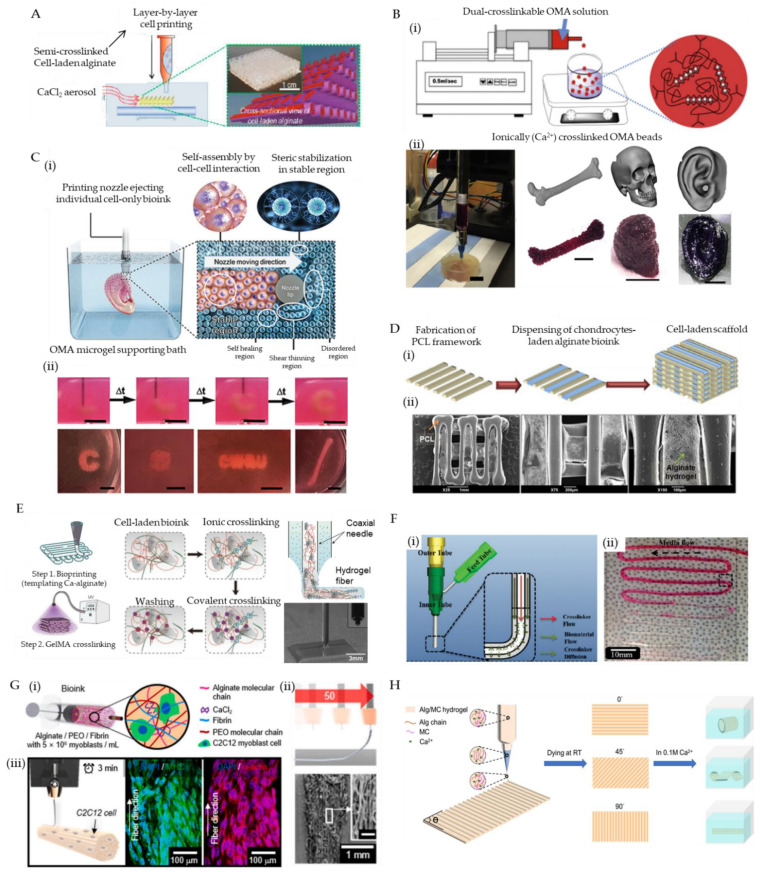
Representative examples that show advanced bioprinting strategies for the adoption of alginate bioinks. (A) A schematic of alginate bioink 3D bioprinting assisted by an aerosol-sparing process, producing semi-crosslinked struts (orange: non-crosslinked, purple: crosslinked by exposure to CaCl2 aerosol). Reproduced with permission from [119]. (B) (i) A schematic depicting the fabrication of ionic/covalent dual-crosslinkable OMA beads; and (ii) the 3D bioprinting of femur, skull, and ear models using the hMSCs-laden OMA microgel bioinks (scale: femur, 1 cm; skull and ear, 100 μm). Reproduced with permission from [122]. (C) (i) A schematic of 3D bioprinting of cells within the alginate microgel supporting medium, where the OMA microgels fluidize when stress is applied by the motion of the printing nozzles (shear-thinning region) and rapidly fill in after the needle passes (self-healing region) while the supporting medium without shear presents solid-like properties; and (ii) captures of bioprinting a letter “C” (time-course images), a cubic, an acronym “CWRU”, and a femur using stem cell-only bioinks. Reproduced with permission from [123]. (D) (i) A schematic of the fabrication process of cell-laden PCL/alginate hybrid scaffold using the collaborative 3D bioprinting strategy, and (ii) the SEM images of the fabricated porous hybrid scaffold at magnifications of ×25, ×75, and ×150. Reproduced with permission from [124]. (E) Schematic illustration of the fabrication process that coaxial extrudes a GelMA/alginate hybrid bioin through the core needle and CaCl2 solution through the shell needle, which sequentially undergoes ionic crosslinking and covalent crosslinking, resulting in direct 3D bioprinting of GelMA/alginate fibers. Reproduced with permission from [126]. (F) (i) A schematic of coaxial printing CaCl2/alginate solutions using a core/shell nozzle; and (ii) an image of bioprinted alginate microfluidic channels. Reproduced with permission from [128]. (G) (i) A schematic of the formulated cell-laden alginate/PEO/fibrin bioink for the electrohydrodynamic-direct-writing fabrication, (ii) A schematic and SEM images of microfibers fabricated using 50 mm/s nozzle moving speed (scale of the inset: 100 μm), (iii) A schematic showing the micro-scale printing of C2C12 cell-laden constructs and immunofluorescent images revealing the orientation of matured muscular fibers. Reproduced with permission from [129]. (H) A schematic of 4D bioprinting for fabricate Alg/MC hydrogels and their 3D deformations in CaCl2 solution. Reproduced with permission from [130].

References

    1. Murphy S.V., Atala A. 3D bioprinting of tissues and organs. Nat. Biotechnol. 2014;32:773–785. doi: 10.1038/nbt.2958. - DOI - PubMed
    1. Vijayavenkataraman S., Yan W.-C., Lu W.F., Wang C.-H., Fuh J.Y.H. 3D bioprinting of tissues and organs for regenerative medicine. Adv. Drug Deliv. Rev. 2018;132:296–332. doi: 10.1016/j.addr.2018.07.004. - DOI - PubMed
    1. Rawal P., Tripathi D.M., Ramakrishna S., Kaur S. Prospects for 3D bioprinting of organoids. Bio-Des. Manuf. 2021;4:627–640. doi: 10.1007/s42242-020-00124-1. - DOI
    1. Nie J., Gao Q., Fu J., He Y. Grafting of 3D bioprinting to in vitro drug screening: A review. Adv. Healthc. Mater. 2020;9:1901773. doi: 10.1002/adhm.201901773. - DOI - PubMed
    1. Sun W., Starly B., Daly A.C., Burdick J.A., Groll J., Skeldon G., Shu W., Sakai Y., Shinohara M., Nishikawa M. The bioprinting roadmap. Biofabrication. 2020;12:022002. doi: 10.1088/1758-5090/ab5158. - DOI - PubMed

LinkOut - more resources