Covid-19 Vaccine Effectiveness in New York State
- PMID: 34942067
- PMCID: PMC8693697
- DOI: 10.1056/NEJMoa2116063
Covid-19 Vaccine Effectiveness in New York State
Abstract
Background: Population-based data from the United States on the effectiveness of the three coronavirus disease 2019 (Covid-19) vaccines currently authorized by the Food and Drug Administration are limited. Whether declines in effectiveness are due to waning immunity, the B.1.617.2 (delta) variant of the severe acute respiratory syndrome coronavirus 2 (SARS-CoV-2), or other causes is unknown.
Methods: We used data for 8,690,825 adults in New York State to assess the effectiveness of the BNT162b2, mRNA-1273, and Ad26.COV2.S vaccines against laboratory-confirmed Covid-19 and hospitalization with Covid-19 (i.e., Covid-19 diagnosed at or after admission). We compared cohorts defined according to vaccine product received, age, and month of full vaccination with age-specific unvaccinated cohorts by linking statewide testing, hospital, and vaccine registry databases. We assessed vaccine effectiveness against Covid-19 from May 1 through September 3, 2021, and against hospitalization with Covid-19 from May 1 through August 31, 2021.
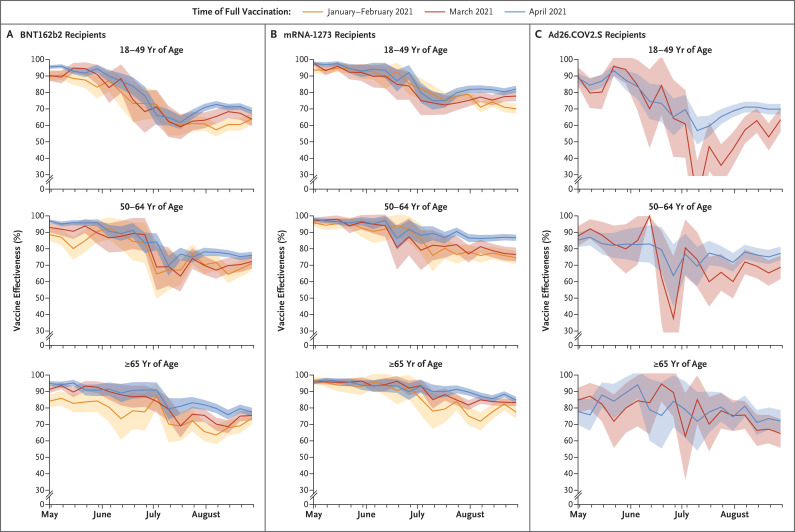
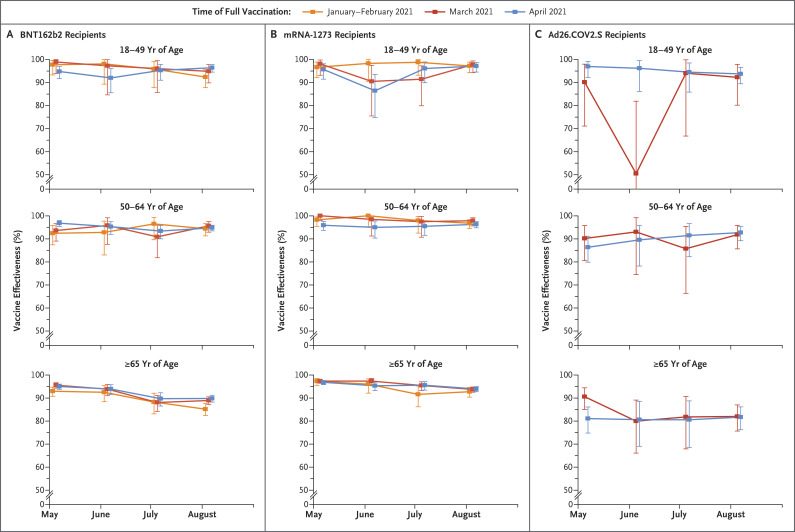
Results: There were 150,865 cases of Covid-19 and 14,477 hospitalizations with Covid-19. During the week of May 1, 2021, when the delta variant made up 1.8% of the circulating variants, the median vaccine effectiveness against Covid-19 was 91.3% (range, 84.1 to 97.0) for BNT162b2, 96.9% (range, 93.7 to 98.0) for mRNA-1273, and 86.6% (range, 77.8 to 89.7) for Ad26.COV2.S. Subsequently, effectiveness declined contemporaneously in all cohorts, from a median of 93.4% (range, 77.8 to 98.0) during the week of May 1 to a nadir of 73.5% (range, 13.8 to 90.0) around July 10, when the prevalence of the delta variant was 85.3%. By the week of August 28, when the prevalence of the delta variant was 99.6%, the effectiveness was 74.2% (range, 63.4 to 86.8). Effectiveness against hospitalization with Covid-19 among adults 18 to 64 years of age remained almost exclusively greater than 86%, with no apparent time trend. Effectiveness declined from May through August among persons 65 years of age or older who had received BNT162b2 (from 94.8 to 88.6%) or mRNA-1273 (from 97.1 to 93.7%). The effectiveness of Ad26.COV2.S was lower than that of the other vaccines, with no trend observed over time (range, 80.0 to 90.6%).
Conclusions: The effectiveness of the three vaccines against Covid-19 declined after the delta variant became predominant. The effectiveness against hospitalization remained high, with modest declines limited to BNT162b2 and mRNA-1273 recipients 65 years of age or older.
Copyright © 2021 Massachusetts Medical Society.
Figures
References
-
- Centers for Disease Control and Prevention. COVID data tracker. 2021. (https://covid.cdc.gov/covid-data-tracker/).
-
- Pfizer-BioNtech. Pfizer-BioNtech COVID-19 vaccine (BNT162, Pf-07302048) vaccines and related biological products advisory committee briefing document. 2021. (https://www.fda.gov/media/144246/download).
-
- Food and Drug Administration. Vaccines and related biological products advisory committee meeting presentation. mRNA-1273 sponsor briefing document. 2021. (https://www.fda.gov/media/144452/download).
-
- Food and Drug Administration. Vaccines and related biological products advisory committee COVID-19 vaccine Ad26.COV2.S VAC31518 (JNJ-78436735) sponsor briefing document. 2021. (https://www.fda.gov/media/146219/download).
-
- Centers for Disease Control and Prevention. Variant proportions. 2021. (https://covid.cdc.gov/covid-data-tracker/#variant-proportions).
Publication types
MeSH terms
Substances
Supplementary concepts
LinkOut - more resources
Full Text Sources
Other Literature Sources
Medical
Miscellaneous