Review
. 2021 Nov 29;8(12):1100.
doi: 10.3390/children8121100.

Prevalence of Sleep Disturbances in Pediatric Cancer Patients and Their Diagnosis and Management

Affiliations
Review

Prevalence of Sleep Disturbances in Pediatric Cancer Patients and Their Diagnosis and Management

Irtiza N Sheikh et al. Children (Basel). .

Abstract

Sleep disturbances represent an understudied yet common source of distress among pediatric cancer patients and survivors, with deleterious effects on quality of life. Sleep issues stem from multiple risk factors, yet individual contributors are difficult to isolate, consequently impeding the identification of targets for intervention. In many pediatric cancer patients, disrupted sleep and its negative impact on quality of life continue into adulthood and may affect various functional domains. This literature review highlights the types and prevalence of sleep disturbances in pediatric cancer patients during active treatment and through survivorship. Potential etiological and risk factors for disturbed sleep are summarized, including the effects of cancer and its treatment, psychosocial and family factors, as well as individual-patient aspects, such as genetics, mood and coping skills. While existing assessment and management strategies are reviewed, the literature is incomplete, and significant gaps emerge in our understanding of sleep disturbances in pediatric cancer patients and survivors. The review concludes with recommendations of areas where further research is needed. The aims of this review include increasing clinicians' awareness of sleep disturbances as a significant source of poor quality of life in pediatric cancer patients and survivors and directing researchers to gaps in our understanding of sleep disturbances in pediatric cancer patients and survivors.

Keywords: adolescents and young adults; excessive daytime sleepiness; insomnia; pediatric cancer; sleep disturbance; survivorship.


Conflict of interest statement

The authors declare no conflict of interest.

Figures
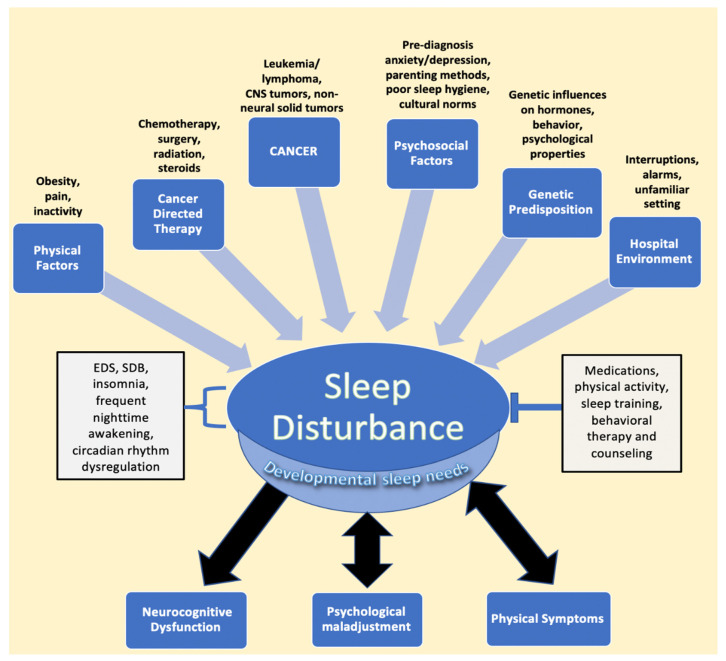
Figure 1
Figure 1
Factors impacting sleep in children diagnosed with cancer. The figure describes the various entities described in the literature that lead to sleep disturbance, followed by the resulting sequalae of negatively impacted sleep. EDS, SDB, frequent nighttime awakening, and circadian rhythm dysregulation are components of disturbed sleep, while interventions such as medications, physical activity, sleep training, and counseling represent mitigating factors that relieve sleep issues. Developmental sleep needs are affected globally by sleep disturbances, despite the fact that children of different ages require different amounts of sleep. Psychological maladjustment and physical symptoms, such as pain, have been found to have a bidirectional relationship with sleep issues. Abbreviations: CNS, central nervous system; EDS, excessive daytime sleepiness; SDB, sleep disordered breathing.
Figure 2
Figure 2
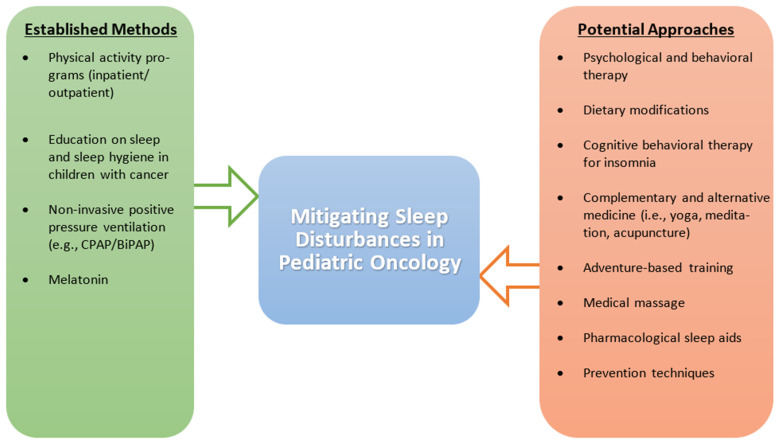
Established and potential management strategies to address sleep disturbances in pediatric cancer patients. The figure compares established methods that have been found to positively impact sleep to potential methods that require more investigation, specifically in the pediatric cancer population. Abbreviations: BiPAP, bi-level positive airway pressure; CPAP, continuous positive airway pressure.
Figure 3
Figure 3
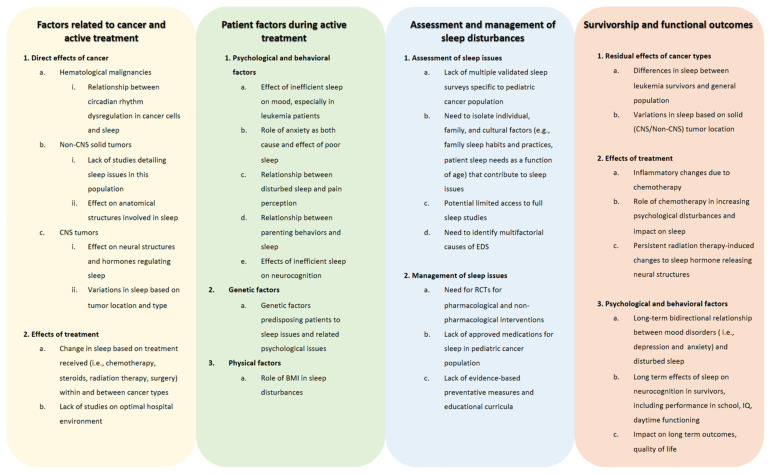
Gaps in knowledge on sleep disturbances in children with cancer. The figure describes areas where there is a need for further investigation in regard to sleep issues, their assessment and management, and their causes and sequalae during and after treatment, including many years into survivorship. Abbreviations: BMI, body mass index; CNS, central nervous system; EDS, excessive daytime sleepiness; IQ, intelligence quotient; RCT, randomized controlled trial.

References

    1. Cunningham M.R., Walton M.A., Carter P.M. The Major Causes of Death in Children and Adolescents in the United States. New Engl. J. Med. 2018;379:2468–2475. doi: 10.1056/NEJMsr1804754. - DOI - PMC - PubMed
    1. Rosen G., Brand S.R. Sleep in children with cancer: Case review of 70 children evaluated in a comprehensive pediatric sleep center. Support. Care Cancer. 2011;19:985–994. doi: 10.1007/s00520-010-0921-y. - DOI - PubMed
    1. O’Leary M., Krailo M., Anderson J.R., Reaman G.H. Progress in Childhood Cancer: 50 Years of Research Collaboration, a Report from the Children’s Oncology Group. Semin. Oncol. 2008;35:484–493. doi: 10.1053/j.seminoncol.2008.07.008. - DOI - PMC - PubMed
    1. Hart N.C., Palermo T.M., Rosen C.L. Health-related quality of life among children presenting to a pediatric sleep disorders clinic. Behav. Sleep. Med. 2005;3:4–17. doi: 10.1207/s15402010bsm0301_3. - DOI - PubMed
    1. Walker A.J., Johnson K.P., Miaskowski C., Lee K.A., Gedaly-Duff V. Sleep quality and sleep hygiene behaviors of adolescents during chemotherapy. J. Clin. Sleep Med. 2010;6:439–444. doi: 10.5664/jcsm.27932. - DOI - PMC - PubMed

LinkOut - more resources