Review
. 2021 Nov 24;11(12):2181.
doi: 10.3390/diagnostics11122181.

Deep Learning Applications in Magnetic Resonance Imaging: Has the Future Become Present?

Affiliations
Review

Deep Learning Applications in Magnetic Resonance Imaging: Has the Future Become Present?

Sebastian Gassenmaier et al. Diagnostics (Basel). .

Abstract

Deep learning technologies and applications demonstrate one of the most important upcoming developments in radiology. The impact and influence of these technologies on image acquisition and reporting might change daily clinical practice. The aim of this review was to present current deep learning technologies, with a focus on magnetic resonance image reconstruction. The first part of this manuscript concentrates on the basic technical principles that are necessary for deep learning image reconstruction. The second part highlights the translation of these techniques into clinical practice. The third part outlines the different aspects of image reconstruction techniques, and presents a review of the current literature regarding image reconstruction and image post-processing in MRI. The promising results of the most recent studies indicate that deep learning will be a major player in radiology in the upcoming years. Apart from decision and diagnosis support, the major advantages of deep learning magnetic resonance imaging reconstruction techniques are related to acquisition time reduction and the improvement of image quality. The implementation of these techniques may be the solution for the alleviation of limited scanner availability via workflow acceleration. It can be assumed that this disruptive technology will change daily routines and workflows permanently.

Keywords: DL; GRE; MRI; MSK; TSE; deep learning; prostate MRI.


Conflict of interest statement

Dominik Nickel is an employee of Siemens Healthcare.

Figures
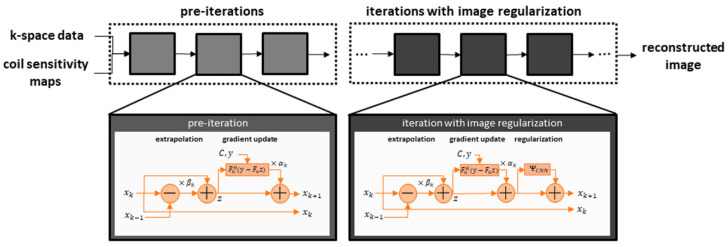
Figure 1
Figure 1
The network receives conventionally determined coil sensitivity maps that specify the local sensitivity of each receiving channel, as well as the under-sampled k-space data. The reconstruction iteratively updates the image based on the gradients of the data fidelity term. In the first step, this may be done without image regularization, as the architecture focuses on generating non-acquired k-space samples which are based on the inherent parallel imaging component of the data fidelity term. As the extrapolation may still involve trainable parameters, such as the gradient step-sizes, these iterations are called pre-cascades. The main deep-learning aspect is then included in subsequent cascades that further include an image-enhancing neural network as regularization.
Figure 2
Figure 2
Figure 2 shows an example of a T2-weighted turbo spin-echo (TSE) image of the prostate in the axial plane, with standard reconstruction (SR) and deep learning reconstruction (DL) of a second, under-sampled acquisition of the same patient. SR is shown on the left, with an acquisition time of 4:19 min. The acquisition time of DL was 1:20 min in the same patient (right-hand-side image). Motion artifacts were reduced due to the shortened acquisition time.
Figure 3
Figure 3
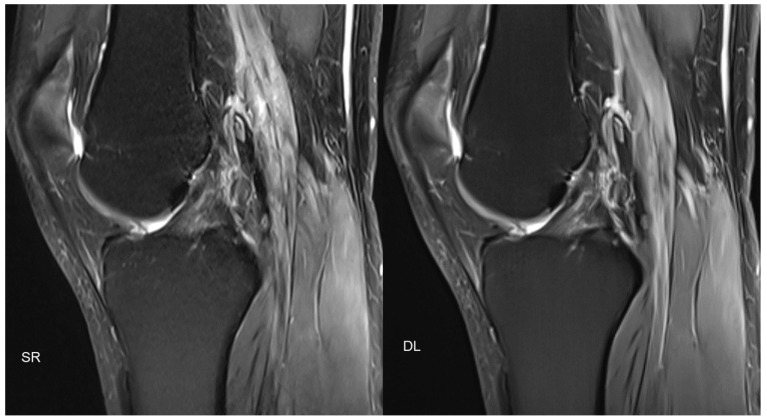
Figure 3 shows an example of PD-weighted turbo spin-echo (TSE) imaging, with fat sat of the knee in the sagittal plane, with standard reconstruction (SR; acquisition time 3:11 min) and deep learning reconstruction (DL; acquisition time 1:33 min) of the same patient. Similar to Figure 2, two different acquisitions were performed (standard acquisition for SR and conventionally under-sampled acquisition for DL).
Figure 4
Figure 4
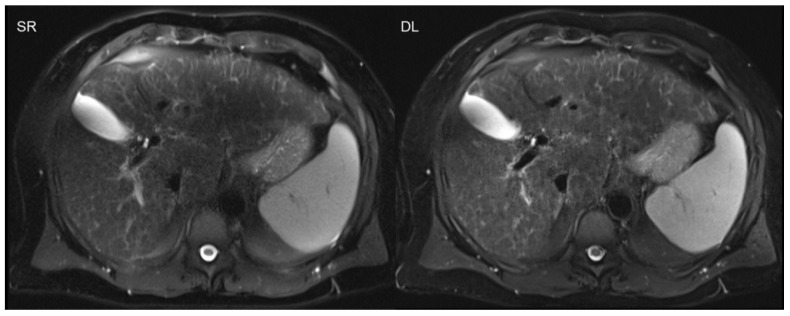
Deep learning reconstruction (DL; acquisition time 0:16 min) of accelerated T2-weighted half-Fourier acquisition single-shot turbo spin-echo sequence (HASTE) of the upper abdomen using a 3T scanner is shown on the right. The left-hand side image demonstrates standard reconstruction (SR; acquisition time 1:30 min).
Figure 5
Figure 5
Dynamic contrast-enhanced T1-weighted gradient echo imaging (VIBE Dixon) of the liver. Standard reconstruction is shown on the left. The right hand-side image shows the result of post-processing of the same dataset without change of acquisition parameters, using a deep learning super-resolution algorithm with improved sharpness and contrast.

References

    1. Mazurowski M.A., Buda M., Saha A., Bashir M.R. Deep learning in radiology: An overview of the concepts and a survey of the state of the art with focus on MRI. J. Magn. Reason. Imaging. 2019;49:939–954. doi: 10.1002/jmri.26534. - DOI - PMC - PubMed
    1. Shen D., Wu G., Suk H.I. Deep Learning in Medical Image Analysis. Annu. Rev. Biomed. Eng. 2017;19:221–248. doi: 10.1146/annurev-bioeng-071516-044442. - DOI - PMC - PubMed
    1. Litjens G., Kooi T., Bejnordi B.E., Setio A.A.A., Ciompi F., Ghafoorian M., van der Laak J.A.W.M., van Ginneken B., Sanchez C.I. A survey on deep learning in medical image analysis. Med. Image Anal. 2017;42:60–88. doi: 10.1016/j.media.2017.07.005. - DOI - PubMed
    1. Lundervold A.S., Lundervold A. An overview of deep learning in medical imaging focusing on MRI. Z. Med. Phys. 2019;29:102–127. doi: 10.1016/j.zemedi.2018.11.002. - DOI - PubMed
    1. Shin H.C., Roth H.R., Gao M., Lu L., Xu Z., Nogues I., Yao J., Mollura D., Summers R.M. Deep Convolutional Neural Networks for Computer-Aided Detection: CNN Architectures, Dataset Characteristics and Transfer Learning. IEEE Trans. Med. Imaging. 2016;35:1285–1298. doi: 10.1109/TMI.2016.2528162. - DOI - PMC - PubMed

LinkOut - more resources