


The E-Textile for Biomedical Applications: A Systematic Review of Literature
- PMID: 34943500
- PMCID: PMC8700039
- DOI: 10.3390/diagnostics11122263
The E-Textile for Biomedical Applications: A Systematic Review of Literature
Abstract
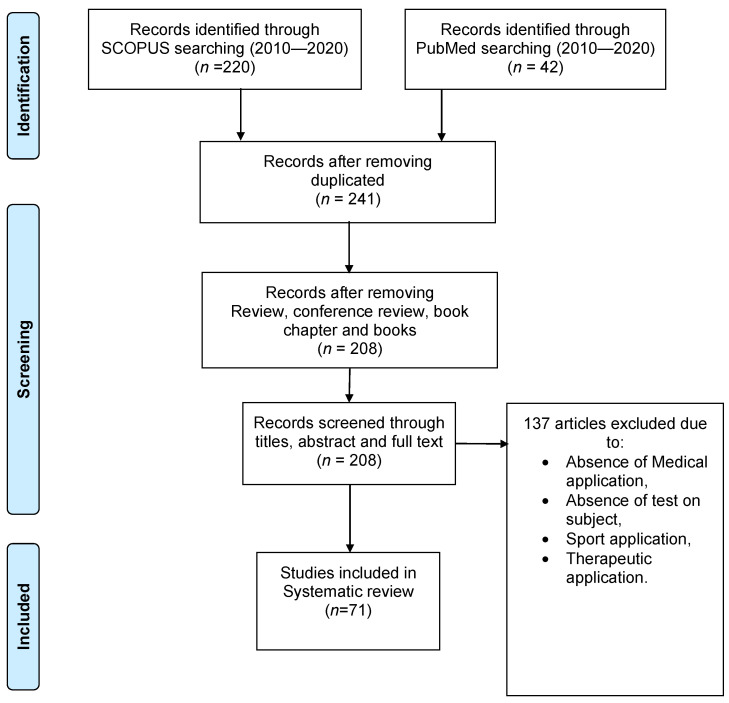
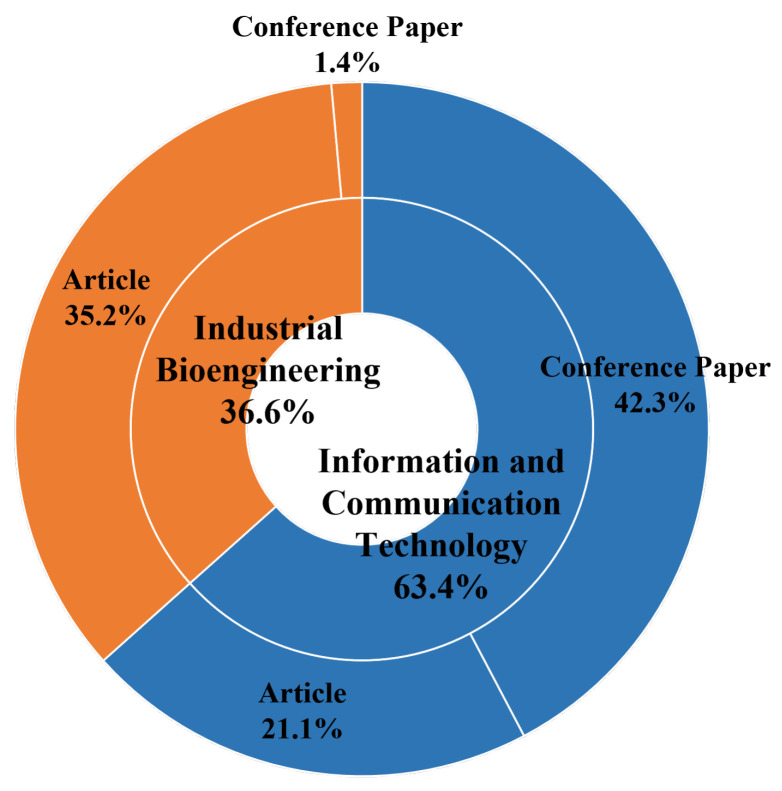
The use of e-textile technologies spread out in the scientific research with several applications in both medical and nonmedical world. In particular, wearable technologies and miniature electronics devices were implemented and tested for medical research purposes. In this paper, a systematic review regarding the use of e-textile for clinical applications was conducted: the Scopus and Pubmed databases were investigate by considering research studies from 2010 to 2020. Overall, 262 papers were found, and 71 of them were included in the systematic review. Of the included studies, 63.4% focused on information and communication technology studies, while the other 36.6% focused on industrial bioengineering applications. Overall, 56.3% of the research was published as an article, while the remainder were conference papers. Papers included in the review were grouped by main aim into cardiological, muscular, physical medicine and orthopaedic, respiratory, and miscellaneous applications. The systematic review showed that there are several types of applications regarding e-textile in medicine and several devices were implemented as well; nevertheless, there is still a lack of validation studies on larger cohorts of subjects since the majority of the research only focuses on developing and testing the new device without considering a further extended validation.
Keywords: ECG; IMUs; biomedical engineering; diagnosis; e-textile; health monitoring; motion analysis; sEMG; smart garments; wearable.
Conflict of interest statement
The authors declare no conflict of interest.
Figures
References
-
- Jung Y., Kim S., Choi B. Consumer valuation of the wearables: The case of smartwatches. Comput. Hum. Behav. 2016;63:899–905. doi: 10.1016/j.chb.2016.06.040. - DOI
-
- Ghaffarzadeh K., Hayward J. Stretchable and conformable electronics: Heading toward market reality. Inf. Disp. 2017;33:28–31. doi: 10.1002/j.2637-496X.2017.tb01043.x. - DOI
-
- Amitrano F., Donisi L., Coccia A., Biancardi A., Pagano G., D’Addio G. Experimental development and validation of an e-textile sock prototype; Proceedings of the 2020 IEEE International Symposium on Medical Measurements and Applications (MeMeA); Bari, Italy. 1 June–1 July 2020; pp. 1–5. - DOI
Publication types
LinkOut - more resources
Full Text Sources
