. 2021 Nov 26;10(12):1453.
doi: 10.3390/antibiotics10121453.

Alternative and Complementary Therapies against Foodborne Salmonella Infections

Affiliations

Alternative and Complementary Therapies against Foodborne Salmonella Infections

Mohamed F Ghaly et al. Antibiotics (Basel). .

Abstract

The limitations in the therapeutic options for foodborne pathogens lead to treatments failure, especially for multidrug-resistant (MDR) Salmonella sp., worldwide. Therefore, we aimed to find alternative and complementary therapies against these resistant foodborne pathogens. Out of 100 meat products samples, the prevalence rate of salmonella was 6%, serotyped only as S. Typhimurium and S. Enteritidis. According to the antibiotic susceptibility assays, the majority of our isolates were MDR and susceptible to cefotaxime. Out of the 13 tested plant extracts, five only showed an inhibition zone in the range of 8-50 mm against both serotypes. Based on their promising activity, the oily extract of cinnamon and aqueous extract of paprika represented the highest potency. Surprisingly, a significant synergistic effect was detected between cinnamon oil and cefotaxime. Depending on Gas Chromatography/Mass Spectrometry (GC-MS), the antimicrobial activity of cinnamon oil was attributed to four components including linalool, camphor, (Z)-3-Phenylacrylaldehyde and its stereoisomer 2-Propenal-3-phenyl. The anti-virulence activities of these compounds were confirmed on the basis of computational molecular docking studies. Accordingly, we recommended the use of cinnamon oil as a food additive to fight the resistant foodborne pathogens. Additionally, we confirmed its therapeutic uses, especially when co-administrated with other antimicrobial agents.

Keywords: Salmonella; cefotaxime; cinnamon; foodborne; paprika.


Conflict of interest statement

The authors do not have any conflicts of interest to declare.

Figures

Figure 1
Figure 1
Percentage of the resistant Salmonella isolates to each antimicrobial agent. In contrast to rifampicin, the cefotaxime, ciprofloxacin, and amoxicillin+ clavulanic acid showed a maximum antimicrobial activity against all Salmonella isolates.
Figure 2
Figure 2
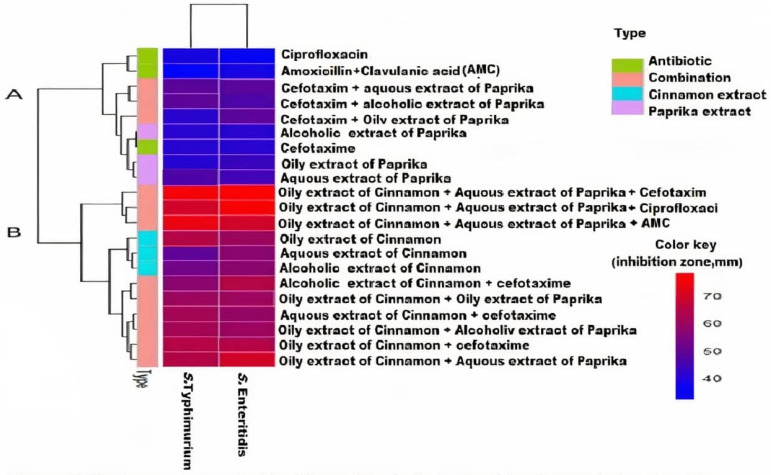
Heat map supported by hierarchical clustering (dendrogram). This figure shows the effect of different treatments against the two species of Salmonella. The color key indicates the inhibition zone measured as mm. The analyses were conducted using R program (packagepheatmap). The type refers to the category of the treatment.
Figure 3
Figure 3
Non-metric multidimensional scaling. The overlap among various treatments against the two Salmonella serotypes was visualized. Each dot refers to treatment of one biological replicate. This analysis was conducted using the PC-ORD software. Cefo: cefotaxime, pa: paprika, pa1: aqueous extract of paprika, pa2: alcoholic extract of paprika, pa3: oily extract of paprika, C.oil: cinnamon oil.
Figure 4
Figure 4
TLC-bioautography of cinnamon oil extract.
Figure 5
Figure 5
Docking poses and 2D interaction diagrams of selected compounds for Salmonella’s SipD protein (PDB ID 3O01). Crystal conformation of co-crystallized ligand is colored in yellow and docked conformation is colored in blue. Green shading in 2D interaction diagrams represents hydrophobic interactions, grey areas, broken thick lines around ligand shape indicates accessible surface, and arrows represent hydrogen bonds.

References

    1. Tadesse D.A., Zhao S., Tong E., Ayers S., Singh A., Bartholomew M.J., McDermott P.F. Antimicrobial drug resistance in Escherichia coli from humans and food animals, United States, 1950–2002. Emerg. Infect. Dis. 2012;18:741–749. doi: 10.3201/eid1805.111153. - DOI - PMC - PubMed
    1. Sharma S. Food preservatives and their harmful effects. Int. J. Sci. Res. Publ. 2015;5:1–2.
    1. Okeke I.N., Laxminarayan R., Bhutta Z.A., Duse A.G., Jenkins P., O’Brien T.F., Pablos-Mendez A., Klugman K.P. Antimicrobial resistance in developing countries. Part I: Recent trends and current status. Lancet Infect. Dis. 2005;5:481–493. doi: 10.1016/S1473-3099(05)70189-4. - DOI - PubMed
    1. Hyldgaard M., Mygind T., Meyer R.L. Essential oils in food preservation: Mode of action, synergies, and interactions with food matrix components. Front. Microbiol. 2012;3:12. doi: 10.3389/fmicb.2012.00012. - DOI - PMC - PubMed
    1. Elshafie H.S., Viggiani L., Mostafa M.S., El-Hashash M.A., Camele I., Bufo S.A. Biological Activity and Chemical Identification of Ornithine Lipid Produced by Burkholderia Gladioli Pv. Agaricicola ICMP 11096 Using LC-MS and NMR Analyses. J. Biol. Res. 2018;90:2. doi: 10.4081/jbr.2017.6534. - DOI

LinkOut - more resources