


Are We Approaching Peak Meat Consumption? Analysis of Meat Consumption from 2000 to 2019 in 35 Countries and Its Relationship to Gross Domestic Product
- PMID: 34944243
- PMCID: PMC8697883
- DOI: 10.3390/ani11123466
Are We Approaching Peak Meat Consumption? Analysis of Meat Consumption from 2000 to 2019 in 35 Countries and Its Relationship to Gross Domestic Product
Abstract
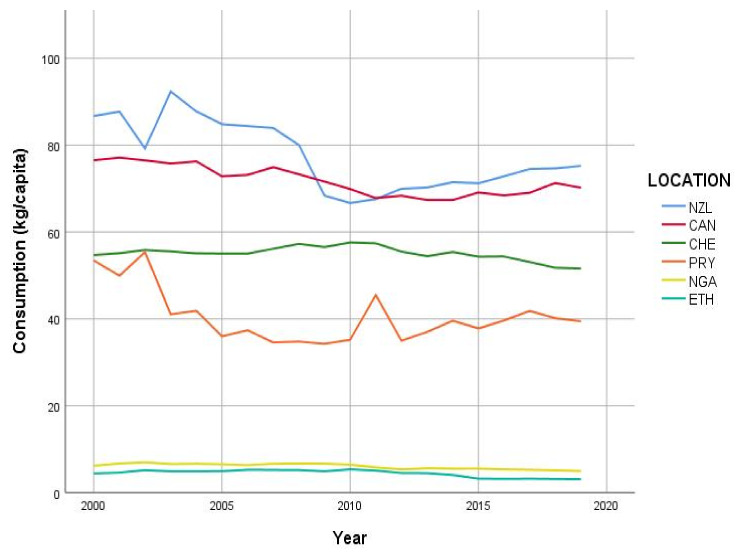
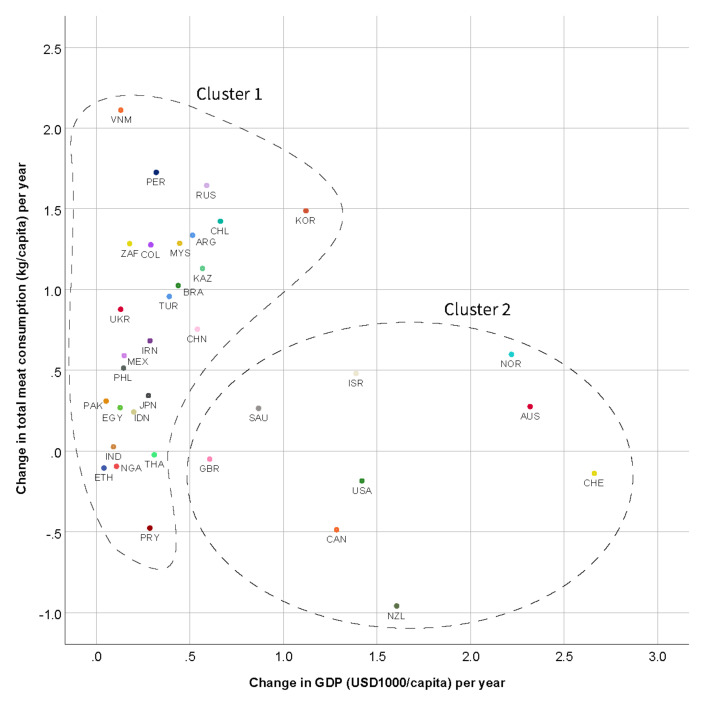
Growing prosperity, but also disease outbreaks, natural disasters, and consumer preferences are changing global meat consumption. We investigated the 2000-2019 trends in 35 countries monitored by the Food and Agriculture Organization and the Organisation for Economic Co-operation and Development. We also tested relationships with Gross Domestic Product (GDP). Several countries appeared to be reaching peak consumption of some meats, and three (New Zealand, Canada, and Switzerland) have reached this. Poultry consumption increased over time in most countries, and beef and mutton/lamb consumption decreased in many. Using cluster analysis, we divided countries into two clusters: one in which increases in GDP per capita matched increases in meat consumption; and a second one of nine countries, for which there was no association between per capita change in GDP and meat consumption. There was evidence of a tipping point around USD 40,000 of GDP per capita, after which increases in economic well-being do not lead to increased meat consumption.
Keywords: COVID-19; GDP; beef; lamb; meat consumption; pork; poultry; sustainability.
Conflict of interest statement
The authors declare no conflict of interest.
Figures

References
-
- Ritchie H., Roser M. Meat and Dairy Production. 2019. [(accessed on 27 September 2021)]. Our World in Data. Available online: https://ourworldindata.org/meat-production.
-
- United Nations (UN) Policy Brief: The Impact of COVID-19 on Food Security and Nutrition. [(accessed on 27 September 2021)];2020 Available online: https://www.un.org/sites/un2.un.org/files/sg_policy_brief_on_covid_impac....
-
- Vranken L., Avermaete T., Petalios D., Mathijs E. Curbing global meat consumption: Emerging evidence of a second nutrition transition. Environ. Sci. Policy. 2014;39:95–106. doi: 10.1016/j.envsci.2014.02.009. - DOI
-
- Carrington D. Europe and US Could Reach ‘Peak Meat’ in 2025—Report. The Guardian. Mar 24, 2021. [(accessed on 27 September 2021)]. Available online: https://www.theguardian.com/environment/2021/mar/23/europe-and-us-could-....
LinkOut - more resources
Full Text Sources
