Review
. 2021 Dec 14;9(12):1916.
doi: 10.3390/biomedicines9121916.

Peripheral Cytokine Levels as a Prognostic Indicator in Gastric Cancer: A Review of Existing Literature

Affiliations
Review

Peripheral Cytokine Levels as a Prognostic Indicator in Gastric Cancer: A Review of Existing Literature

Elton Yang et al. Biomedicines. .

Abstract

Although strong connections exist between the carcinogenesis of gastric cancer and chronic inflammation, gastric cancer is unique in that the chronic gastritis which frequently precedes carcinogenesis is strongly associated with H. pylori infection. The interplay between H. pylori virulence factors and host immune cells is complex but culminates in the activation of inflammatory pathways and transcription factors such as NF-κB, STAT3, and AP-1, all of which upregulate cytokine production. Due to the key role of cytokines in modulating the immune response against tumour cells as well as possibly stimulating tumour growth and proliferation, different patterns of cytokine secretion may be associated with varying patient outcomes. In relation to gastric cancer, interleukin-6, 8, 10, 17A, TNF, and IFN-γ may have pro-tumour properties, although interleukin-10, TNF, and IFN-γ may have anti-tumour effects. However, due to the lack of studies investigating patient outcomes, only a link between higher interleukin-6 levels and poorer prognosis has been demonstrated. Further investigations which link peripheral cytokine levels to patient prognosis may elucidate important pathological mechanisms in gastric cancer which adversely impact patient survival and allow treatments targeting these processes to be developed.

Keywords: Helicobacter pylori; cytokine; gastric cancer; interferon-gamma; interleukin; tumour necrosis factor.


Conflict of interest statement

The authors declare no conflict of interest.

Figures
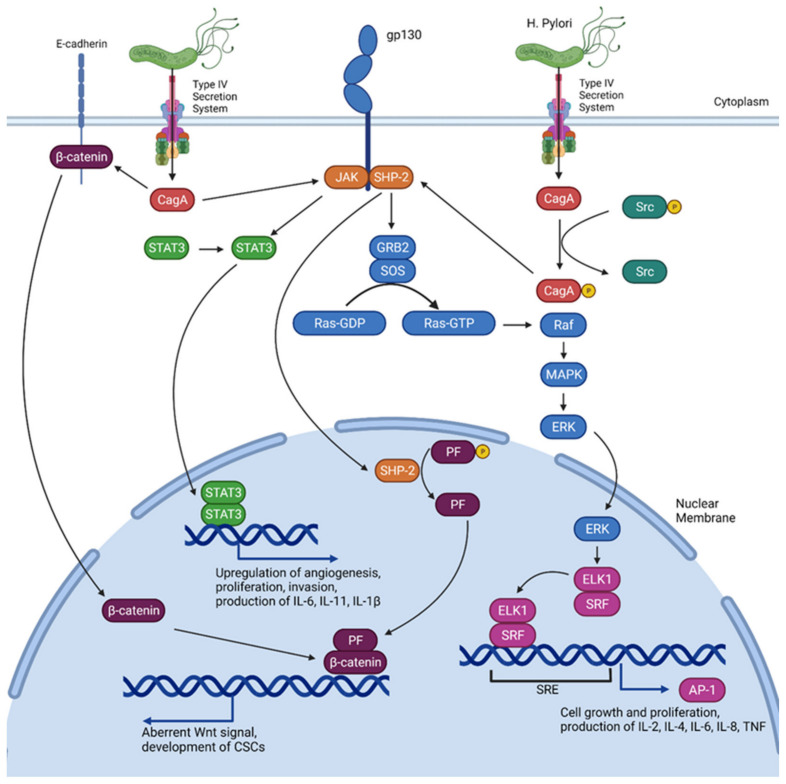
Figure 1
Figure 1
Activation of several inflammatory pathways known to produce cytokines mediated by H. pylori infection. CagA injected via T4SS which is phosphorylated by Src activates Ras/Raf/MAPK/ERK via SHP-2 [27]; nuclear translocation of ERK subsequently induces ETS like-1 protein (ELK1) and serum response factor (SRF) binding to the serum response element (SRE) leading to transcription of AP-1 [28]. STAT3 dimerisation and nuclear translocation also occurs after CagA mediated activation of JAK. CagA further activates β-catenin, which in conjunction with SHP-2 dephosphorylating parafibromin (PF) following nuclear translocation enables the formation of the PF/β-catenin complex to activate Wnt signalling pathways [6], which is associated with development of CSCs. AP-1 and STAT3 also play key roles in signalling for cell growth and proliferation; their dysregulation may increase the risk of carcinogenesis.
Figure 2
Figure 2
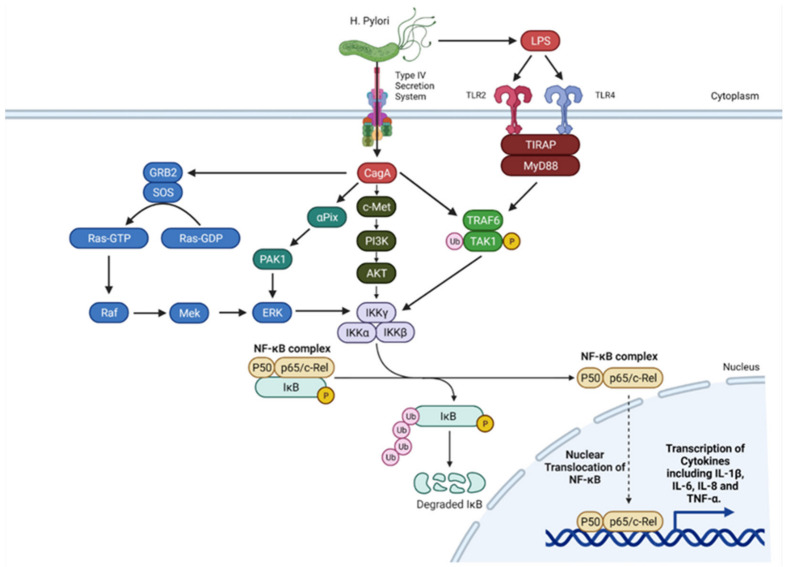
Activation of NF-κB by CagA released by H. pylori. Multiple activation pathways are CagA dependent; activation of growth factor receptor-bound protein 2 (GRB2) leads to Ras/Raf activation, which in turn activates NF-κB. This pathway can also occur via P21-activated kinase 1 (PAK1) [32]. NF-κB activation can also occur through c-met and phosphatidylinositol 3-kinase (PI3K) upstream activation, as well as via tumour necrosis factor receptor-associated factor 6 (TRAF6) and transforming growth factor-β-activated kinase 1 (TAK1). The TRAF6/TAK1 pathway can be activated by H. pylori liposaccharide (LPS) activation of toll-like receptor 4 (TLR4). Figure adapted from “NF-κB Signalling Pathway”, by BioRender.com (2021). Retrieved from https://app.biorender.com/biorender-templates (accessed on 6 November 2021).
Figure 3
Figure 3
Differentiation pathways of CD4+ T-cells, which are dependent on the cytokine profile. Consequently, each different CD4+ T-cell lineage possesses a distinctive cytokine production pattern as shown above. Figure adapted from “T cell activation and differentiation”, by BioRender.com (2021). Retrieved from https://app.biorender.com/biorender-template (accessed on 6 November 2021).

References

    1. Rawla P., Barsouk A. Epidemiology of gastric cancer: Global trends, risk factors and prevention. Prz. Gastroenterol. 2019;14:26–38. doi: 10.5114/pg.2018.80001. - DOI - PMC - PubMed
    1. Sitarz R., Skierucha M., Mielko J., Offerhaus J., Maciejewski R., Polkowski W. Gastric cancer: Epidemiology, prevention, classification, and treatment. Cancer Res. 2018;10:239–248. doi: 10.2147/CMAR.S149619. - DOI - PMC - PubMed
    1. Matsueda S., Graham D. Immunotherapy in gastric cancer. World J. Gastroenterol. 2014;20:1657. doi: 10.3748/wjg.v20.i7.1657. - DOI - PMC - PubMed
    1. Oya Y., Hayakawa Y., Koike K. Tumor microenvironment in gastric cancers. Cancer Sci. 2020;111:2696–2707. doi: 10.1111/cas.14521. - DOI - PMC - PubMed
    1. Chung H.W. Role of the tumor microenvironment in the pathogenesis of gastric carcinoma. World J. Gastroenterol. 2014;20:1667. doi: 10.3748/wjg.v20.i7.1667. - DOI - PMC - PubMed

LinkOut - more resources