Review
. 2021 Dec 9;13(24):6206.
doi: 10.3390/cancers13246206.

The Colorectal Cancer Tumor Microenvironment and Its Impact on Liver and Lung Metastasis

Affiliations
Review

The Colorectal Cancer Tumor Microenvironment and Its Impact on Liver and Lung Metastasis

Raghav Chandra et al. Cancers (Basel). .

Abstract

Colorectal cancer (CRC) is the third most common malignancy and the second most common cause of cancer-related mortality worldwide. A total of 20% of CRC patients present with distant metastases, most frequently to the liver and lung. In the primary tumor, as well as at each metastatic site, the cellular components of the tumor microenvironment (TME) contribute to tumor engraftment and metastasis. These include immune cells (macrophages, neutrophils, T lymphocytes, and dendritic cells) and stromal cells (cancer-associated fibroblasts and endothelial cells). In this review, we highlight how the TME influences tumor progression and invasion at the primary site and its function in fostering metastatic niches in the liver and lungs. We also discuss emerging clinical strategies to target the CRC TME.

Keywords: colorectal cancer; colorectal liver metastasis; colorectal pulmonary metastasis; immuno-oncology; novel anticancer therapy; tumor microenvironment.


Conflict of interest statement

The authors declare no conflict of interest.

Figures
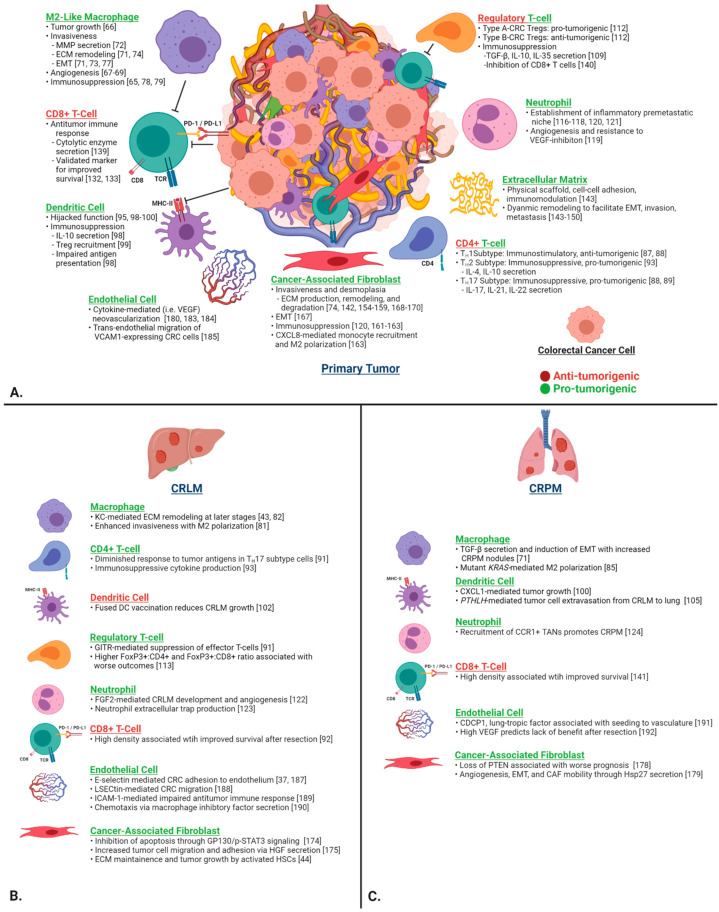
Figure 2
Figure 2
(A) Contributions of the key individual components of the CRC TME on tumor progression, invasion, ECM remodeling, immunosuppression, and metastasis in the primary tumor. (B) CRLM- and (C) CRPM-specific functions are depicted in the lower two panels. Green headings signify pro-tumorigenic functions, and red headings signify anti-tumorigenic functions. Abbreviations: CRC, colorectal cancer; ECM, extracellular matrix; EMT, epithelial–mesenchymal transition; MMP, matrix metalloproteinase; TME, tumor microenvironment.
Figure 1
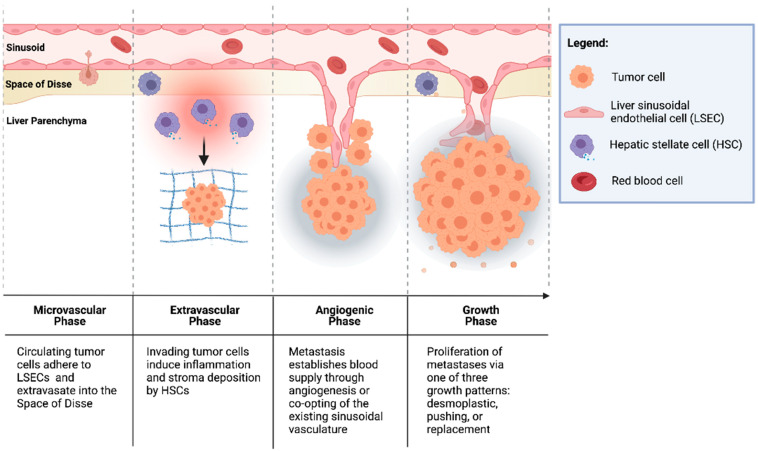
Figure 1
Formation of colorectal liver metastases through four overlapping phases: microvascular, extravascular, angiogenic, and growth.

References

    1. Keum N., Giovannucci E. Global burden of colorectal cancer: Emerging trends, risk factors and prevention strategies. Nat. Rev. Gastroenterol. Hepatol. 2019;16:713–732. doi: 10.1038/s41575-019-0189-8. - DOI - PubMed
    1. Kinj R., Bondiau P.Y., Francois E., Gerard J.P., Naghavi A.O., Leysalle A., Chamorey E., Evesque L., Padovani B., Ianessi A., et al. Radiosensitivity of Colon and Rectal Lung Oligometastasis Treated with Stereotactic Ablative Radiotherapy. Clin. Color. Cancer. 2017;16:e211–e220. doi: 10.1016/j.clcc.2016.08.003. - DOI - PubMed
    1. Widder J., Klinkenberg T.J., Ubbels J.F., Wiegman E.M., Groen H.J., Langendijk J.A. Pulmonary oligometastases: Metastasectomy or stereotactic ablative radiotherapy? Radiother. Oncol. 2013;107:409–413. doi: 10.1016/j.radonc.2013.05.024. - DOI - PubMed
    1. Andre T., Shiu K.K., Kim T.W., Jensen B.V., Jensen L.H., Punt C., Smith D., Garcia-Carbonero R., Benavides M., Gibbs P., et al. Pembrolizumab in Microsatellite-Instability-High Advanced Colorectal Cancer. N. Engl. J. Med. 2020;383:2207–2218. doi: 10.1056/NEJMoa2017699. - DOI - PubMed
    1. Benson A.B., Venook A.P., Al-Hawary M.M., Arain M.A., Chen Y.-J., Ciombor K.K., Cohen S., Cooper H.S., Deming D., Farkas L. Colon cancer, version 2.2021, NCCN clinical practice guidelines in oncology. J. Natl. Compr. Cancer Netw. 2021;19:329–359. doi: 10.6004/jnccn.2021.0012. - DOI - PubMed

LinkOut - more resources