Review
. 2021 Dec 10;13(24):6219.
doi: 10.3390/cancers13246219.

Shooting at Moving and Hidden Targets-Tumour Cell Plasticity and the Notch Signalling Pathway in Head and Neck Squamous Cell Carcinomas

Affiliations
Review

Shooting at Moving and Hidden Targets-Tumour Cell Plasticity and the Notch Signalling Pathway in Head and Neck Squamous Cell Carcinomas

Joanna Kałafut et al. Cancers (Basel). .

Abstract

Head and Neck Squamous Cell Carcinoma (HNSCC) is often aggressive, with poor response to current therapies in approximately 40-50% of the patients. Current therapies are restricted to operation and irradiation, often combined with a small number of standard-of-care chemotherapeutic drugs, preferentially for advanced tumour patients. Only very recently, newer targeted therapies have entered the clinics, including Cetuximab, which targets the EGF receptor (EGFR), and several immune checkpoint inhibitors targeting the immune receptor PD-1 and its ligand PD-L1. HNSCC tumour tissues are characterized by a high degree of intra-tumour heterogeneity (ITH), and non-genetic alterations that may affect both non-transformed cells, such as cancer-associated fibroblasts (CAFs), and transformed carcinoma cells. This very high degree of heterogeneity likely contributes to acquired drug resistance, tumour dormancy, relapse, and distant or lymph node metastasis. ITH, in turn, is likely promoted by pronounced tumour cell plasticity, which manifests in highly dynamic and reversible phenomena such as of partial or hybrid forms of epithelial-to-mesenchymal transition (EMT), and enhanced tumour stemness. Stemness and tumour cell plasticity are strongly promoted by Notch signalling, which remains poorly understood especially in HNSCC. Here, we aim to elucidate how Notch signal may act both as a tumour suppressor and proto-oncogenic, probably during different stages of tumour cell initiation and progression. Notch signalling also interacts with numerous other signalling pathways, that may also have a decisive impact on tumour cell plasticity, acquired radio/chemoresistance, and metastatic progression of HNSCC. We outline the current stage of research related to Notch signalling, and how this pathway may be intricately interconnected with other, druggable targets and signalling mechanisms in HNSCC.

Keywords: HNSCC; Notch signalling pathway; angiogenesis; cancer stem cells (CSC); epithelial-to-mesenchymal transition (EMT); extracellular matrix (ECM); head and neck squamous cell carcinoma; human papillomavirus (HPV); intra-tumour heterogeneity (ITH); metastasis; tumour cell plasticity; tumour microenvironment (TME).


Conflict of interest statement

The authors declare no conflict of interest.

Figures
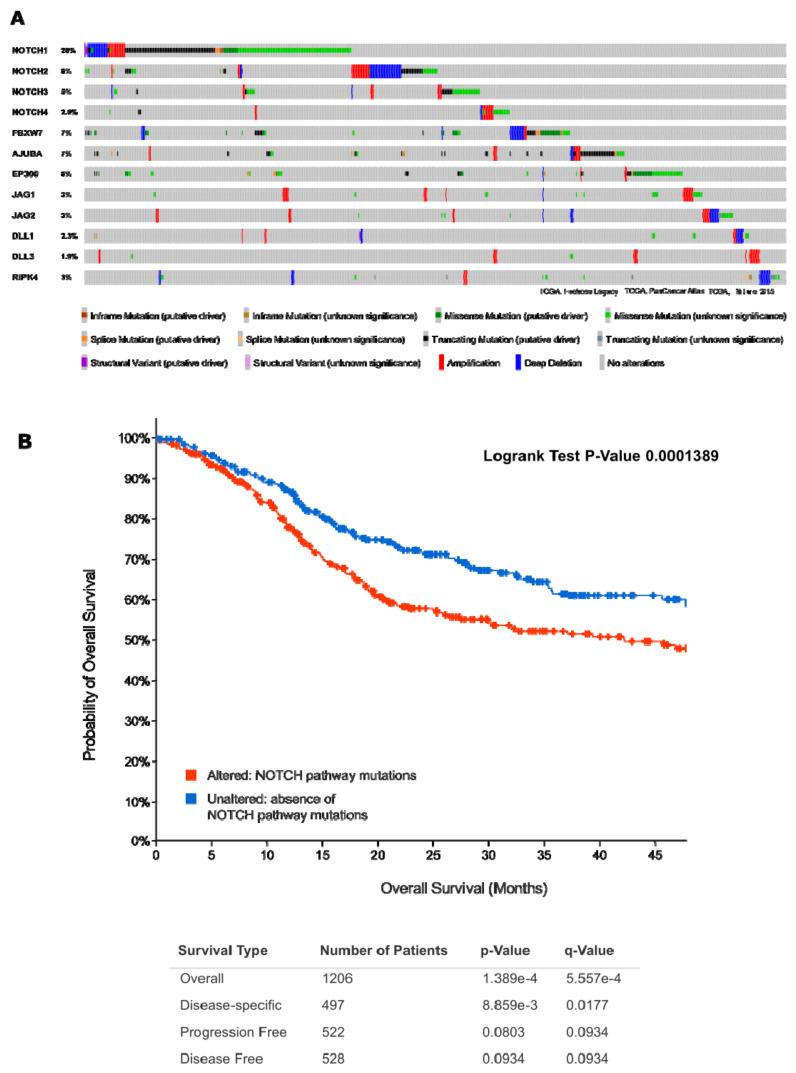
Figure 3
Figure 3
Impact of mutated Notch pathway genes on the survival of head and neck squamous cell carcinoma (HNSCC) patients. (A) DNA copy number changes, structural and point mutations of 12 genes central to Notch pathway activity, across 1332 patient with HNSCC from The Cancer Genome Anatomy (TCGA) repository. (B) Kaplan–Meier plot indicating significantly different overall and disease-specific survival of HNSCC patients that harbour at least one Notch-pathway related mutation or copy-number change (red), compared to patients without mutations in any of these 12 genes (blue). The same 12 genes were also included in the clinical association studies shown in Figure 4. Conclusion: differential activities of the Notch signalling pathway are likely to affect patients’ therapy response and survival (up to 48 months).
Figure 1
Figure 1
Differential mutation frequency observed in 1332 HNSCC patients, depending on NOTCH pathway mutation status—data extracted from TCGA database. NOTCH1-4 mutations are not shown in this figure but serve as the basis for comparisons. (A) Most recurrent mutated genes in HNSCC show similar mutation frequencies as NOTCH-pathway related genes (compare). Some gene mutations, however, including in caspase 8 (CASP8), LDL Receptor Related Protein 1B (LRP1B), and FAT Atypical Cadherin 4 (FAT4), show significant enrichment (indicated by *) in tumours that harbour Notch pathway mutations (red bars), versus those that do not (blue). This may indicate functional synergism of mutations in these putative tumour suppressors with oncogenic changes to Notch pathway activity. (B) A spectrum of additional somatic gene mutations was found significantly enriched (*) in HNSCC tumours that show mutations in NOTCH receptors and ligands, including established Notch-related driver genes such as FBXW7, AJUBA, and EP300. This includes mutations in putative tumour suppressors KMT2A and KMT2C (Lysine Methyltransferase 2A and 2C), which were previously associated with Notch pathway regulation in other cancers.
Figure 2
Figure 2
Correlation of mRNA and protein expression of NOTCH1 in HNSCC illustrates the likely bimodal functional activities of this gene, which can act as both tumour suppressor and proto-oncogene. The graph shows the levels of NOTCH1 mRNA (RNA seq, counts per million reads), plotted against NOTCH1 protein (reverse-phase protein arrays, RPPA; from TGCA “Firehose Legacy” data set). Tumours with NOTCH1 deletion (light and dark blue circles) and/or truncating, loss-of-function mutations (black dots) typically express low to very low ratios of both NOTCH1 mRNA and protein. In contrast, a fraction of tumours (marked by light red circles) show marked over-expression of NOTCH1 mRNA and protein. Missense mutations are rare in these tumours, and no truncating mutations were found.
Figure 4
Figure 4
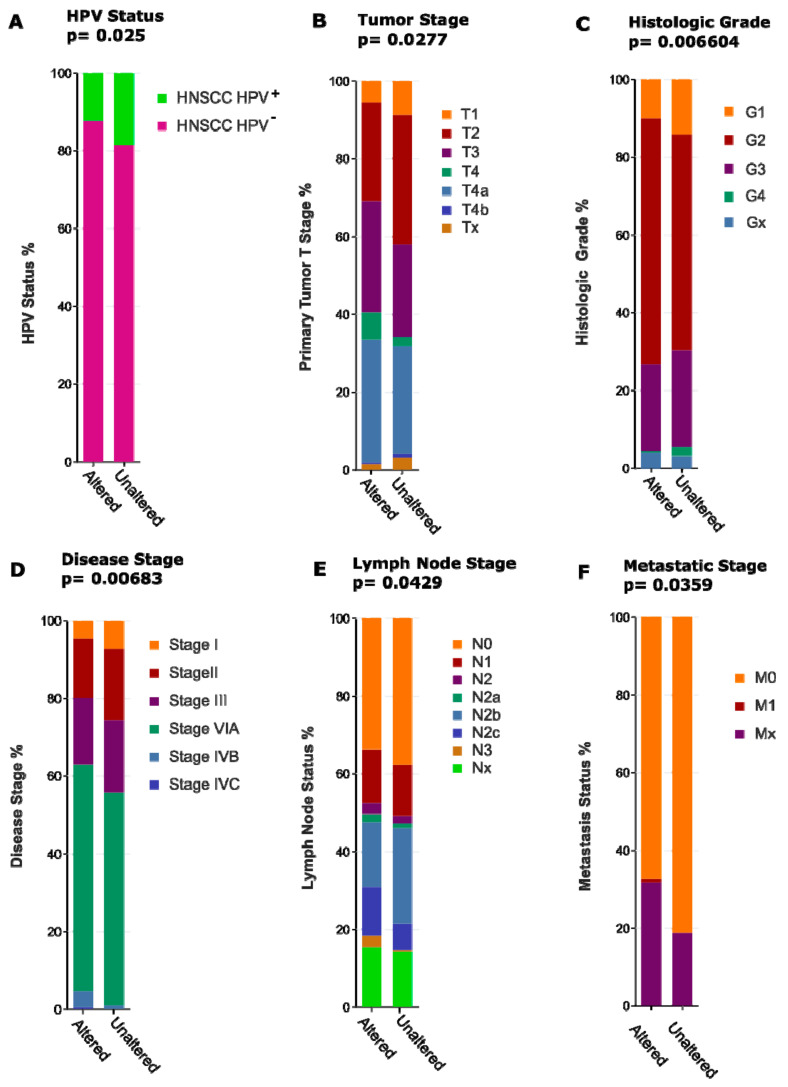
Mutation status of most relevant Notch-pathway related genes incl. NOTCH receptors correlates with various clinical and pathological parameters in HNSCC patients and tissues. Tumours with mutations in prominent Notch pathway-related genes (“altered group”) are less frequently HPV+ (A). Patients with Notch-pathway alterations present with significantly advanced tumour stage (B), histologic grade (C), and disease stage (D). These patients also more frequently develop lymph node metastases (E) and distant metastases (F).
Figure 5
Figure 5
Lack of mutation hotspots in Notch pathway-specific target genes NOTCH1-3, Histone Acetyltransferase P300 (EP300), LIM Domain-Containing protein Ajuba (AJUBA), and F-Box and WD Repeat Domain Containing protein 7 (FBXW7). NOTCH receptor mutations are evenly spread across the entire length of extracellular protein domains, likely resulting in loss-of-function mutations and truncated proteins. Mutations in other Notch-related target genes such as EP300 and AJUBA also do not show any prominent, recurrent hotspots, but can be focused on functional domains, such as the HAT/histone acetylation domain of EP300.
Figure 6
Figure 6
Schematic summary of pathways, and targeted drugs, as described in chapter 2, with a special focus on mechanisms that involve Notch signalling.
Figure 7
Figure 7
Spectrum, or phenotypic continuum of dynamic, cancer-relevant processes promoted by Notch signalling that result in various aspects of tumour cell plasticity. The transgression between epithelial and mesenchymal states, also towards increased stemness, represents a dynamic process that is influenced by a plethora of internal (genetic, epigenetic) and external (ECM, TME, growth actors, and cytokines) factors.3.3. Specific Features and Drivers of EMT in Squamous Cell Carcinomas.

References

    1. Ferlay J., Colombet M., Soerjomataram I., Parkin D.M., Piñeros M., Znaor A., Bray F. Cancer statistics for the year 2020: An overview. Int. J. Cancer. 2021;149:778–789. doi: 10.1002/ijc.33588. - DOI - PubMed
    1. Song Y., Li L., Ou Y., Gao Z., Li E., Li X., Zhang W., Wang J., Xu L., Zhou Y., et al. Identification of genomic alterations in oesophageal squamous cell cancer. Nature. 2014;509:91–95. doi: 10.1038/nature13176. - DOI - PubMed
    1. Sachdeva U.M., Shimonosono M., Flashner S., Cruz-Acuña R., Gabre J.T., Nakagawa H. Understanding the cellular origin and progression of esophageal cancer using esophageal organoids. Cancer Lett. 2021;509:39–52. doi: 10.1016/j.canlet.2021.03.031. - DOI - PMC - PubMed
    1. Sawada G., Niida A., Uchi R., Hirata H., Shimamura T., Suzuki Y., Shiraishi Y., Chiba K., Imoto S., Takahashi Y., et al. Genomic Landscape of Esophageal Squamous Cell Carcinoma in a Japanese Population. Gastroenterology. 2016;150:1171–1182. doi: 10.1053/j.gastro.2016.01.035. - DOI - PubMed
    1. Li Y., Li Y., Chen X. NOTCH and Esophageal Squamous Cell Carcinoma. Adv. Exp. Med. Biol. 2021;1287:59–68. - PMC - PubMed