


Potential to Improve Therapy of Chronic Myeloid Leukemia (CML), Especially for Patients with Older Age: Incidence, Mortality, and Survival Rates of Patients with CML in Switzerland from 1995 to 2017
- PMID: 34944892
- PMCID: PMC8699480
- DOI: 10.3390/cancers13246269
Potential to Improve Therapy of Chronic Myeloid Leukemia (CML), Especially for Patients with Older Age: Incidence, Mortality, and Survival Rates of Patients with CML in Switzerland from 1995 to 2017
Abstract
Background: Tyrosine kinase inhibitors (TKI) substantially improved chronic myeloid leukemia (CML) prognosis. We aimed to describe time period- and age-dependent outcomes by reporting real-world data of CML patients from Switzerland.
Methods: Population-based incidence, mortality, and survival were assessed for four different study periods and age groups on the basis of aggregated data from Swiss Cantonal Cancer Registries.
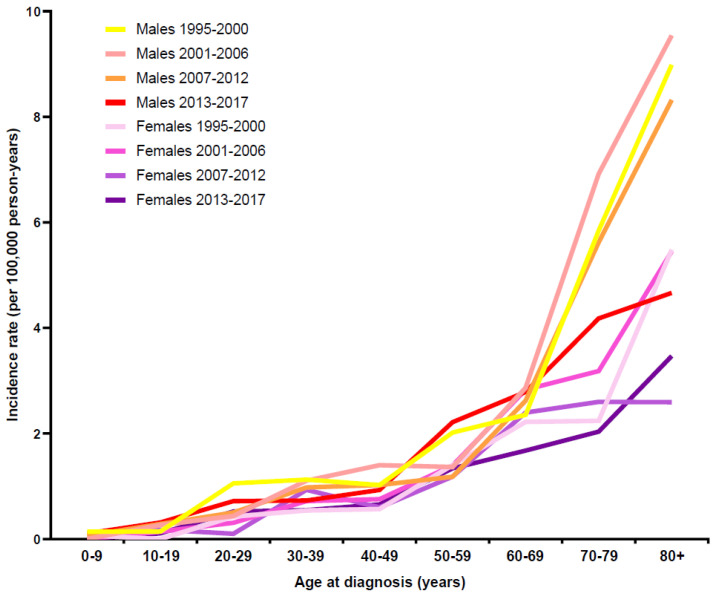
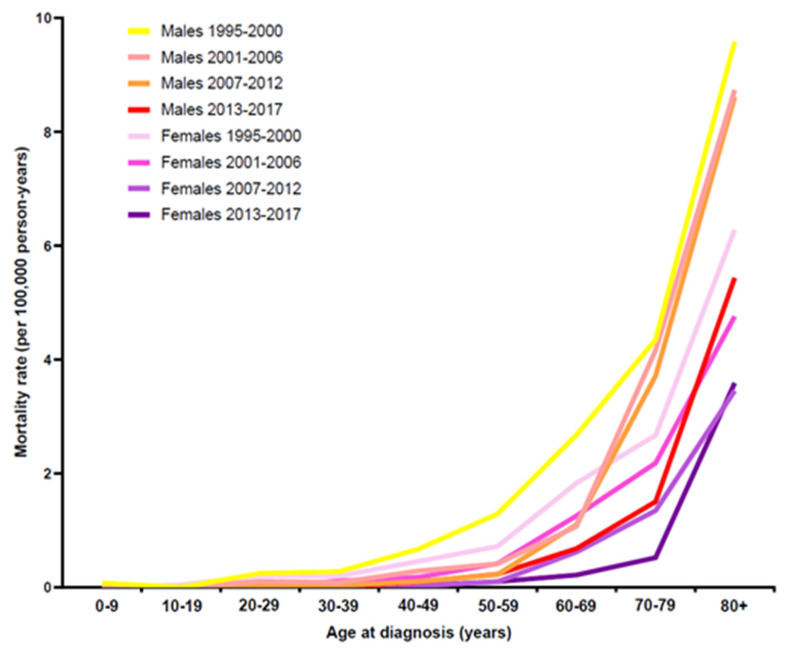
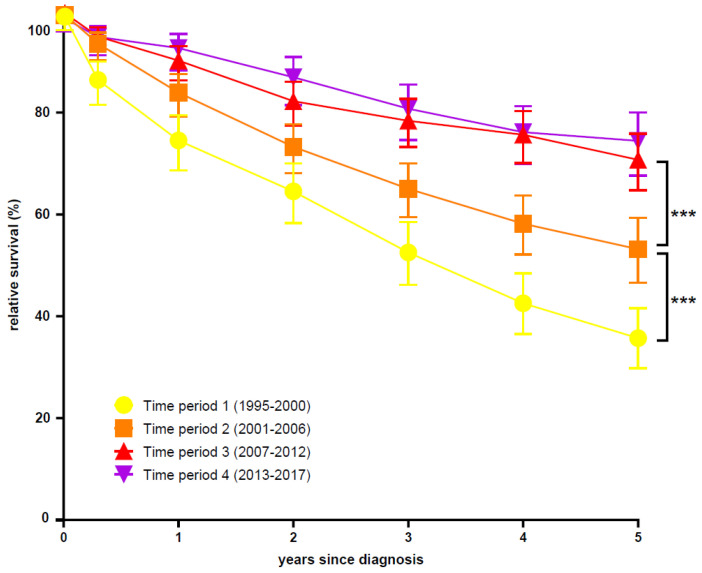
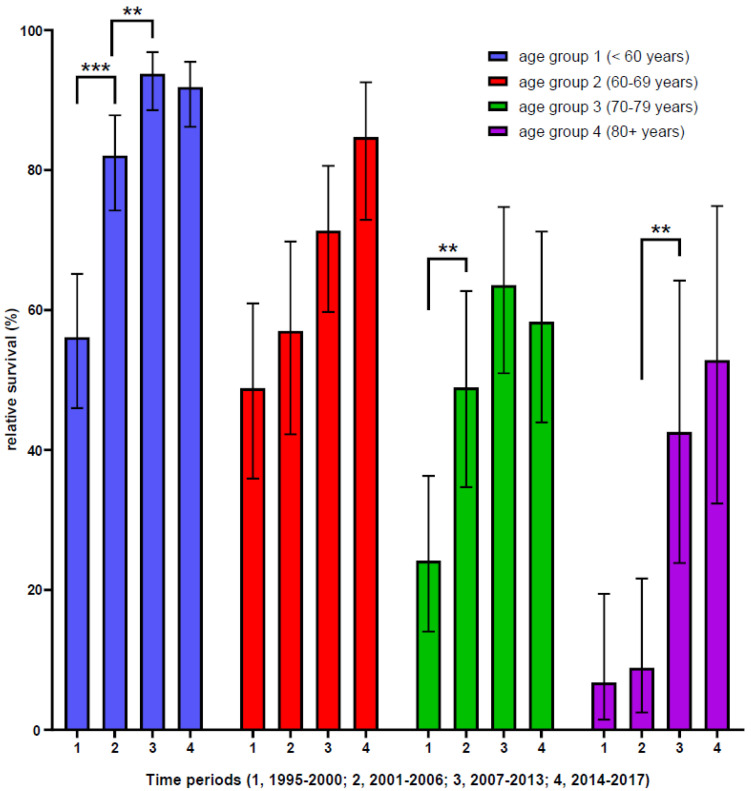
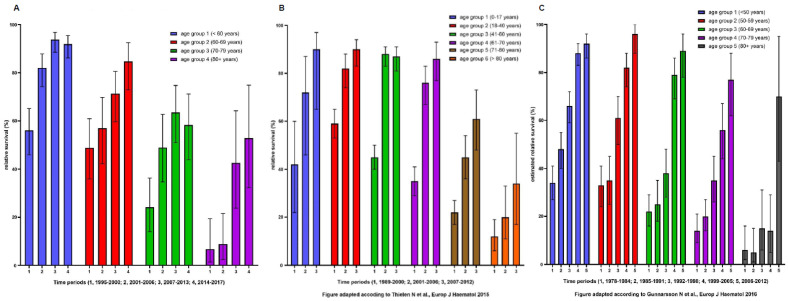
Results: A total of 1552 new CML cases were reported from 1995 to 2017. The age-standardized rate (ASR) for the incidence remained stable, while the ASR for mortality decreased by 50-80%, resulting in a five-year RS from 36% to 74% over all four age groups. Importantly, for patients <60 years (yrs), the five-year RS increased only in earlier time periods up to 92%, whereas for older patients (+80 yrs), the five-year RS continued to increase later, however, reaching only 53% until 2017.
Conclusions: This is the first population-based study of CML patients in Switzerland confirming similar data compared to other population-based registries in Europe. The RS increased significantly in all age groups over the last decades after the establishment of TKI therapy. Interestingly, we found a more prominent increase in RS of patients with older age at later observation periods (45%) compared to patients at younger age (10%), implicating a greater benefit from TKI treatment for elderly occurring with delay since the establishment of TKI therapy. Our findings suggest more potential to improve CML therapy, especially for older patients.
Keywords: CML; incidence; mortality; relative survival; tyrosine kinase inhibitor.
Conflict of interest statement
The authors declare no conflict of interest for this article. Potentially perceived conflicts of interests according to the definitions and terms of International Committee of Medical Journal Editors are N.B.: Alexion: research funding to institution; Amgen: financial support for travel; Astellas: research funding to institution; Celgene/BMS: financial support for travel, research funding to institution; consultancy honoraria; Janssen: financial support for travel; Novartis: financial support for travel, research funding to institution, consultancy honoraria; Roche: financial support for travel, research funding to institution; Sandoz: research funding to institution; Servier: research funding to institution; Takeda: research funding to institution. M.D.: Amgen, Celgene/BMS, Gilead, Novartis, NovoNordisk, Roche: financial support for travel; Gilead Sciences, Novartis: advisory board. V.A.: Recipient of Lilly Quality of Life Award 2007 and 2021. A.F.: no conflicts of interest. J.N.: no conflicts of interest. G.M.B.: Incyte: advisory board, educational project funding; Geron Corporation: consultancy.
Figures
References
-
- Hoffmann V.S., Baccarani M., Hasford J., Lindoerfer D., Burgstaller S., Sertic D., Costeas P., Mayer J., Indrak K., Everaus H., et al. The EUTOS population-based registry: Incidence and clinical characteristics of 2904 CML patients in 20 European Countries. Leukemia. 2015;29:1336–1343. doi: 10.1038/leu.2015.73. - DOI - PubMed
-
- Roman E., Smith A., Appleton S., Crouch S., Kelly R., Kinsey S., Cargo C., Patmore R. Myeloid malignancies in the real-world: Occurrence, progression and survival in the UK’s population-based Haematological Malignancy Research Network 2004-15. Cancer Epidemiol. 2016;42:186–198. doi: 10.1016/j.canep.2016.03.011. - DOI - PMC - PubMed
LinkOut - more resources
Full Text Sources
