


Epidemiology of Antepartum Stillbirths in Austria-A Population-Based Study between 2008 and 2020
- PMID: 34945123
- PMCID: PMC8709287
- DOI: 10.3390/jcm10245828
Epidemiology of Antepartum Stillbirths in Austria-A Population-Based Study between 2008 and 2020
Abstract
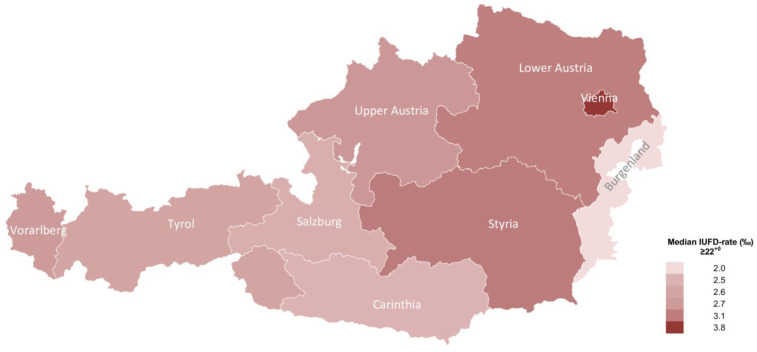
(1) Background: Across Europe, the incidence of antepartum stillbirth varies greatly, partly because of heterogeneous definitions regarding gestational weeks and differences in legislation. With this study, we sought to provide a comprehensive overview on the demographics of antepartum stillbirth in Austria, defined as non-iatrogenic fetal demise ≥22+0 gestational weeks (/40). (2) Methods: We conducted a population-based study on epidemiological characteristics of singleton antepartum stillbirth in Austria between January 2008 and December 2020. Data were derived from the validated Austrian Birth Registry. (3) Results: From January 2008 through December 2020, the antepartum stillbirth rate ≥20+0/40 was 3.10, ≥22+0/40 3.14, and ≥24+0/40 2.83 per 1000 births in Austria. The highest incidence was recorded in the federal states of Vienna, Styria, and Lower and Upper Austria, contributing to 71.9% of all stillbirths in the country. In the last decade, significant fluctuations in incidence were noted: from 2011 to 2012, the rate significantly declined from 3.40 to 3.07‰, whilst it significantly increased from 2.76 to 3.49‰ between 2019 and 2020. The median gestational age of antepartum stillbirth in Austria was 33+0 (27+2-37+4) weeks. Stillbirth rates ≤26/40 ranged from 164.98 to 334.18‰, whilst the lowest rates of 0.58-8.4‰ were observed ≥36/40. The main demographic risk factors were maternal obesity and low parity. (4) Conclusions: In Austria, the antepartum stillbirth rate has remained relatively stable at 2.83-3.10 per 1000 births for the last decade, despite a significant decline in 2012 and an increase in 2020.
Keywords: epidemiology; fetal death; perinatal mortality; registration; stillbirth.
Conflict of interest statement
The authors declare no conflict of interest.
Figures




References
-
- Hug L., You D., Blencowe H., Mishra A., Wang Z., Fix M.J., Wakefield J., Moran A.C., Gaigbe-Togbe V., Suzuki E., et al. Global, regional, and national estimates and trends in stillbirths from 2000 to 2019: A systematic assessment. Lancet. 2021;398:772–785. doi: 10.1016/S0140-6736(21)01112-0. - DOI - PMC - PubMed
-
- Mohangoo A.D., Buitendijk S.E., Szamotulska K., Chalmers J., Irgens L.M., Bolumar F., Nijhuis J.G., Zeitlin J., Euro-Peristat Scientific Committee Gestational age patterns of fetal and neonatal mortality in Europe: Results from the Euro-Peristat project. PLoS ONE. 2011;6:e24727. doi: 10.1371/journal.pone.0024727. - DOI - PMC - PubMed
-
- Blondel B., Cuttini M., Hindori-Mohangoo A.D., Gissler M., Loghi M., Prunet C., Heino A., Smith L., van der Pal-de Bruin K., Macfarlane A., et al. How do late terminations of pregnancy affect comparisons of stillbirth rates in Europe? Analyses of aggregated routine data from the Euro-Peristat Project. BJOG. 2018;125:226–234. doi: 10.1111/1471-0528.14767. - DOI - PubMed
LinkOut - more resources
Full Text Sources
