. 2021 Nov 27;12(12):1459.
doi: 10.3390/mi12121459.

Microfluidic Cell Transport with Piezoelectric Micro Diaphragm Pumps

Affiliations

Microfluidic Cell Transport with Piezoelectric Micro Diaphragm Pumps

Agnes Bußmann et al. Micromachines (Basel). .

Abstract

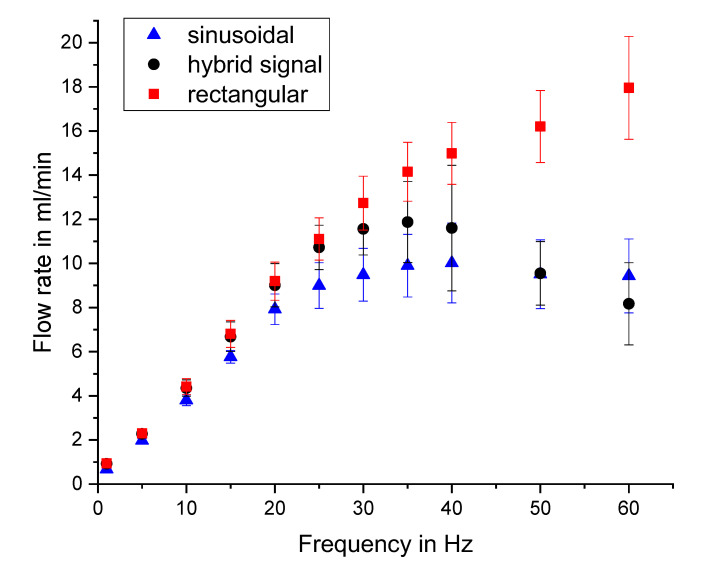
The automated transport of cells can enable far-reaching cell culture research. However, to date, such automated transport has been achieved with large pump systems that often come with long fluidic connections and a large power consumption. Improvement is possible with space- and energy-efficient piezoelectric micro diaphragm pumps, though a precondition for a successful use is to enable transport with little to no mechanical stress on the cell suspension. This study evaluates the impact of the microfluidic transport of cells with the piezoelectric micro diaphragm pump developed by our group. It includes the investigation of different actuation signals. Therewith, we aim to achieve optimal fluidic performance while maximizing the cell viability. The investigation of fluidic properties proves a similar performance with a hybrid actuation signal that is a rectangular waveform with sinusoidal flanks, compared to the fluidically optimal rectangular actuation. The comparison of the cell transport with three actuation signals, sinusoidal, rectangular, and hybrid actuation shows that the hybrid actuation causes less damage than the rectangular actuation. With a 5% reduction of the cell viability it causes similar strain to the transport with sinusoidal actuation. Piezoelectric micro diaphragm pumps with the fluidically efficient hybrid signal actuation are therefore an interesting option for integrable microfluidic workflows.

Keywords: automated cell culture; cell transport; micro diaphragm pump; micro dosing; microfluidic; passive spring valves.


Conflict of interest statement

The authors declare no conflict of interest. The funders had no role in the design of the study; in the collection, analyses, or interpretation of data; in the writing of the manuscript, or in the decision to publish the results.

Figures

Figure A1
Figure A1
(a) Experimental setup of the cell transport including an inlet and outlet reservoir as well as the electric actuation of the pump. (b) Preliminary gravimetric setup to detect the single stroke volume of the piezoelectric micropump. The setup was slightly improved for the final experiments.
Figure A2
Figure A2
Comparison of the fluidic performance of the tested micropump type with different actuation signals. Frequency dependent flow rate at 14 kPa backpressure and an actuation amplitude of −89/300 V. The compared waveforms are a rectangular wave, sinusoidal wave, and a hybrid signal that consist of a rectangular waveform with 60 Hz sinusoidal flanks as has been used for cell transport. The error bars depict the standard deviation of five individual pumps.
Figure 1
Figure 1
Piezoelectric micro diaphragm pump. (a) Functional principle: A negative filed moves the bending actuator upwards and sucks liquid through the passive inlet valve into the pump chamber. A positive electric field moves it towards the chamber bottom and pushes the fluid through the outlet valve. Figure adapted from Bußmann et al. [25]. (b) Section of the pump’s inlet valve including the spring valve and the valve seat that form the valve gap that is approximately 300 µm long and in the open state of the valve 50 µm high.
Figure 2
Figure 2
(a) Experimental setup of the gravimetric measurement to determine the single stroke volume for different actuation signals including a balance (I), the inlet reservoir (II), silicone tubing (III), the micro diaphragm pump (IV) driven with a piezo amplifier (V) and signal generator (VI), an outlet capillary (VII), and pressure equalized reservoir (VIII), as well as automated control and data acquisition (IX). (b) Setup of the cell transport experiments with an inlet- and outlet reservoir as well as the pump connected with silicone tubing. A picture of the two experimental setups is available in Figure A1 in Appendix A.
Figure 3
Figure 3
Mechanical and fluidical characterization of the tested micro diaphragm pumps. (a) The actuator displacement shows the typical piezoelectric hysteresis. Adapted from Bußmann et al. [25]. (b) There is no change in the total stroke height before and after the cell transport. (c) The frequency-dependant flow rate with 14 kPa backpressure at −80/300 V (corresponding to −0.4/1.5 kV/mm) sinusoidal actuation remains nearly unchanged in the linear regime, but changes for high frequencies. The maximal achievable flow rate after cell transport is smaller. (d) Backpressure dependant flow rate at −80/300 V sinusoidal actuation with 30 Hz.
Figure 4
Figure 4
(a) Comparison of the different actuation signal chosen for cell transport. The hybrid signal of 15 Hz rectangular actuation with 60 Hz sinusoidal flanks is a mix of the depicted 15 Hz rectangular waveform and the 60 Hz sinusoidal waveform. (b) Single stroke volume transported by a micropump dependent on the actuation frequency and the steepness of the sinusoidal flanks.
Figure 5
Figure 5
Percentage of viable cells after gating for single cells in the control samples as well as in the transported cell solution for K-562 cells (a) and Jurkat cells (b). Data for each actuation type include 15 individual samples.

References

    1. Kurniawan Y.S. Micro Total Analysis System Application for Biomedicals: A Mini-Review. Biomed. J. Sci. Tech. Res. 2019;12:1–2. doi: 10.26717/BJSTR.2019.12.002294. - DOI
    1. Patabadige D.E.W., Jia S., Sibbitts J., Sadeghi J., Sellens K., Culbertson C. Micro Total Analysis Systems: Fundamental Advances and Applications. Anal. Chem. 2016;88:320–338. doi: 10.1021/acs.analchem.5b04310. - DOI - PubMed
    1. Bancroft G.N., Sikavitsas V.I., Mikos A.G. Technical Note: Design of a Flow Perfusion Bioreactor System for Bone Tissue-Engineering Applications. Tissue Eng. 2003;9:549–554. doi: 10.1089/107632703322066723. - DOI - PubMed
    1. Khait L., Hecker L., Radnoti D., Birla R.K. Micro-Perfusion for Cardiac Tissue Engineering: Development of a Bench-Top System for the Culture of Primary Cardiac Cells. Ann. Biomed. Eng. 2008;36:713–725. doi: 10.1007/s10439-008-9459-2. - DOI - PubMed
    1. Chung B.G., Flanagan L.A., Rhee S.W., Schwartz P.H., Lee A.P., Monuki E.S., Jeon N.L. Human neural stem cell growth and differentiation in a gradient-generating microfluidic device. Lab Chip. 2005;5:401–406. doi: 10.1039/b417651k. - DOI - PubMed

LinkOut - more resources