


Construction of Photoelectrochemical DNA Biosensors Based on TiO2@Carbon Dots@Black Phosphorous Quantum Dots
- PMID: 34945373
- PMCID: PMC8707531
- DOI: 10.3390/mi12121523
Construction of Photoelectrochemical DNA Biosensors Based on TiO2@Carbon Dots@Black Phosphorous Quantum Dots
Abstract
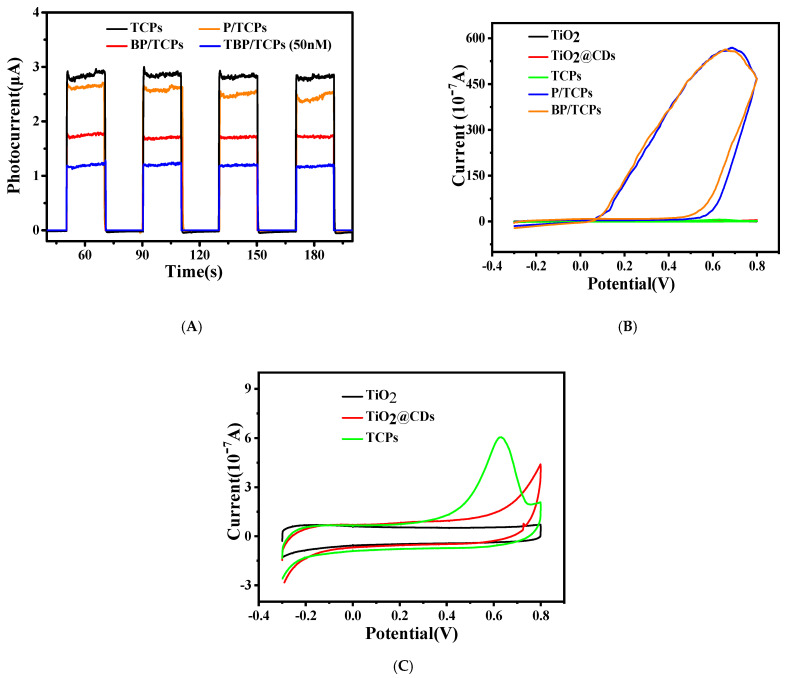
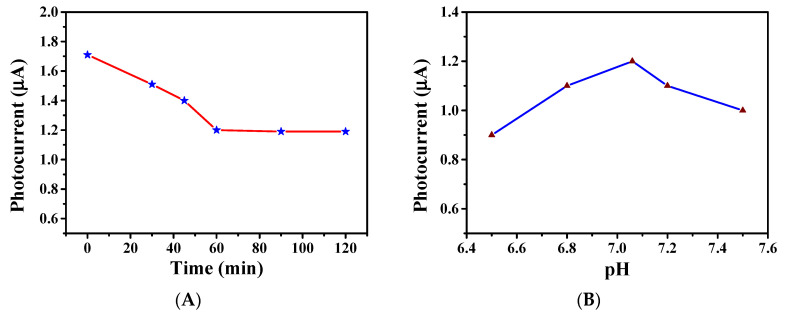
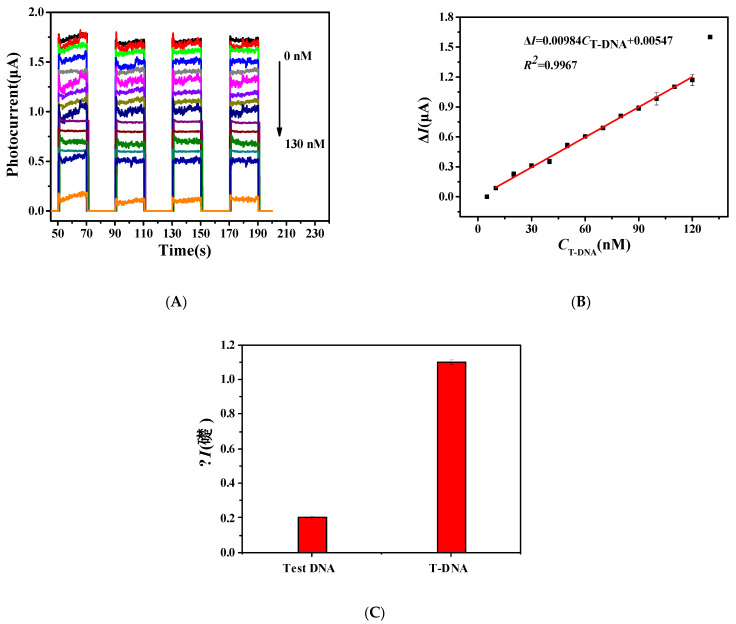
In this work, carbon dots (CDs) and black phosphorus quantum dots (BPQDs) were used to decorate titanium dioxide to enhance the photoelectrochemical (PEC) properties of the nanocomposites (TiO2@CDs@BPQDs), and the modified nanocomposites were used to sensitively detect DNA. We used the hydrothermal method and citric acid as a raw material to prepare CDs with good dispersion and strong fluorescence properties. BPQDs with a uniform particle size were prepared from black phosphorus crystals. The nanocomposites were characterized by fluorescence spectroscopy, UV-Vis absorption spectroscopy, Fourier transform infrared spectroscopy (FTIR) and transmission electron microscopy (TEM). The preparation method of the working electrode was explored, the detection conditions were optimized, and the sensitive detection of target DNA was achieved. The results demonstrate that CDs and BPQDs with good optical properties were successfully prepared, and they were successfully combined with TiO2 to improve the PEC performance of TiO2@CDs@BPQDs. The TiO2-based PEC DNA detection method was constructed with a detection limit of 8.39 nM. The constructed detection method has many advantages, including good sensitivity, a wide detection range, and good specificity. This work provides a promising PEC strategy for the detection of other biomolecules.
Keywords: black phosphorus quantum dots; carbon dots; photoelectrochemical biosensor; titanium dioxide.
Conflict of interest statement
The authors declare no conflict of interest.
Figures
References
-
- Hu W., Yang S., Yang S. Surface modification of TiO2 for perovskite solar cells. Trends Chem. 2019;2:148–162. doi: 10.1016/j.trechm.2019.11.002. - DOI
-
- Wang C., Sun X., Shan H., Zhang H., Xi B. Degradation of landfill leachate using UV-TiO2 photocatalysis combination with aged waste reactors. Processes. 2021;9:946. doi: 10.3390/pr9060946. - DOI
-
- Pang Y.J., Li Y.W., Xu G.Q., Hu Y.T., Kou Z.K., Feng Q., Lv J., Zhang Y., Wang J., Wu Y.C. Z-scheme carbon-bridged Bi2O3/TiO2 nanotube arrays to boost photoelectrochemical detection performance. Appl. Catal. B Environ. 2019;248:255–263. doi: 10.1016/j.apcatb.2019.01.077. - DOI
-
- Jasim K.E., AldalIal S., Hassan A.M. Natural dye-sensitized photovoltaic cell based on nanoporous TiO2. Int. J. Nanopart. 2011;4:359. doi: 10.1504/IJNP.2011.043498. - DOI
-
- Mutalik C., Hsiao Y.C., Chang Y.H., Krisnawati D.I., Alimansur M., Jazidie A., Nuh M., Chang C.C., Wang D.Y., Kuo T.R. High UV-Vis-NIR Light-Induced antibacterial activity by heterostructured TiO2-FeS2 nanocomposites. Int. J. Nanomed. 2020;15:8911–8920. doi: 10.2147/IJN.S282689. - DOI - PMC - PubMed
Grants and funding
LinkOut - more resources
Full Text Sources
