


Assessment of the Spoilage Microbiota during Refrigerated (4 °C) Vacuum-Packed Storage of Fresh Greek Anthotyros Whey Cheese without or with a Crude Enterocin A-B-P-Containing Extract
- PMID: 34945498
- PMCID: PMC8701269
- DOI: 10.3390/foods10122946
Assessment of the Spoilage Microbiota during Refrigerated (4 °C) Vacuum-Packed Storage of Fresh Greek Anthotyros Whey Cheese without or with a Crude Enterocin A-B-P-Containing Extract
Abstract
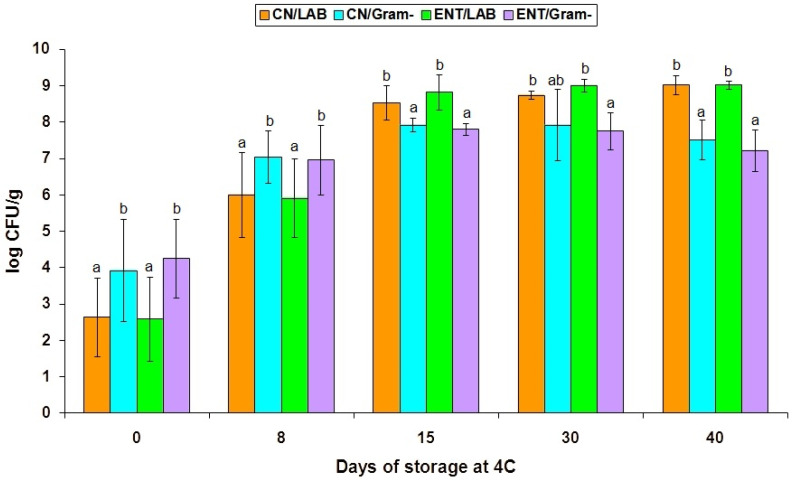
Although fresh whey cheeses are prone to rapid deterioration, mainly by psychrotrophic Gram-negative bacteria and lactic acid bacteria (LAB), data on the specific spoilage species in traditional Greek whey cheeses are scarce. Therefore, this study quantified growth and characterized the primary spoilage bacteria in fresh Anthotyros whey cheeses stored at 4 °C in a vacuum for 40 days, without or with an added 5% (v/w) of an enterocin A-B-P crude extract (CEntE). Psychrotrophic Pseudomonas spp., Aeromonas spp., Hafnia spp. and Serratia spp. grew faster than LAB during early storage. However, LAB outgrew the Gram-negative bacteria and prevailed by mid to late storage in all cheese batches, causing a strong or milder batch-dependent natural acidification. Two major non-slime-producing and two minor biotypes of Leuconostoc-like bacteria, all identified as Leuconostoc mesenteroides by 16S rRNA sequencing, dominated the LAB association (76.7%), which also included four subdominant Carnobacterium maltaromaticum biotypes (10.9%), one Leuconostoc lactis biotype (3.3%) and few Lactococcus (1.6%), mesophilic Lactobacillus (0.8%) and Enterococcus (0.8%). Growth and distribution of LAB and Gram-negative species were strongly batch-dependent and plant-dependent. The CEntE neither retarded growth nor altered the whey cheese spoilage association but enhanced LAB growth and the declines of Gram-negative bacteria by late storage.
Keywords: Anthotyros; Carnobacterium maltaromaticum; Hafnia; Leuconostoc mesenteroides; Pseudomonas; Serratia; whey cheese.
Conflict of interest statement
The authors declare no conflict of interest.
Figures
References
-
- Pintado M.E., Macedo A.C., Malcata F.X. Review: Technology, chemistry and microbiology of whey cheeses. Food Sci. Technol. Int. 2001;7:105–116. doi: 10.1177/108201320100700202. - DOI
-
- Alichanidis E., Polychroniadou A. Characteristics of major traditional regional cheese varieties of East-Mediterranean countries: A review. Dairy Sci. Technol. 2008;88:495–510. doi: 10.1051/dst:2008023. - DOI
-
- Samelis J., Kakouri A., Rogga K.J., Savvaidis I.N., Kontominas M.G. Nisin treatments to control Listeria monocytogenes post-processing contamination on Anthotyros, a traditional Greek whey cheese, stored at 4 C in vacuum packages. Food Microbiol. 2003;20:661–669. doi: 10.1016/S0740-0020(03)00018-2. - DOI
-
- Hough G., Puglieso M.L., Sanchez R., Da Silva O.M. Sensory and microbiological shelf-life of a commercial Ricotta cheese. J. Dairy Sci. 1999;82:454–459. doi: 10.3168/jds.S0022-0302(99)75253-7. - DOI
Grants and funding
LinkOut - more resources
Full Text Sources
Miscellaneous
