Review
. 2021 Dec 3;11(12):1286.
doi: 10.3390/jpm11121286.

From DNA Copy Number Gains and Tumor Dependencies to Novel Therapeutic Targets for High-Risk Neuroblastoma

Affiliations
Review

From DNA Copy Number Gains and Tumor Dependencies to Novel Therapeutic Targets for High-Risk Neuroblastoma

Bieke Decaesteker et al. J Pers Med. .

Abstract

Neuroblastoma is a pediatric tumor arising from the sympatho-adrenal lineage and a worldwide leading cause of childhood cancer-related deaths. About half of high-risk patients die from the disease while survivors suffer from multiple therapy-related side-effects. While neuroblastomas present with a low mutational burden, focal and large segmental DNA copy number aberrations are highly recurrent and associated with poor survival. It can be assumed that the affected chromosomal regions contain critical genes implicated in neuroblastoma biology and behavior. More specifically, evidence has emerged that several of these genes are implicated in tumor dependencies thus potentially providing novel therapeutic entry points. In this review, we briefly review the current status of recurrent DNA copy number aberrations in neuroblastoma and provide an overview of the genes affected by these genomic variants for which a direct role in neuroblastoma has been established. Several of these genes are implicated in networks that positively regulate MYCN expression or stability as well as cell cycle control and apoptosis. Finally, we summarize alternative approaches to identify and prioritize candidate copy-number driven dependency genes for neuroblastoma offering novel therapeutic opportunities.

Keywords: DNA copy number gains; MYCN; dependency; drug targets; neuroblastoma.


Conflict of interest statement

The authors declare no conflict of interest. The funders had no role in the design of the study; in the collection, analyses, or interpretation of data; in the writing of the manuscript, or in the decision to publish the results.

Figures
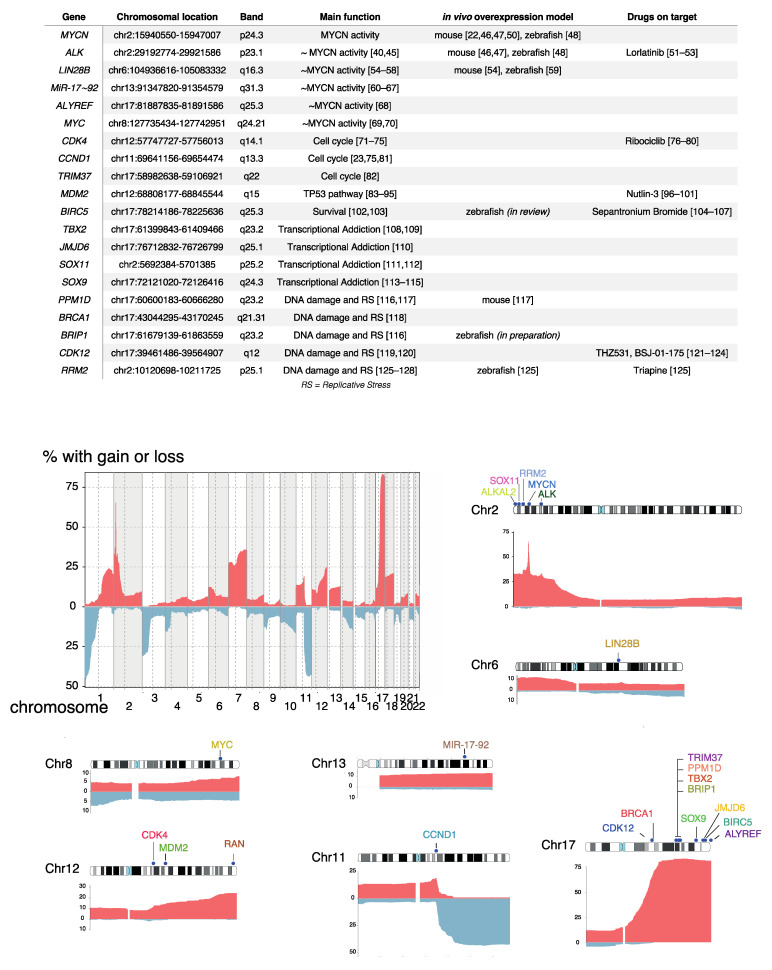
Figure 2
Figure 2
Table describing the copy number affected genes discussed in this review, their chromosomal location and cytoband, their main function with references, in vivo modeling with references, and drugs on target with references. Frequency of copy number gains/amplifications (red) and losses (blue) for chromosomes 1 to 22 in 542 high-risk NB samples with segmental CNAs [38]. Copy number affected genes in NB that were discussed in this review are depicted on their chromosome with the associated copy number frequency (chromosome 2, 6, 8, 11, 12, 13 and 17). Refs. [22,23,40,45,46,47,48,50,51,52,53,54,55,56,57,58,59,60,61,62,63,64,65,66,67,68,69,70,71,72,73,74,75,76,77,78,79,80,81,82,83,84,85,86,87,88,89,90,91,92,93,94,95,96,97,98,99,100,101,102,103,104,105,106,107,108,109,110,111,112,113,114,115,116,117,118,119,120,121,122,123,124,125,126,127,128] are cited in Figure 2.
Figure 3
Figure 3
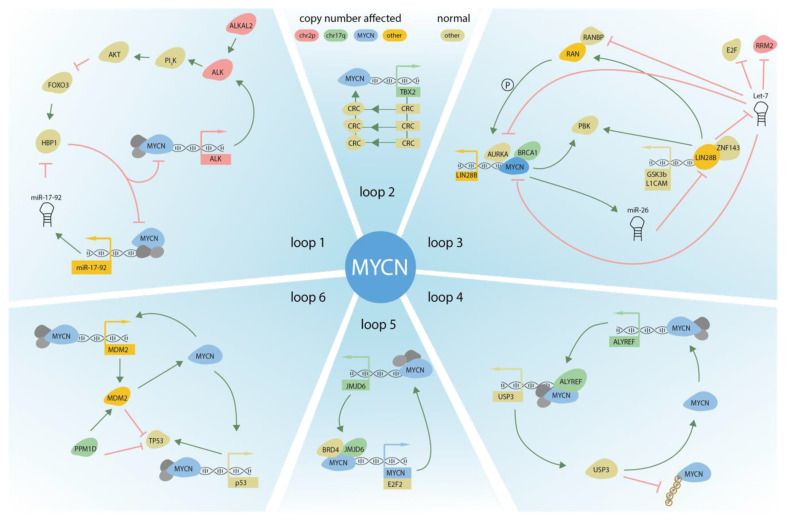
DNA copy number affected genes and their upstream and downstream regulators, supporting MYCN activity in NB. Six different autoregulatory loops are depicted. Color of the proteins (circles) or genes (square) indicates the genomic location of the CNA.
Figure 1
Figure 1
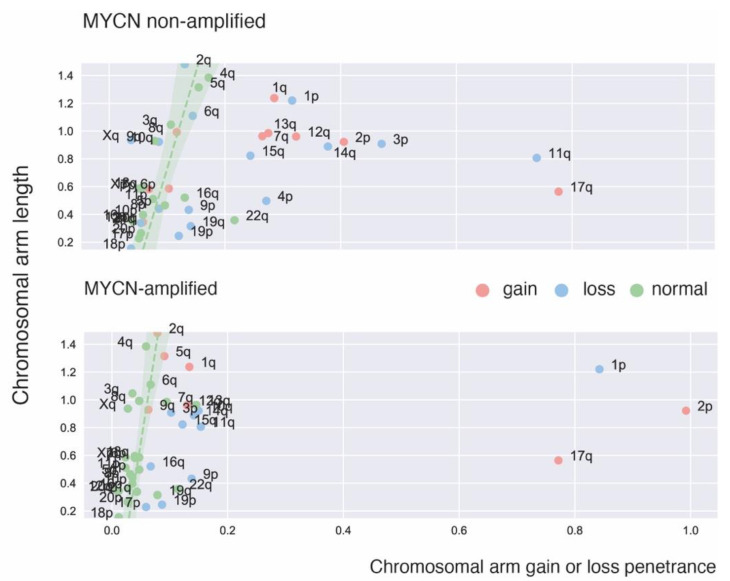
Correlation between chromosome arm length and amount of gains and/or losses on the arm in a dataset of 542 high-risk primary NB tumors [38] showing recurrent copy number imbalances in MYCN non-amplified and MYCN-amplified tumors. Gains or losses that spanned both chromosomal arms where not withhold. For every chromosomal arm the ratio of gains versus losses was analyzed in a binomial test to establish whether either the number of gains was exceptional in respect to the number of losses or the other way around. If a significant amount of gains was found for the total number of gains and losses, the chromosomal arm is displayed in red, if the other way around in blue, and if both losses and gains on the arm were on par (p-value binomial test ≥0.05) they are displayed in green. The ‘green’ arms were used to calculate a linear regression between chromosomal arm length and total number of combined losses and gains. The standard deviation on this linear regression is depicted in a shaded green area to indicate where normal amounts of gains and losses lie for the chromosome arms of different length. Outliers can now easily be identified in the two MYCN groups and comprise the usual suspects.
Figure 4
Figure 4
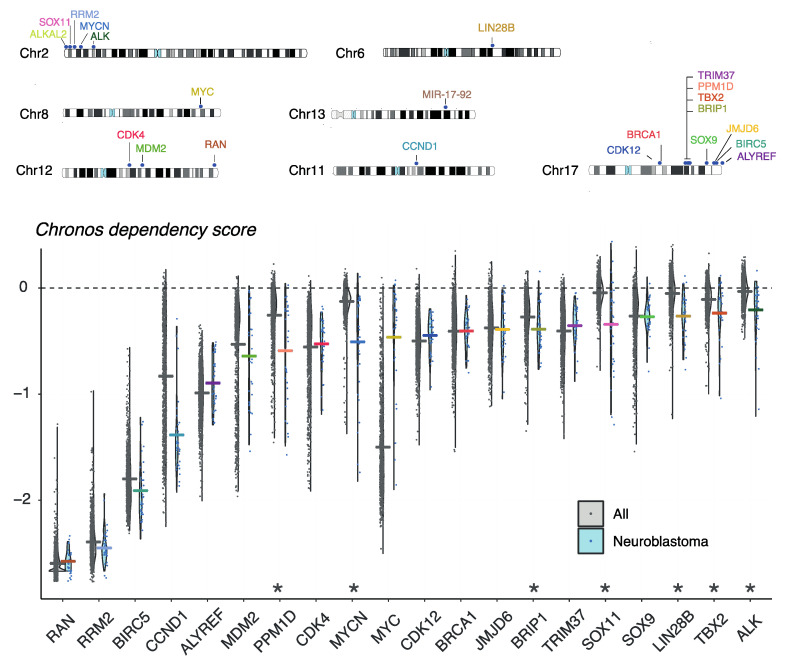
Copy number affected genes in NB that were discussed in this review are depicted on their chromosome (chromosome 2, 6, 8, 11, 12, 13 and 17). Chronos dependency score for each copy number affected gene discussed in this review in a publicly available CRISPR screen across 1032 cancer cell lines (AVANA CRISPR 21Q3, available via the DepMap Portal). A lower Chronos score indicates a higher likelihood that the gene is essential for the cell line. Asterix means that the mean dependency score of the gene in NB cells (blue) is significantly lower than the mean dependency score in other cell lines (grey). Two-group comparison with p-value for each gene computed from empirical Bayes moderated t-statistic, enriched lineages are those with p-value < 0.0005. Dependency scores for ALKAL2 and MIR-17-92 are not available.

References

    1. Monclair T., Brodeur G.M., Ambros P.F., Brisse H.J., Cecchetto G., Holmes K., Kaneko M., London W.B., Matthay K.K., Nuchtern J.G., et al. The International Neuroblastoma Risk Group (INRG) staging system: An INRG Task Force report. J. Clin. Oncol. Off. J. Am. Soc. Clin. Oncol. 2009;27:298–303. doi: 10.1200/JCO.2008.16.6876. - DOI - PMC - PubMed
    1. Cohn S.L., Pearson A.D.J., London W.B., Monclair T., Ambros P.F., Brodeur G.M., Faldum A., Hero B., Iehara T., Machin D., et al. The International Neuroblastoma Risk Group (INRG) classification system: An INRG Task Force report. J. Clin. Oncol. Off. J. Am. Soc. Clin. Oncol. 2009;27:289–297. doi: 10.1200/JCO.2008.16.6785. - DOI - PMC - PubMed
    1. Matthay K.K., Maris J.M., Schleiermacher G., Nakagawara A., Mackall C.L., Diller L., Weiss W.A. Neuroblastoma. Nat. Rev. Dis. Primer. 2016;2:16078. doi: 10.1038/nrdp.2016.78. - DOI - PubMed
    1. Schwab M., Varmus H.E., Bishop J.M., Grzeschik K.H., Naylor S.L., Sakaguchi A.Y., Brodeur G., Trent J. Chromosome localization in normal human cells and neuroblastomas of a gene related to c-myc. Nature. 1984;308:288–291. doi: 10.1038/308288a0. - DOI - PubMed
    1. Brodeur G.M., Seeger R.C., Schwab M., Varmus H.E., Bishop J.M. Amplification of N-myc in untreated human neuroblastomas correlates with advanced disease stage. Science. 1984;224:1121–1124. doi: 10.1126/science.6719137. - DOI - PubMed

LinkOut - more resources