


Proteomics of Two Thermotolerant Isolates of Trichoderma under High-Temperature Stress
- PMID: 34946985
- PMCID: PMC8704589
- DOI: 10.3390/jof7121002
Proteomics of Two Thermotolerant Isolates of Trichoderma under High-Temperature Stress
Abstract
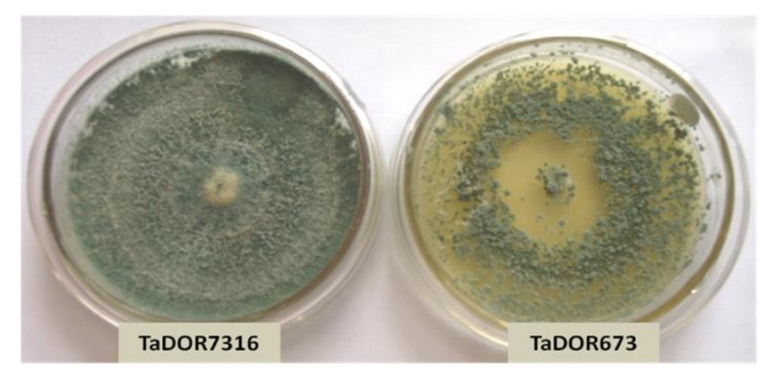
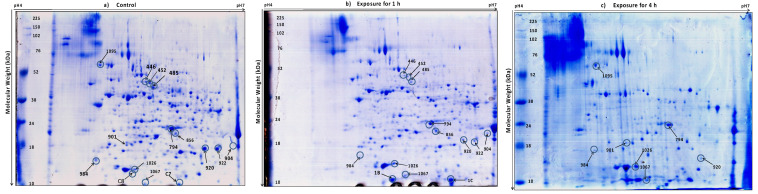
Several species of the soil borne fungus of the genus Trichoderma are known to be versatile, opportunistic plant symbionts and are the most successful biocontrol agents used in today's agriculture. To be successful in field conditions, the fungus must endure varying climatic conditions. Studies have indicated that a high atmospheric temperature coupled with low humidity is a major factor in the inconsistent performance of Trichoderma under field conditions. Understanding the molecular modulations associated with Trichoderma that persist and deliver under abiotic stress conditions will aid in exploiting the value of these organisms for such uses. In this study, a comparative proteomic analysis, using two-dimensional gel electrophoresis (2DE) and matrix-assisted laser desorption/time-of-flight (MALDI-TOF-TOF) mass spectrometry, was used to identify proteins associated with thermotolerance in two thermotolerant isolates of Trichoderma: T. longibrachiatum 673, TaDOR673 and T. asperellum 7316, TaDOR7316; with 32 differentially expressed proteins being identified. Sequence homology and conserved domains were used to identify these proteins and to assign a probable function to them. The thermotolerant isolate, TaDOR673, seemed to employ the stress signaling MAPK pathways and heat shock response pathways to combat the stress condition, whereas the moderately tolerant isolate, TaDOR7316, seemed to adapt to high-temperature conditions by reducing the accumulation of misfolded proteins through an unfolded protein response pathway and autophagy. In addition, there were unique, as well as common, proteins that were differentially expressed in the two isolates studied.
Keywords: Hsf1; MAPK; Trichoderma; UPR; autophagy; cell wall remodeling; thermotolerance.
Conflict of interest statement
The authors declare no conflict of interest.
Figures


References
-
- Verma M., Brar S., Tyagi R., Surampalli R., Valero J. Antagonistic fungi, Trichoderma spp.: Panoply of biological control. Biochem. Eng. J. 2007;37:1–20. doi: 10.1016/j.bej.2007.05.012. - DOI
-
- Vinale F., Sivasithamparam K., Ghisalberti E.L., Marra R., Woo S., Lorito M. Trichoderma-plant-pathogen interatctions. Soil Biol. Biochem. 2008;40:1–10. doi: 10.1016/j.soilbio.2007.07.002. - DOI
-
- Benitez T., Rincon A.M., Limon M.C., Codon A.C. Biocontrol mechanisms of Trichoderma strains. Int. Microbiol. 2004;7:249–260. - PubMed
-
- Elad Y. Biological control of foliar pathogens by means of Trichoderma harzianum and potential modes of action. Crop. Prot. 2000;19:709–714. doi: 10.1016/S0261-2194(00)00094-6. - DOI
-
- Zin N.A., Badaluddin N.A. Biological functions of Trichoderma spp. for agriculture applications. Ann. Agric. Sci. 2020;65:68–178. doi: 10.1016/j.aoas.2020.09.003. - DOI
Grants and funding
LinkOut - more resources
Full Text Sources
