


Stroke Survivors' Personal Efficacy Beliefs and Outcome Expectations of Tai Chi Exercise: A Qualitative Descriptive Study
- PMID: 34948610
- PMCID: PMC8701141
- DOI: 10.3390/ijerph182413001
Stroke Survivors' Personal Efficacy Beliefs and Outcome Expectations of Tai Chi Exercise: A Qualitative Descriptive Study
Abstract
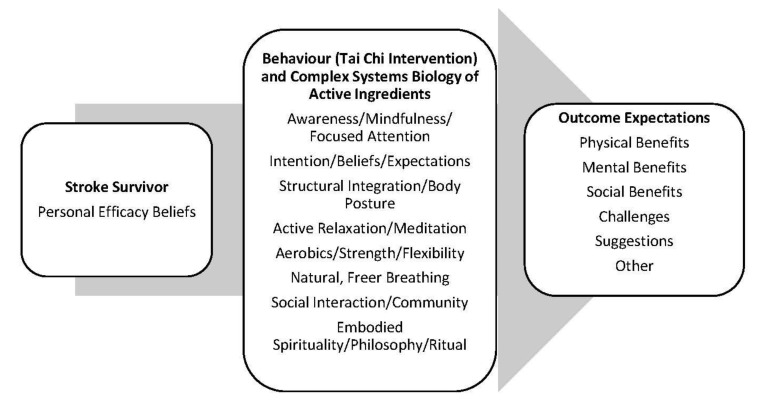
Prior qualitative research conducted among stroke survivors to explore the potential benefits and challenges of participating in tai chi exercise during stroke recovery is limited to those without depression. A qualitative descriptive approach was used. Social Cognitive Theory and Complex Systems Biology provided the theoretical framework, with focus group interview data collected from stroke survivors after participation in a tai chi intervention. Due to COVID-19, the focus group interview was conducted via online video conferencing. Content analysis of the de-identified transcript was conducted with a-priori codes based on the theoretical framework and inductive codes that were added during the analysis process. Lincoln and Guba's criteria were followed to ensure trustworthiness of the data. Community-dwelling stroke survivors (n = 7) participating in the focus group interviews were on average 68 years old, mainly retired (71%, n = 5), married women (57%, n = 4) with >13 years education (86%, n = 6). The three major themes were: personal efficacy beliefs, tai chi intervention active ingredients, and outcome expectations. Social Cognitive Theory underscored stroke survivors' personal efficacy beliefs, behavior, and outcome expectations, while Complex Systems Biology highlighted the active ingredients of the tai chi intervention they experienced. Participation in the 8-week tai chi intervention led to perceived physical, mental, and social benefits post stroke.
Keywords: complex systems biology; focus groups; qualitative research; social cognitive theory; stroke rehabilitation; tai chi.
Conflict of interest statement
The authors declare no conflict of interest.
References
-
- Virani S.S., Alonso A., Aparicio H.J., Benjamin E.J., Bittencourt M.S., Callaway C.W., Carson A.P., Chamberlain A.M., Cheng S., Delling F.N., et al. Heart Disease and Stroke Statistics-2021 Update: A Report From the American Heart Association. Circulation. 2021;143:e254–e743. doi: 10.1161/CIR.0000000000000950. - DOI - PubMed
-
- Towfighi A., Ovbiagele B., El Husseini N., Hackett M.L., Jorge R.E., Kissela B.M., Mitchell P.H., Skolarus L.E., Whooley M.A., Williams L.S., et al. Poststroke Depression: A Scientific Statement for Healthcare Professionals From the American Heart Association/American Stroke Association. Stroke. 2017;48:e30–e43. doi: 10.1161/STR.0000000000000113. - DOI - PubMed
-
- Levine G.N., Cohen B.E., Commodore-Mensah Y., Fleury J., Huffman J.C., Khalid U., Labarthe D.R., Lavretsky H., Michos E.D., Spatz E.S., et al. Psychological Health, Well-Being, and the Mind-Heart-Body Connection: A Scientific Statement From the American Heart Association. Circulation. 2021;143:e763–e783. doi: 10.1161/CIR.0000000000000947. - DOI - PubMed
Publication types
MeSH terms
LinkOut - more resources
Full Text Sources
Medical
