


Validity and Reliability of the Cardiac Rehabilitation Barriers Scale in the Czech Republic (CRBS-CZE): Determination of Key Barriers in East-Central Europe
- PMID: 34948722
- PMCID: PMC8701715
- DOI: 10.3390/ijerph182413113
Validity and Reliability of the Cardiac Rehabilitation Barriers Scale in the Czech Republic (CRBS-CZE): Determination of Key Barriers in East-Central Europe
Abstract
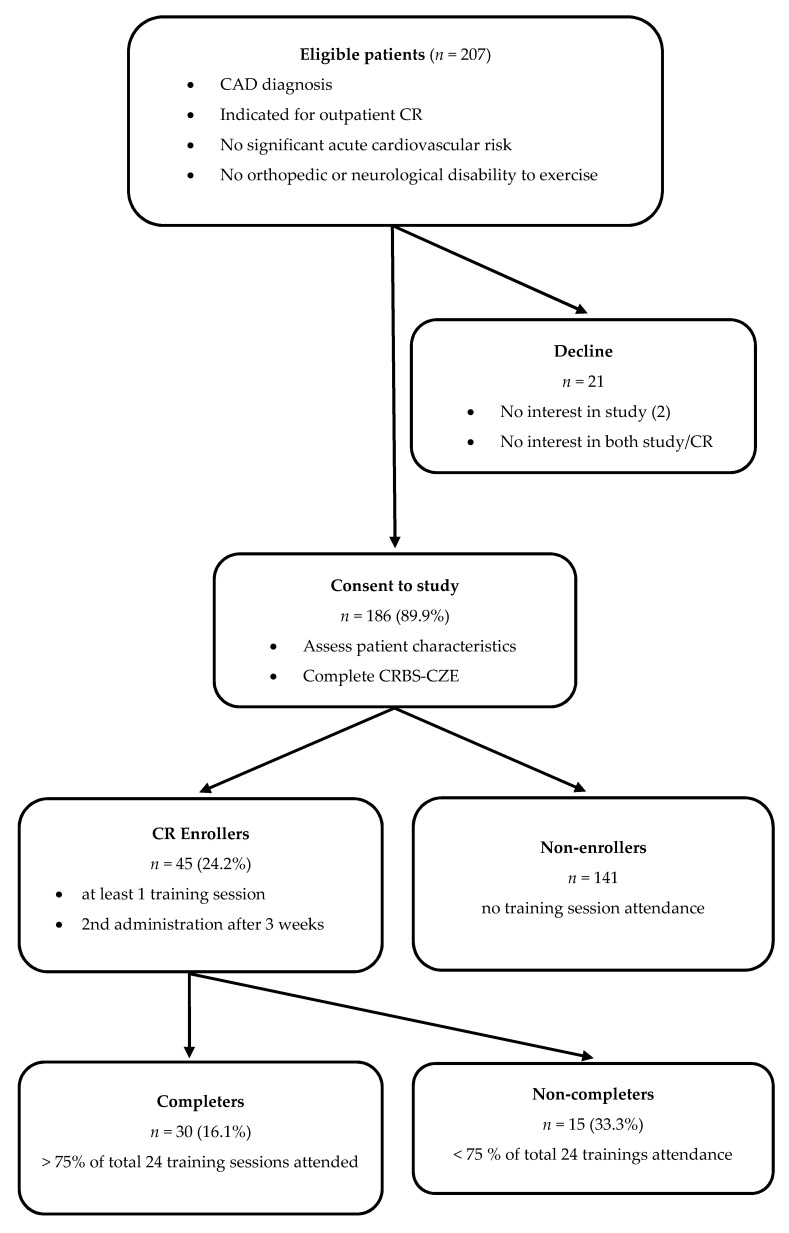
Cardiovascular rehabilitation (CR) is an effective secondary preventive model of care. However, the use of CR is insufficient, and the reasons for this are not well-characterized in East-Central Europe. This prospective observational study psychometrically validated the recently translated Cardiac Rehabilitation Barriers Scale for the Czech language (CRBS-CZE) and identified the main CR barriers. Consecutive cardiac in/out-patients were approached from January 2020 for 18 months, of whom 186 (89.9%) consented. In addition to sociodemographic characteristics, participants completed the 21-item CRBS-CZE (response options 1-5, with higher scores representing greater barriers), and their CR utilization was tracked. Forty-five (24.2%) participants enrolled in CR, of whom 42 completed the CRBS a second time thereafter. Factor analysis revealed four factors, consistent with other CRBS translations. Internal reliability was acceptable for all but one factor (Cronbach's alpha range = 0.44-0.77). Mean total barrier scores were significantly higher in non-enrollers (p < 0.001), decreased from first and second administration in these enrollers (p < 0.001), and were lower in CR completers (p < 0.001), supporting criterion validity. There were also significant differences in barrier scores by education, geography, tobacco use, among other variables, further supporting validity. The biggest barriers to enrolment were distance, work responsibilities, lack of time, transportation problems, and comorbidities; and the greatest barriers to adherence were distance and travel. Several items were considered irrelevant at first and second administration. Other barriers included wearing a mask during the COVID-19 pandemic. The study demonstrated sufficient validity and reliability of CRBS-CZE, which supports its use in future research.
Keywords: Czech Republic; barriers; cardiac rehabilitation; coronary artery disease; utilization.
Conflict of interest statement
The authors declare no conflict of interest.
References
-
- World Health Organization Noncommunicable Diseases Country Profiles. 2018. [(accessed on 30 January 2021)]. Available online: https://www.who.int/nmh/publications/ncd-profiles-2018/en/
-
- Ústav Zdravotnických Informací a Statistiky ČR Zdravotnická Ročenka České Republiky. 2018. [(accessed on 30 January 2021)]. Available online: https://www.uzis.cz/res/f/008280/zdrroccz-2018.pdf.
-
- Český Statistický Úřad Výsledky Zdravotnických Účtů ČR 2010–2018. [(accessed on 30 January 2021)]. Available online: https://www.czso.cz/documents/10180/122362658/26000520.pdf/ce8cd21a-9317....
-
- World Health Organization Cardiovascular Diseases. [(accessed on 30 January 2021)]. Available online: https://www.who.int/news-room/fact-sheets/detail/cardiovascular-diseases...
Publication types
MeSH terms
LinkOut - more resources
Full Text Sources
Medical
