


The contributory role of vascular health in age-related anabolic resistance
- PMID: 34951146
- PMCID: PMC8818606
- DOI: 10.1002/jcsm.12898
The contributory role of vascular health in age-related anabolic resistance
Abstract
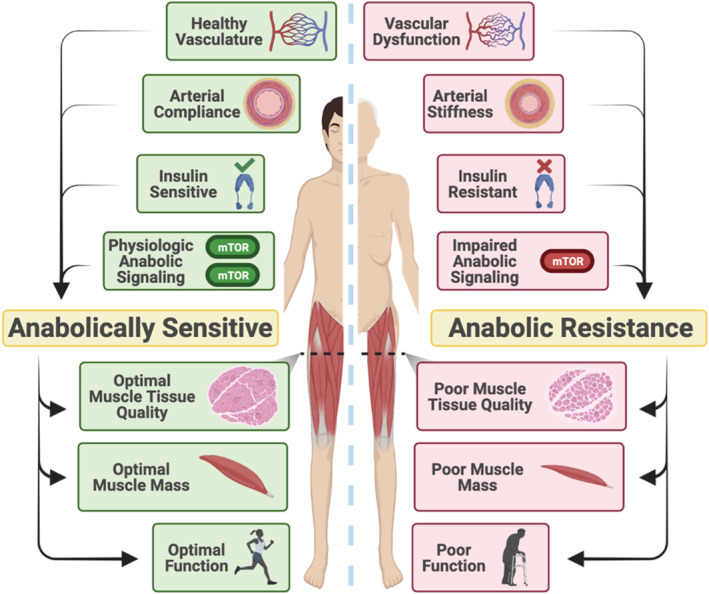
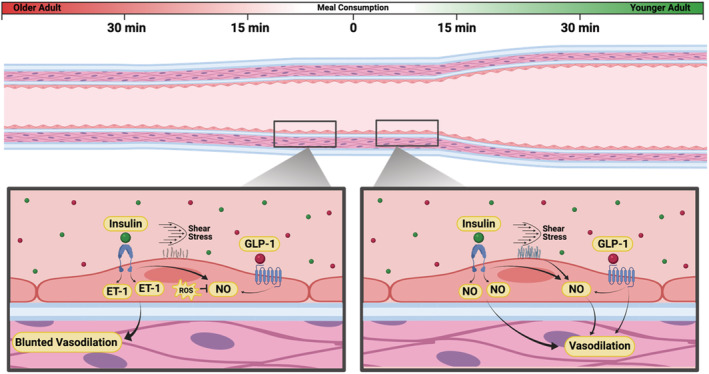
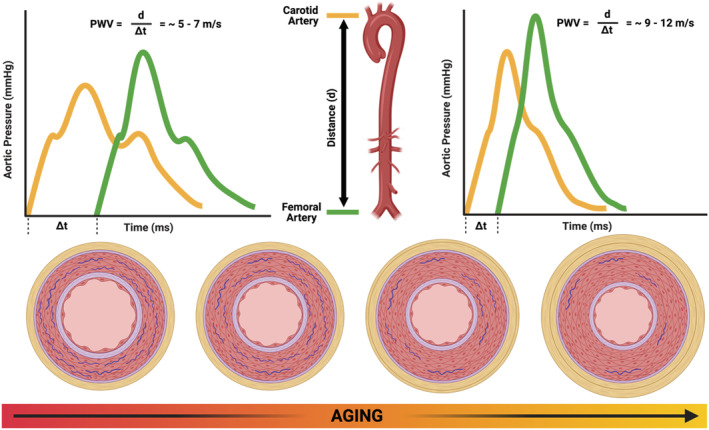
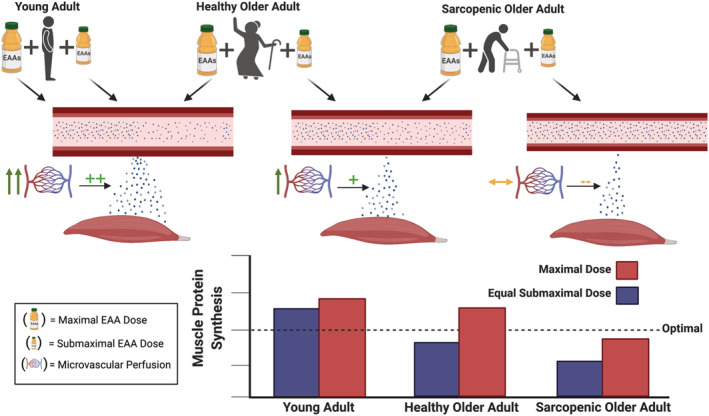
Sarcopenia, or the age-related loss of skeletal muscle mass and function, is an increasingly prevalent condition that contributes to reduced quality of life, morbidity, and mortality in older adults. Older adults display blunted anabolic responses to otherwise anabolic stimuli-a phenomenon that has been termed anabolic resistance (AR)-which is likely a casual factor in sarcopenia development. AR is multifaceted, but historically much of the mechanistic focus has been on signalling impairments, and less focus has been placed on the role of the vasculature in postprandial protein kinetics. The vascular endothelium plays an indispensable role in regulating vascular tone and blood flow, and age-related impairments in vascular health may impede nutrient-stimulated vasodilation and subsequently the ability to deliver nutrients (e.g. amino acids) to skeletal muscle. Although the majority of data has been obtained studying younger adults, the relatively limited data on the effect of blood flow on protein kinetics in older adults suggest that vasodilatory function, especially of the microvasculature, strongly influences the muscle protein synthetic response to amino acid feedings. In this narrative review, we examine evidence of AR in older adults following amino acid and mixed meal consumption, examine the evidence linking vascular dysfunction and insulin resistance to age-related AR, review the influence of nitric oxide and endothelin-1 on age-related vascular dysfunction as it relates to AR, briefly review the potential causal role of arterial stiffness in promoting skeletal muscle microvascular dysfunction and AR, and provide a brief overview and future considerations for research examining age-related AR.
Keywords: Ageing; Anabolic resistance; Blood flow; Insulin; Muscle protein synthesis; Vasodilation.
© 2021 The Authors. Journal of Cachexia, Sarcopenia and Muscle published by John Wiley & Sons Ltd on behalf of Society on Sarcopenia, Cachexia and Wasting Disorders.
Conflict of interest statement
E.M.R. declares that she has no conflicts of interest. A.A.F. is listed as an inventor on US Patent 9364463 B2 entitled ‘Use of amino acid supplementation for improved muscle recovery’ and US Patent Application 20200253908 entitled ‘Use of amino acid supplementation for improved muscle protein synthesis’. N.D.M.J. currently serves on the American Heart Association (AHA) Research Committee, as well as two AHA research‐related subcommittees. Within the last year, N.D.M.J. has received compensation as a book reviewer, as well as a chapter author, for Human Kinetics.
Figures
References
-
- Jenkins ND, Buckner SL, Cochrane KC, Bergstrom HC, Palmer TB, Johnson GO, et al. Age‐related differences in rates of torque development and rise in EMG are eliminated by normalization. Exp Gerontol 2014;57:18–28. - PubMed
-
- Jenkins ND, Housh TJ, Palmer TB, Cochrane KC, Bergstrom HC, Johnson GO, et al. Relative differences in strength and power from slow to fast isokinetic velocities may reflect dynapenia. Muscle Nerve 2015;52:120–130. - PubMed
Publication types
MeSH terms
Substances
Grants and funding
LinkOut - more resources
Full Text Sources
Research Materials
