


Medical and Health-Related Misinformation on Social Media: Bibliometric Study of the Scientific Literature
- PMID: 34951864
- PMCID: PMC8793917
- DOI: 10.2196/28152
Medical and Health-Related Misinformation on Social Media: Bibliometric Study of the Scientific Literature
Abstract
Background: Social media has been extensively used for the communication of health-related information and consecutively for the potential spread of medical misinformation. Conventional systematic reviews have been published on this topic to identify original articles and to summarize their methodological approaches and themes. A bibliometric study could complement their findings, for instance, by evaluating the geographical distribution of the publications and determining if they were well cited and disseminated in high-impact journals.
Objective: The aim of this study was to perform a bibliometric analysis of the current literature to discover the prevalent trends and topics related to medical misinformation on social media.
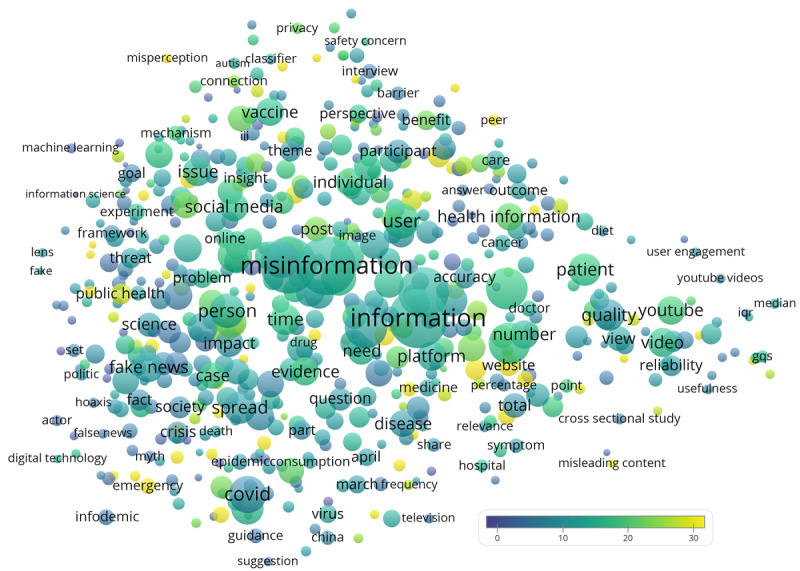
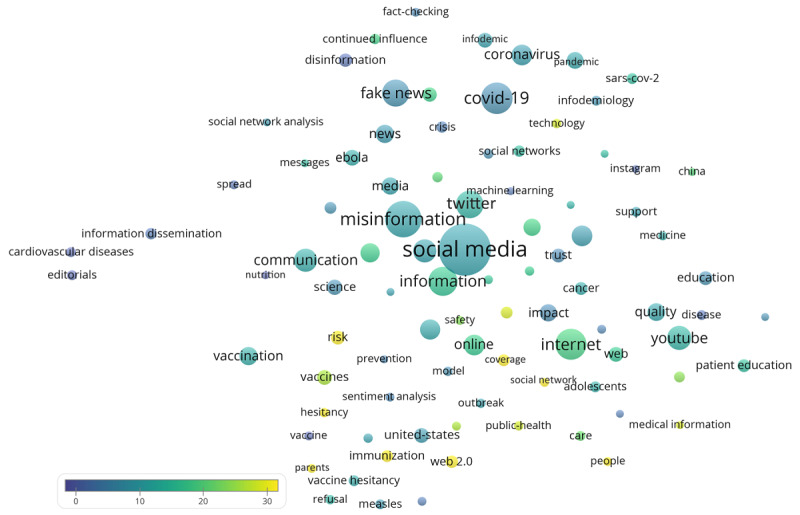
Methods: The Web of Science Core Collection electronic database was accessed to identify relevant papers with the following search string: ALL=(misinformati* OR "wrong informati*" OR disinformati* OR "misleading informati*" OR "fake news*") AND ALL=(medic* OR illness* OR disease* OR health* OR pharma* OR drug* OR therap*) AND ALL=("social media*" OR Facebook* OR Twitter* OR Instagram* OR YouTube* OR Weibo* OR Whatsapp* OR Reddit* OR TikTok* OR WeChat*). Full records were exported to a bibliometric software, VOSviewer, to link bibliographic information with citation data. Term and keyword maps were created to illustrate recurring terms and keywords.
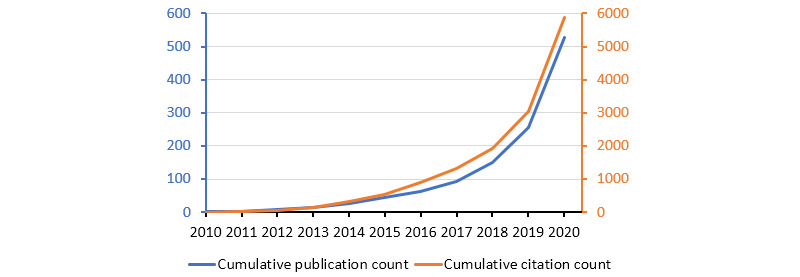
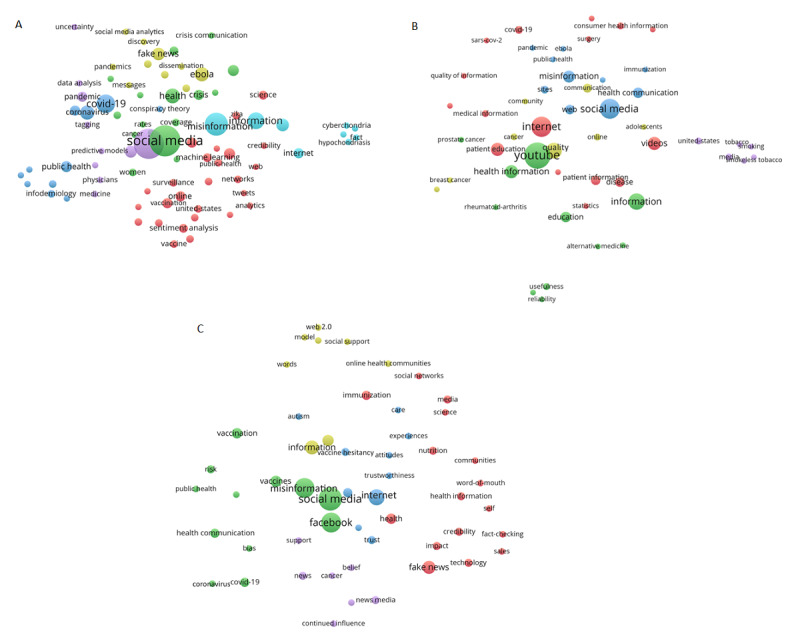
Results: Based on an analysis of 529 papers on medical and health-related misinformation on social media, we found that the most popularly investigated social media platforms were Twitter (n=90), YouTube (n=67), and Facebook (n=57). Articles targeting these 3 platforms had higher citations per paper (>13.7) than articles covering other social media platforms (Instagram, Weibo, WhatsApp, Reddit, and WeChat; citations per paper <8.7). Moreover, social media platform-specific papers accounted for 44.1% (233/529) of all identified publications. Investigations on these platforms had different foci. Twitter-based research explored cyberchondria and hypochondriasis, YouTube-based research explored tobacco smoking, and Facebook-based research studied vaccine hesitancy related to autism. COVID-19 was a common topic investigated across all platforms. Overall, the United States contributed to half of all identified papers, and 80% of the top 10 most productive institutions were based in this country. The identified papers were mostly published in journals of the categories public environmental and occupational health, communication, health care sciences services, medical informatics, and medicine general internal, with the top journal being the Journal of Medical Internet Research.
Conclusions: There is a significant platform-specific topic preference for social media investigations on medical misinformation. With a large population of internet users from China, it may be reasonably expected that Weibo, WeChat, and TikTok (and its Chinese version Douyin) would be more investigated in future studies. Currently, these platforms present research gaps that leave their usage and information dissemination warranting further evaluation. Future studies should also include social platforms targeting non-English users to provide a wider global perspective.
Keywords: COVID-19; Twitter; bibliometric; dissemination; health; knowledge exchange; social media.
©Andy Wai Kan Yeung, Anela Tosevska, Elisabeth Klager, Fabian Eibensteiner, Christos Tsagkaris, Emil D Parvanov, Faisal A Nawaz, Sabine Völkl-Kernstock, Eva Schaden, Maria Kletecka-Pulker, Harald Willschke, Atanas G Atanasov. Originally published in the Journal of Medical Internet Research (https://www.jmir.org), 25.01.2022.
Conflict of interest statement
Conflicts of Interest: None declared.
Figures
References
-
- Chew C, Eysenbach G. Pandemics in the age of Twitter: content analysis of Tweets during the 2009 H1N1 outbreak. PLoS One. 2010 Nov 29;5(11):e14118. doi: 10.1371/journal.pone.0014118. https://dx.plos.org/10.1371/journal.pone.0014118 - DOI - PMC - PubMed
-
- Kouzy R, Abi Jaoude J, Kraitem A, El Alam MB, Karam B, Adib E, Zarka J, Traboulsi C, Akl EW, Baddour K. Coronavirus Goes Viral: Quantifying the COVID-19 Misinformation Epidemic on Twitter. Cureus. 2020 Mar 13;12(3):e7255. doi: 10.7759/cureus.7255. http://europepmc.org/abstract/MED/32292669 - DOI - PMC - PubMed
-
- Househ M, Borycki E, Kushniruk A. Empowering patients through social media: the benefits and challenges. Health Informatics J. 2014 Mar 18;20(1):50–8. doi: 10.1177/1460458213476969. https://journals.sagepub.com/doi/10.1177/1460458213476969?url_ver=Z39.88... 20/1/50 - DOI - PubMed
-
- Hagg E, Dahinten VS, Currie LM. The emerging use of social media for health-related purposes in low and middle-income countries: A scoping review. Int J Med Inform. 2018 Jul;115:92–105. doi: 10.1016/j.ijmedinf.2018.04.010. http://europepmc.org/abstract/MED/29779724 S1386-5056(18)30456-8 - DOI - PMC - PubMed
MeSH terms
LinkOut - more resources
Full Text Sources
Medical
